To resolve HDMI sync issues on a Sony Bravia 9, start by ensuring all devices are updated to the latest firmware. Disable "Enhanced Format" in the HDMI input settings if using older cables, or switch to Ultra High Speed (48Gbps) HDMI cables. Toggle "BRAVIA Sync" off and on, and perform a power cycle by unplugging the TV for 60 seconds to clear the cache.
The Sony Bravia 9, a technological marvel representing the current zenith of Mini-LED architecture, is not immune to the fundamental entropy that plagues the HDMI interface. When you plug a modern console (such as an Xbox Series X that might get stuck on a green screen) or a high-end receiver into one of its four HDMI ports, you are participating in a multi-billion dollar handshake protocol—HDMI 2.1—that is notoriously fragile. If your screen flickers to black—a symptom sometimes indicating PS5 Black Screen Issues? How to Fix HDMI 2.1 Handshake Failures—your sound drops out, or the "No Signal" banner haunts your living room, you are experiencing a breakdown in the communication layer between the source and the display.
The Anatomy of the Handshake: Understanding HDMI EDID and HDCP 2.3
The HDMI 2.1 specification on the Bravia 9 is a complex beast. It relies on a process called EDID (Extended Display Identification Data) exchange. When you turn on your TV, it asks the source (be it a <a href="https://www.amazon.com/s?k=PlayStation%205&tag=gunesseo-21" rel="sponsored noopener" target="_blank">PlayStation 5, an <a href="https://www.amazon.com/s?k=Xbox%20Series%20X&tag=gunesseo-21" rel="sponsored noopener" target="_blank">Xbox Series X, or an Apple TV 4K), "What can you do?" The source replies with a list of its capabilities—4K at 120Hz, HDR10, Dolby Vision, VRR (Variable Refresh Rate).
If there is a mismatch in this negotiation, the result isn’t just a simple error; it is a cascade failure. The Bravia 9’s chipset, despite its high-performance XR Processor, must reconcile these requests with the HDCP 2.3 content protection protocols.
Real Field Report: The "Black Screen" Phenomenon on Reddit
If you spend enough time on the r/bravia or r/hometheater subreddits, you will find recurring threads from users who upgraded to a Bravia 9 only to find their older Marantz or Denon receivers causing intermittent signal loss. The consensus among power users isn't that the Sony is "broken," but that the HDMI 2.1 implementation is "unforgiving."
One user, posting under the handle u/AV_Archivist, noted: "I spent three days blaming the TV’s internal firmware. It wasn’t the TV. It was an active optical HDMI cable that was falling out of spec when the TV tried to negotiate VRR. Swapping to a passive, certified 48Gbps cable fixed the handshake drops immediately. The Bravia 9 is so sensitive to bandwidth fluctuations that it just gives up on the connection rather than downscaling."
Diagnosing Through Firmware: The Reality of Software Fragility
Sony’s update cycle for the Bravia 9 is frequent. While patches often target image processing algorithms, they frequently contain subtle tweaks to the HDMI controller firmware. If you are experiencing sync issues, the first step is to verify your current OS build under Settings > System > About > Status > System Software Update.
- The Power Cycle Ritual: It sounds like a cliché, but it is a fundamental requirement of Linux-based Android TV OS. A "Soft Restart" (holding the power button on the remote) does not always purge the HDMI controller’s buffer. You must perform a "Hard Reset": unplug the TV from the wall outlet while it is powered on. Wait for the capacitors to discharge—usually, 60 seconds is the industry standard—before plugging it back in. This forces the HDMI handshake to re-initialize from a clean state.
Optimizing HDMI Signal Formats for VRR and ALLM Performance
The Bravia 9 provides three settings for its HDMI inputs: Standard, Enhanced, and Enhanced (VRR). Many users fall into the trap of setting all inputs to "Enhanced (VRR)" by default.
However, if you have a legacy device—like a Nintendo Switch or a standard Blu-ray player—connected to an input expecting a high-bandwidth signal, the Bravia 9’s controller may struggle to keep the clock locked.
- Navigate to Settings > Channels & Inputs > External Inputs > HDMI Signal Format.
- Set non-gaming ports to "Enhanced Format" (without VRR) to eliminate unnecessary negotiation overhead.
- Only enable "Enhanced (VRR)" on the specific port dedicated to your PC or high-end console.
The Cable Fallacy: Why Your "Gold-Plated" Cable Might Be Trashing Your Signal
There is a pervasive myth in the enthusiast community that "gold-plated" or "expensive" cables offer better image quality. In the digital domain, you either have a signal or you don’t. However, with HDMI 2.1, the bandwidth requirements (48Gbps) are immense.
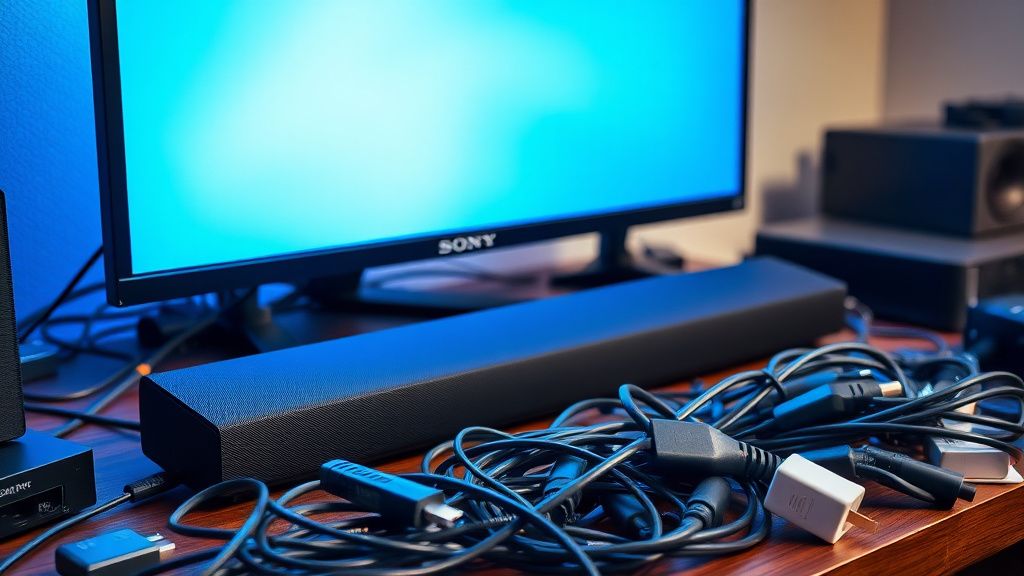
Technical failure in cables often manifests as "sparkles"—tiny white dots—or complete signal blackouts during high-frame-rate gaming. If you are using a cable longer than 3 meters without an active repeater or an Ultra High Speed certified optical cable, you are inviting packet loss. The Bravia 9’s HDMI controller is extremely aggressive in its error correction; if it detects too many corrupt packets, it will kill the signal to protect the hardware.
Counter-Criticism: Is the BRAVIA Sync Protocol Over-Engineered?
Critics, including several prominent maintainers on AVSForum, argue that Sony’s implementation of HDMI-CEC (the backbone of BRAVIA Sync) is too intrusive. BRAVIA Sync is designed to allow one remote to control everything, but it often creates "command loops."
If you have a soundbar connected via HDMI eARC, the Bravia 9 attempts to take master control of the entire signal chain. If the soundbar’s CEC implementation is non-compliant, it will constantly send "wake-up" or "input-switch" signals, causing the TV to randomly jump inputs or lose audio sync.
- The Workaround: If you are tired of the ecosystem chaos, navigate to Settings > Channels & Inputs > External Inputs > BRAVIA Sync settings. Turn off "Device Control" and "Auto-Device Off." It breaks the convenience of a single remote, but it restores the stability of your hardware stack.
Infrastructure Stress: The eARC Conflict
eARC (enhanced Audio Return Channel) is the most common point of failure for sync issues on the Bravia 9. When audio sync fails, it is usually because the TV and the soundbar cannot decide who is the "Master Clock" for the audio stream.
If you hear intermittent pops or clicks, ensure the "Digital Audio Out" is set to "Auto 1" or "Auto 2." "Pass Through" is often the most stable setting for users with high-end receivers, as it prevents the TV from attempting to transcode the audio data, effectively removing one potential layer of failure from the chain.
Edge-Case: The "Handshake Hang" with PC GPUs
If you are running an NVIDIA RTX 40-series card into the Bravia 9, you are at the mercy of both Sony’s firmware and NVIDIA’s DisplayPort-to-HDMI conversion drivers. Many sync issues are actually driver-level crashes.
- Engineering Compromise: Ensure your GPU driver is set to the same color depth as the TV port. If the TV is in 10-bit mode, but the GPU is forced into 12-bit, you will experience a "no signal" black screen. This is a classic example of an edge case where the TV and GPU simply refuse to agree on the color math, leading to a dropped handshake.
Why does my Bravia 9 suddenly lose audio when I switch from Netflix to my game console?
This is a known issue related to how the Bravia 9 handles internal app-to-HDMI switching. The TV attempts to keep the audio processor active. To fix this, go to Settings > Sound > Audio Output and toggle the "A/V Sync" setting. Often, simply disabling "Dolby Digital Plus" if you aren't using a multi-channel setup can resolve the switching delay.
I bought a "Certified 8K" cable, why is it still flickering?
Labeling is often misleading. "Certified 8K" is marketing speak; you need to look for the "Ultra High Speed HDMI" holographic sticker on the packaging. If the cable is longer than 5 feet (1.5m), passive copper cables start to struggle with 4K/120Hz/HDR signals. Switch to a shorter cable or an active fiber-optic HDMI 2.1 cable to ensure signal integrity.
Does turning off "BRAVIA Sync" affect the eARC soundbar connection?
No. BRAVIA Sync controls power and input commands via CEC, while eARC uses a completely different physical layer on the HDMI wire. You can disable all CEC features for a more stable input experience without losing your high-quality eARC audio connection to your receiver.
Is the "Enhanced (VRR)" mode causing my screen to pulse?
If the frame rate of your content drops below the VRR refresh window of the TV (typically 40Hz), the Bravia 9 may exhibit "LFC" (Low Framerate Compensation) flickering. This is inherent to the panel’s V-Sync logic. It isn't a defect; it is the panel struggling to maintain a stable refresh rate when the source device is outputting a stuttering signal.
Should I factory reset the TV?
Only as a last resort. Factory resets on the Bravia 9 are destructive and rarely fix handshake issues if the root cause is a bad cable or a buggy HDMI-CEC negotiation. Try clearing the cache for the "External Inputs" app in the system apps menu first—this effectively achieves the same result without wiping your color calibration settings.
The Bravia 9 is an exceptional display, but it exists in an ecosystem that is messy by design. HDMI 2.1, while powerful, is a sprawling specification where manufacturer implementations often collide. By focusing on physical signal integrity, minimizing CEC interference, and managing your software expectations, you can navigate the "handshake hell" and achieve the visual fidelity the panel was designed to deliver. If the problems persist after these steps, document the hardware revision of your source device and check the Sony support forums for specific "Known Issues" regarding that manufacturer's handshake behavior.
Bu makale affiliate linkleri içermektedir.