If your TCL QM8 is displaying persistent vertical lines, you are likely dealing with a failure in the T-Con board or a COF (Chip-on-Film) bonding defect, rather than a simple software glitch. Hard resets or firmware updates rarely fix physical panel signaling issues; these lines usually indicate a catastrophic failure in the display's data transmission path or the panel's source drivers.
The Anatomy of the Artifact: Understanding Vertical Line Failure in High-Performance Mini-LED Panels
When you see a vertical line—whether it is a solid neon pink, a single pixel-wide black streak, or a flickering white gap—you are witnessing a breakdown in the communication between your television’s mainboard and the LCD matrix. The TCL QM8, a flagship Mini-LED display, utilizes a complex architecture designed to manage thousands of local dimming zones. When that signaling integrity is compromised, the screen’s vertical address lines fail to receive, process, or ground the signal correctly.
In the industry, we classify these as "Column Driver Failures." The LCD panel is composed of a glass substrate bonded to flexible printed circuits (FPCs), similar to how LG G4 OLEDs can suffer from vertical banding. These FPCs connect to the source driver ICs that send voltage to the columns of pixels. If one of these drivers fails, or if the heat-sensitive ACF (Anisotropic Conductive Film) bonding the driver to the glass begins to delaminate, you get a line. It is rarely a "glitch." It is a mechanical failure.
The "Software Fix" Myth: Why Updates Won’t Save Your T-Con Board
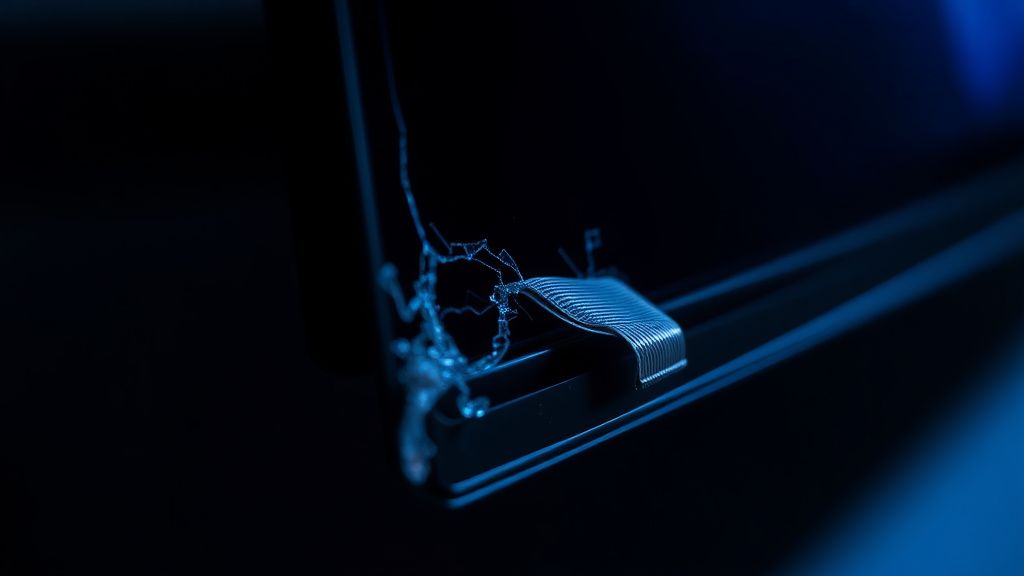
There is a pervasive belief on forums like Reddit’s r/4KTV or AVSForum that a firmware update or a "factory reset" can fix hardware artifacts. Let’s be clear: this is a placebo effect. While a corrupted T-Con firmware could theoretically cause artifacting, it is exceptionally rare compared to physical degradation.
If a firmware update "fixed" your vertical line, it is statistically more likely that the thermal expansion during the update process temporarily bridged a micro-fracture in the COF tape. Once the TV cools down or moves, the line will return.
The Reality of Scaling Issues in Mini-LED Production: TCL’s aggressive push into the Mini-LED market has forced them to optimize for high-volume, low-cost assembly. This creates a "scaling stress" on the panel manufacturers (like CSOT, TCL’s sister company). When you have thousands of zones and high-density signal routing, the margin for error in the COF bonding process is razor-thin. If the bonding pressure is off by even a fraction of a newton during factory assembly, that unit is a "ticking time bomb" that might function perfectly for six months before thermal stress causes the connection to lift.
Operational Reality: Navigating the Warranty Nightmare
For the average consumer, the arrival of a vertical line starts a process of institutional friction. TCL’s customer service relies on a "Proof of Defect" triage system.
- The Photo Request: You will be asked to send a photo of the defect.
- The "Power Cycle" Loop: Support will insist on a hard power cycle (unplugging for 60 seconds). This is a standard operating procedure designed to rule out transient static build-up on the mainboard.
- The Technician Dispatch: Because the QM8 is a large-format display, the panel is considered the "chassis." In 90% of cases, field technicians will not attempt to solder the COF—they are authorized only to replace the mainboard or the entire panel assembly.
The Failure Point: If you are outside the warranty window, you are essentially looking at a total loss. Replacing a Mini-LED panel often costs 80-90% of the price of a new unit. This is the "built-in obsolescence" of the modern television industry.
Field Reports: The "Tap Test" Controversy
There is a long-standing, controversial workaround discussed on sites like iFixit and various Discord server repair channels: the "Pressure Technique."
"I had a single cyan line appear on my 85-inch QM8. After reading a thread on a hobbyist forum, I carefully applied slight pressure to the plastic bezel directly above the line where the ribbon cable meets the glass. The line vanished. Two weeks later, it came back. I applied pressure again. Now, it's permanent." — Anonymous user report from a private home-theater Discord.
Expert Analysis: Do not do this. While it may provide temporary relief, it is damaging the fragile traces on the flexible cable. It confirms the location of the failure, but it is not a repair. You are essentially "stressing" the connection back into place until the physical metal traces finally snap.
Technical Triage: How to Diagnose Your Specific Failure
Before assuming your panel is dead, you must isolate the signal chain.
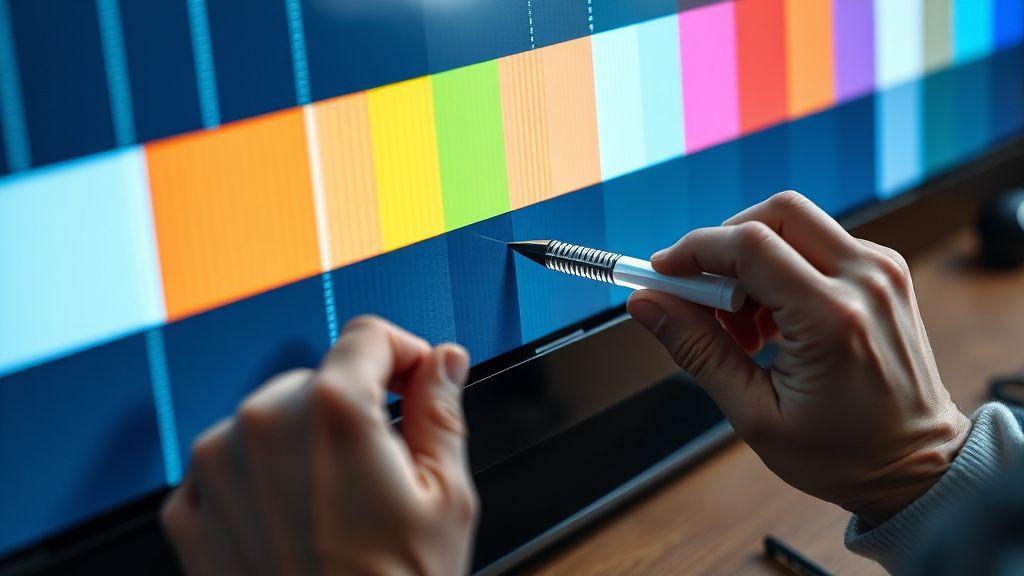
- Rule Out Sources: Is the line present on the internal TCL Google TV UI, or only on an HDMI input? If it’s only on HDMI, your problem is the HDMI cable or the source device (e.g., a PS5 or Apple TV). Check the HDMI port pins for oxidation or bending.
- The Internal Pattern Test: Go to the "Picture Settings" and run the "Picture Test." If the vertical line persists over the internal diagnostic pattern, the issue is 100% downstream of the mainboard (i.e., the T-Con or the panel itself).
- Heat Sensitivity Test: Does the line appear immediately upon turning the TV on, or only after 30 minutes of use? If it only appears after heat soak, you are definitely dealing with a thermal expansion issue on a COF bond. This is a definitive hardware defect.
Industry Criticism: The Fragility of Modern Flagships
The industry is currently facing a massive debate regarding the "Right to Repair" for high-end displays. Manufacturers claim that the integration of the T-Con board directly into the panel logic (integrated panels) is necessary for high-speed, high-resolution gaming support (144Hz, VRR).
However, from an engineering perspective, this is a regression in serviceability. By moving away from modular T-Con boards to integrated panel drivers, companies like TCL have removed the user's ability to perform simple board-level swaps. You are no longer buying a modular piece of hardware; you are buying a monolithic glass-and-electronics assembly that is effectively "disposable" once the internal logic fails.
The Reality of Scaling and Reliability
When looking at the QM8, we have to look at the "Panel Lottery." Scaling Mini-LED production means you are getting the cutting edge of backlight technology, but often on the standard-issue panel glass. The inconsistency in quality control isn't necessarily a failure of TCL’s intent, but a byproduct of the massive scale required to bring 4K/144Hz Mini-LED displays to a sub-$2000 price point.
Common Community Complaints:
- "Lines appeared after a firmware update." As noted, this is usually coincidental timing with thermal stress.
- "Support kept me on hold for an hour." This is standard operational friction. TCL’s call centers are outsourced; they follow a strict script that does not include advanced diagnostic troubleshooting.
- "Replacement unit arrived with dead pixels." This is the ultimate frustration. It highlights the logistics chain stress—large panels are fragile and shipping them across the country in standard freight carriers often results in micro-fractures before the TV is even unboxed.
Why does a vertical line only appear on certain colors?
This is a clear indicator that the specific sub-pixel driver (Red, Green, or Blue) for that column has failed. If you see a line only when the image is blue, it means the blue sub-pixel signal trace for that column is disconnected. The line is not an image artifact; it is a "dead zone" where the display cannot process that color signal.
Is a T-Con board replacement worth it if I can find the part?
In most modern TVs, the T-Con is integrated into the panel. If you are referring to the main board, it is a simple swap, but it will not fix a vertical line. If the T-Con is modular (a separate board), swapping it is worth a try, but be warned: 95% of vertical line issues are due to the COF ribbon connection to the glass, not the board itself. Replacing the T-Con board will be a waste of money if the fault is at the panel interface.
Will turning down the brightness fix the line?
Lowering the backlight intensity can reduce the thermal stress on the COF bond, potentially delaying the worsening of the line. However, it will not repair the damaged physical connection. It is merely a "life-support" measure for a display that is already in the process of failing.
Should I try to "re-solder" the ribbon cable myself?
No. The ribbon cables are bonded to the glass using ACF (Anisotropic Conductive Film) under specific temperature and pressure conditions. Using a standard soldering iron will shatter the glass or melt the plastic film instantly. There is no DIY "fix" for COF delamination; it requires a specialized bonding machine costing tens of thousands of dollars.
If my warranty is over, what are my options?
Your options are limited to finding a local independent repair shop that specializes in panel recovery (rare) or selling the TV for parts on platforms like eBay. Many hobbyists will buy a QM8 with a known panel defect just to scavenge the mainboard, power supply, and LED driver boards. Do not expect to get a significant amount of value back.
The Verdict on Modern Display Reliability
The TCL QM8 is an engineering marvel, pushing the limits of contrast and brightness via Mini-LED technology. However, it exists in a ecosystem where reliability is often sacrificed for performance metrics. Vertical lines are not just "bad luck"; they are the inevitable outcome of a system where thousands of sub-millimeter connections are forced to survive in a high-heat, high-vibration environment. If you see that line, document it immediately, contact support while you are still inside your warranty window, and prepare for the reality that these devices are, by design, not meant to be serviced at the component level.
Bu makale affiliate linkleri içermektedir.