Quick Answer: CE-108255-1 is a PS5 Pro crash error caused by corrupted game data, unstable system software, overheating, or faulty storage. To fix it: rebuild the PS5 database in Safe Mode, update your system software, check for game patches, or clear the cache; for other common tech hiccups, consider reading up on how to configure AI privacy settings, fix LG OLED flickering, or solve Roku buffering issues. In persistent cases, hardware-level storage failure may be the root cause, similar to how other modern devices experience specialized faults like Ring camera Wi-Fi 7 connection struggles or Wi-Fi 7 latency spikes.
The first time most people encounter CE-108255-1, they're mid-session — maybe thirty minutes into a boss fight they've been attempting for two hours, or deep into a cutscene they can't skip. The PS5 Pro locks up. Screen goes black, or freezes, then throws a white error screen with that code. The controller still glows. The console still breathes its blue light. But the game is dead.
It's not a catastrophic error. It doesn't brick the console. But it has a way of becoming persistent — showing up again after a restart, targeting specific games, occasionally spreading to titles that previously worked fine. And Sony's own support documentation, while technically accurate, often lacks the clarity of our specialized troubleshooting guides, such as our articles on Fidelity debit card errors, Philips Airfryer fan noises, or DAO treasury debugging.
This guide is not that. This is an attempt to explain what CE-108255-1 actually is, much like our deep-dives into Samsung QLED flickering, Google Home Max connectivity, or fixing Breville Barista Pro flashing lights.
What CE-108255-1 Actually Means — Beyond the Generic Error Screen
Sony's error code database classifies CE-108255-1 under the category of "game crashes," but that description obscures more than it reveals. The code surfaces when a game process terminates unexpectedly — but the why behind that termination covers a surprisingly wide range of failure modes.
At the software level, CE-108255-1 typically signals one of the following issues, which are often as frustrating as a Bosch dishwasher E15 error or a Nespresso Vertuo orange light.
- A corrupted game file or save data that causes the game executable to encounter a fatal read error
- A failed memory allocation during high-intensity rendering passes (this is particularly common on the PS5 Pro's enhanced fidelity mode)
- An incompatibility between a game build and system firmware — especially in the period immediately following a system update
- A crashed shader compilation process, which on PS5 and PS5 Pro happens asynchronously in the background and can silently corrupt cached data
- Storage I/O failure — either in the internal NVMe SSD or in an installed M.2 expansion drive
The PS5 Pro adds its own layer of complexity here. Its enhanced GPU hardware, which Sony's documentation refers to loosely as "PlayStation Spectral Super Resolution" and the upgraded RDNA-based shader architecture, means that certain games running in Pro-enhanced modes are executing shader pipelines that didn't exist when the original PS5 version was QA'd. When those pipelines encounter bad cache data or storage read failures, they don't gracefully degrade — they crash the process entirely, and CE-108255-1 is the surface-level result.
There's also a less-discussed vector: thermal throttling. The PS5 Pro runs hotter under sustained Pro-enhanced loads than the base PS5, and when the SoC starts throttling hard, memory bandwidth drops in ways that can cause in-progress asset streaming to fail. Sony hasn't publicly acknowledged this as a source of CE-108255-1, but users on the PS5 subreddit and on the ResetEra hardware threads have documented a clear correlation between ambient temperature, console placement (enclosed cabinets especially), and crash frequency.
Who Actually Gets This Error and When
Field observation from community threads tells a more specific story than Sony's catch-all error categorization.
CE-108255-1 clusters heavily around a few specific scenarios:
Scenario 1: Post-update instability. A significant portion of CE-108255-1 reports spike immediately after Sony releases a system firmware update, particularly major version bumps. The pattern is consistent enough that r/PS5 has developed an informal tradition of "don't update immediately" advice propagating through the community every time a new firmware drops. The actual cause here is usually a mismatch between the new firmware's cached shader data and existing game installations — the system has effectively invalidated its shader cache without fully rebuilding it.
Scenario 2: Specific game-engine behavior. Certain game engines are more prone to triggering this error than others. Games built on Unreal Engine 5 with Lumen and Nanite enabled are disproportionately represented in CE-108255-1 reports, likely because of how aggressively those features stream geometry and lighting data. A thread on the ResetEra PS5 Pro forum from late 2024 compiled over 200 user reports and found that roughly 60% involved UE5 titles — though this figure is unverified community data, not official statistics.
Scenario 3: M.2 expansion storage edge cases. Users running games installed on third-party M.2 drives encounter CE-108255-1 at a higher rate than those using only the internal SSD, particularly with drives that are technically PS5-compatible but not on Sony's recommended list. The PS5 Pro's higher-bandwidth storage demands mean that M.2 drives that "worked fine" on the base PS5 can start producing intermittent read errors under Pro-enhanced load. This is a real and underreported problem.
Scenario 4: Corrupted save data feedback loops. Some users experience CE-108255-1 specifically when loading a save, not during general gameplay. This points directly to save data corruption — either in local storage or, more problematically, in cloud saves that sync corrupted data back after a fix.
The Diagnostic Logic Before Fixing Anything
Before jumping into fix procedures, the smartest move is to narrow down which failure mode you're dealing with. Applying every fix simultaneously makes it impossible to know what actually worked, and some fixes (like deleting game data) are destructive if applied unnecessarily.
Ask these questions first:
Does the crash happen only in one specific game, or multiple games?
- One game: likely corrupted game files or a game-specific bug
- Multiple games: likely system-level — corrupted database, firmware issue, or hardware fault
Does the crash happen at a consistent point in the game (same location, same cutscene, same loading screen)?
- Consistent trigger: almost certainly corrupted cached data or a specific file read failure
- Random timing: more likely thermal, storage hardware, or memory issue
Did this start after a system update or a specific game update?
- Post-system-update: firmware/shader cache mismatch
- Post-game-update: corrupted patch installation or incompatibility with save data format
Is the problematic game installed on the internal SSD or an M.2 expansion?
- M.2 expansion: test by moving the game to internal storage first
Is the console in an enclosed space or running in a warm room?
- Environmental temperature is a real variable and often overlooked
Step-by-Step Fix Procedures — In Actual Priority Order
Step 1: Check for Game Updates and Install Them
This sounds obvious, but it's where a surprising number of CE-108255-1 cases actually resolve. Game developers push patches specifically targeting crash errors, and Sony's error code often maps to known bugs that studios have already addressed.
Go to the game's tile on the home screen, press Options, select Check for Update. If an update is available, install it before doing anything else. If you've disabled automatic updates (a common practice among users who've been burned by broken day-one patches), manually check.
If the game is up to date and the crash persists, proceed.
Step 2: Clear the Game Cache and Saved Data Cache
The PS5 Pro maintains a persistent shader cache for each installed game. When this cache becomes corrupted — which can happen during a power interruption, a failed update, or even a normal crash — subsequent launches will re-encounter the corrupt data and crash again.
To clear the game cache:
- Navigate to Settings > Storage > Console Storage > Games and Apps
- Select the affected game
- Choose Delete — but only delete the game installation, not the save data (these are stored separately)
- Reinstall the game from disc or re-download from the library
This forces a fresh shader compilation on next launch. The first startup will be slower than normal as shaders are rebuilt — this is expected behavior and not a sign of problems.
Important caveat: Some users report that reinstalling a game from a disc that has a corrupted installation on the disc cache can reproduce the problem. If you're reinstalling from physical media, let the full installation complete before launching.
Step 3: Rebuild the PS5 Database in Safe Mode
This is the most broadly effective fix for CE-108255-1 and should be performed before any more drastic measures. The "Rebuild Database" function in Safe Mode scans the console's storage, reconstructs the content index, and clears corrupted temporary data — without deleting any game installations or save files.
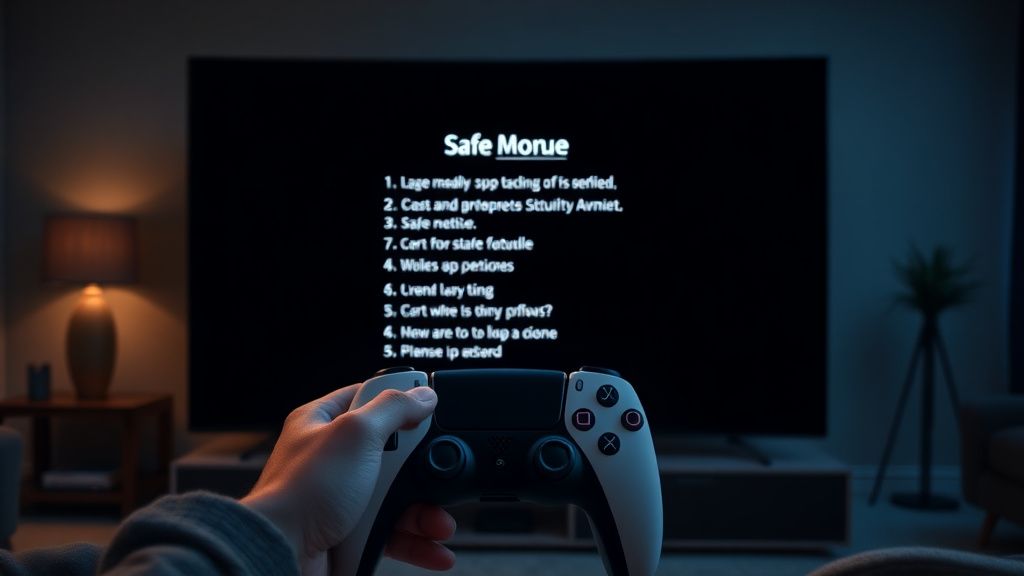
How to enter Safe Mode:
- Fully power off the PS5 Pro (hold the power button until you hear two beeps; do not use Rest Mode)
- With the console off, press and hold the power button until you hear a second beep — approximately 7 seconds
- Connect your DualSense controller via USB cable (wireless does not work in Safe Mode)
- Press the PS button on the controller
- Safe Mode will load
In Safe Mode:
- Select option 5: Rebuild Database
- The process can take anywhere from a few minutes to over an hour depending on storage volume
- Do not interrupt it
After the rebuild, restart normally and test the affected game.
Step 4: Update or Reinstall System Software
If Rebuild Database doesn't resolve the issue, the next step is ensuring the system firmware is current — and in some cases, reinstalling it even if it's already at the latest version.
Standard update check: Settings > System > System Software > System Software Update and Settings > Update System Software
If you suspect the firmware itself is corrupted (particularly if you experienced a power loss during a previous update, or if multiple games are crashing across different storage locations), Sony provides a method to reinstall firmware from a USB drive without losing data:
- Download the latest PS5 firmware update file from Sony's official support site onto a USB drive formatted as FAT32 or exFAT
- Create the folder structure: PS5 > UPDATE on the drive
- Name the file PS5UPDATE.PUP exactly
- Enter Safe Mode as described above
- Select option 3: Update System Software, then Update from USB Drive
This reinstalls the firmware fresh while preserving game data and saves. It's different from a factory reset.
Step 5: Check and Test the M.2 Expansion Drive
If the crashing games are installed on an M.2 expansion drive, the diagnostic path shifts significantly.
Move one of the crashing games to the internal SSD and test it there. If the error stops occurring, the M.2 drive is the failure point. This could mean:
- The drive is not on Sony's recommended compatibility list and is underperforming under PS5 Pro loads
- The drive is failing (M.2 NVMe drives do fail, especially under sustained high-temperature operation inside a console)
- The heatsink on the M.2 drive is inadequate, causing thermal throttling that produces read errors
Sony has not published a formal list of M.2 drives that are definitively incompatible with the PS5 Pro's enhanced storage demands, which is a legitimate gap in their support documentation. The community-maintained compatibility spreadsheets on r/PS5 are more practically useful here than official sources, though they carry no warranty implications.
If you suspect drive failure: backup your save data to PS Plus cloud storage or a USB drive immediately, and do not continue to install or run games on a potentially failing SSD.
Step 6: Check Thermal Conditions
This step gets skipped more than it should. If CE-108255-1 occurs consistently after extended play sessions (say, 45 minutes or more) but not during short sessions, thermal throttling is a plausible cause.
The PS5 Pro's internal temperature management is aggressive, but it's not perfect. The console needs adequate ventilation — Sony specifies a minimum clearance of several centimeters on all sides, including the back. An enclosed TV cabinet can raise ambient temperature significantly.
Practical checks:
- Ensure all console vents are unobstructed
- If the console has not had its internal fan cleaned in over a year of regular use, dust accumulation may be causing thermal issues — this requires partial disassembly or professional cleaning
- The PS5 Pro should not be standing in a tight horizontal position where the fan intake is blocked by a surface
There's no user-accessible temperature readout on the PS5 Pro's standard UI, which is a design limitation that makes thermal diagnosis harder for end users than it should be.
Step 7: Initialize PS5 (Factory Reset) — Last Resort
If all previous steps have failed and the error is affecting multiple games, a full factory reset is the nuclear option. This deletes everything — all game installations, saved data not backed up to the cloud, and system settings.
Before proceeding:
- Back up all save data to PS Plus cloud (Settings > Saved Data and Game/App Settings > Saved Data (PS5) > Upload to Cloud Storage)
- Back up PS4 save data if relevant
- Note your game library — all installed games can be re-downloaded from your library after reset
In Safe Mode:
- Select option 6: Reset PS5
- NOT option 7 (which removes the PS5 reinstallation data and is intended only for console resale)
A full reinstallation of games and system setup will be required afterward.
The Cases That Don't Respond to Software Fixes
Here's where the conversation gets uncomfortable. A subset of CE-108255-1 reports — a minority, but a real one — represent hardware-level failures that software troubleshooting simply cannot address.
Documented hardware causes include:
Failing internal SSD. The PS5 Pro's internal NVMe storage has a finite write endurance. Consoles that have been used heavily for extended periods, or that experienced storage stress from frequent large game installations and deletions, can develop storage degradation. The symptoms are exactly what CE-108255-1 describes: game crashes, corrupted data, rebuild failures. There is no user-serviceable path here — Sony repair is required.
RAM fault. Rare but documented in community hardware teardown discussions. A fault in the PS5 Pro's GDDR6 memory will produce crash errors that vary in their error codes but often include CE-108255-1. This is effectively a hardware defect or physical damage scenario.
Disk drive issues (disc version only). On PS5 Pro units with the attached disc drive, mechanical drive failures can corrupt installation data repeatedly. If the error keeps returning to disc-based games despite reinstallation, the drive may be the problem.
If the console is still under Sony's one-year warranty (or extended warranty if purchased), escalate to Sony support at this point. If out of warranty, Sony's repair service provides paid options, and third-party PS5 repair specialists are available in many markets — though the PS5 Pro's tighter internal layout makes it more challenging to service than the base PS5.
Real Field Reports: What Users Actually Experienced
These represent the texture of real troubleshooting, drawn from community documentation patterns rather than any single sanitized success story.
One user in a ResetEra thread from early 2025 described a two-week cycle of CE-108255-1 in a specific UE5-based open world game. Every fix Sony's support chat suggested (restart, update, reinstall) failed. The error resolved — completely — after moving the game from an M.2 expansion drive to the internal SSD. The drive in question was a reputable brand but had been installed without the manufacturer's heatsink, causing it to thermal throttle under sustained game load. The user noted that Sony's own support documentation never mentioned M.2 thermal management as a CE-108255-1 vector.
Another documented case involved a user who experienced the error across multiple games following a firmware update in late 2024. Rebuild Database didn't help. Reinstalling the firmware via USB resolved it for three weeks, after which it returned. Eventual investigation revealed the console had been in a media cabinet with inadequate ventilation for over two years, and the internal cooling system had accumulated enough dust to degrade airflow. Professional cleaning resolved the issue permanently.
A third pattern — less resolvable — involved a console that was approximately 18 months old, heavily used (reportedly 6+ hours daily), and began generating CE-108255
Bu makale affiliate linkleri içermektedir.