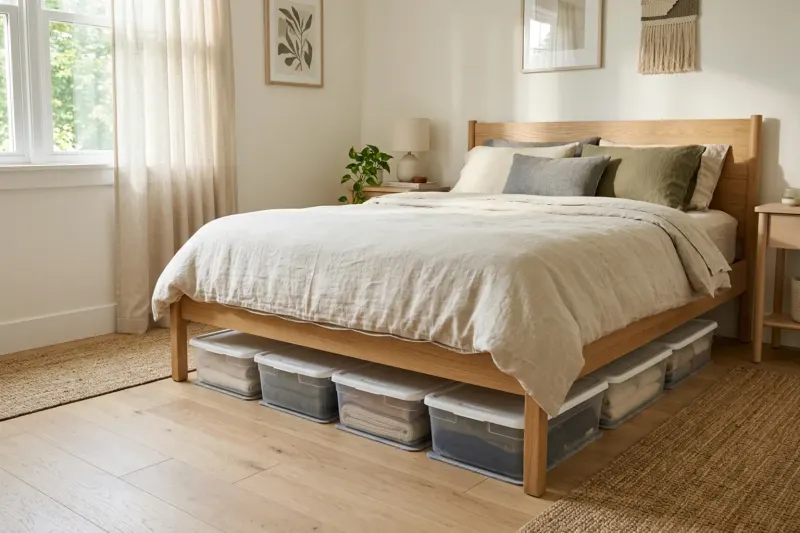
When your bedroom closet reaches capacity, the open footprint beneath your bed frame offers the largest untouched storage zone in the room. In small bedrooms and rental apartments, however, sliding containers under a mattress without a clear plan often creates new headaches: plastic runners scratch floor finishes, lids jam against frame rails, and bins get trapped behind bedside nightstands. Turning this area into reliable, dust-free storage requires taking accurate dimensional measurements around center frame supports, matching container shells to your flooring material, and ensuring your room walkways provide enough clearance to pull the containers out. With straightforward planning and the right low-profile bins, you can reclaim this footprint without risking damage to your floors or your security deposit.
Mapping Vertical Clearances, Bed Frame Rails, and Center Supports
Before buying any containers, measure the exact vertical and horizontal clearances beneath your bed. Most platform beds, slatted wood frames, and standard tubular metal frames provide between 5.0 and 10.0 in (12.7 to 25.4 cm) of vertical space between the floor and the bottom edge of the side rail. Low-profile storage bins generally range from 4.0 to 6.5 in (10.2 to 16.5 cm) in total exterior height, including their lids. It is vital to measure from the finished floor surface to the lowest overhead obstruction rather than the face of the outer decorative frame. In many frames, internal wooden slats, support ledgers, or steel angle brackets sit 0.5 to 1.0 in (1.3 to 2.5 cm) lower than the outer perimeter rail. Always reserve an operational clearance buffer of at least 0.5 to 1.0 in (1.3 to 2.5 cm) between the top of the bin lid and the lowest point above it. This margin allows the box to glide freely over slight floor unevenness, prevents catching on mattress ticking or dust covers, and accommodates downward mattress deflection when someone lies down on the bed.
Horizontal clearance under a bed is rarely an unobstructed open void. Queen, King, and California King bed frames incorporate longitudinal or transverse center support rails supported by one or more intermediate floor posts. These structural posts divide the under-bed area into distinct structural bays or quadrants. To map your available footprint, measure the clear width between the inside edge of your side rail and the center support post. Next, measure the length between the footboard post, the intermediate center post, and the headboard post. Writing down the dimensions of each distinct bay prevents buying oversized monolithic boxes that cannot sit flat because they collide with support hardware.
Related guide: Organize a Small Linen Closet Without Drilling
Comparing Rigid Polypropylene, Wheeled Trays, and Compressible Fabric Organizers
Choosing the right bin construction depends on what you plan to store, how often you need to access it, and your bedroom flooring:
- **Rigid Polypropylene Boxes:** Solid-walled polypropylene containers with snap-fit lids provide a sealed barrier against household dust motes, pet dander, and ambient moisture. Rigid translucent or frosted plastic lets you inspect contents without unclipping latches. These boxes are structural enough to resist bowing under load and can be stacked two units high if your frame clearance exceeds 11.0 to 12.0 in (27.9 to 30.5 cm). Because their dimensions are fixed, verify that the lid handles and perimeter lips clear frame rails.
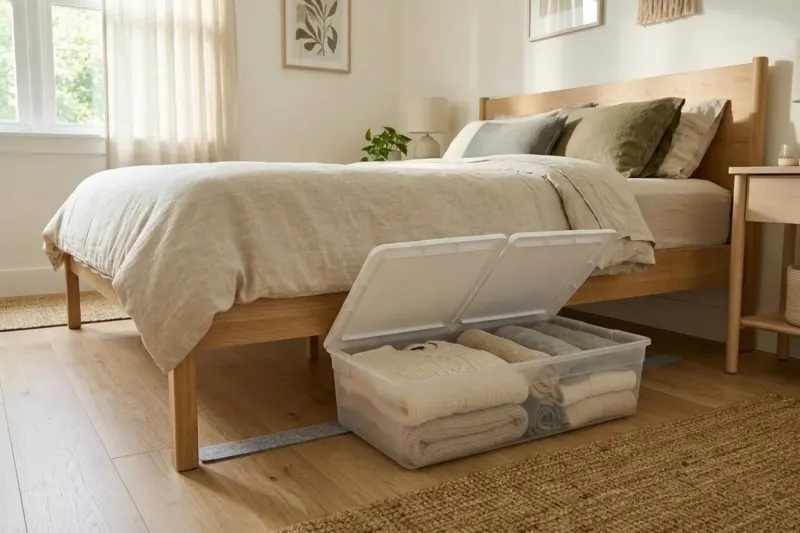
- **Split-Hinged Lidded Bins:** A split-hinged lid features a center transverse fold that allows the box to open from either end. In bedrooms where the adjacent aisle between the bed and a wall or dresser is narrower than the full length of the box, split lids allow you to retrieve contents by pulling the container only halfway out from beneath the rail.
- **In-Line Wheeled Organizers:** Containers fitted with low-profile, unidirectional caster wheels roll smoothly when heavily loaded with books, dense textiles, or shoes. However, these small wheels require a hard, uniform substrate. On flat hardwood, laminate, or short-pile commercial rugs, they roll with minimal effort. On plush carpet or medium-pile rugs, small wheels sink into the fibers and seize up, creating high drag and potentially bending axle housings.
- **Structured Fabric and Canvas Bins:** Zippered organizers made of polyester or non-woven fabric reinforced with internal cardboard or plastic stiffeners are suitable for very shallow cavities. These cases compress vertically down to 4.0 in (10.2 cm), allowing them to pass under low metal bed frames where rigid plastic lids cannot clear. Fitted with three-sided zippered openings and clear PVC top viewing windows, they keep seasonal linens clean while offering enough flex to squeeze around awkward legs.
Related guide: Small Pantry Storage with Bins and Turntables
Factoring Walkway Clearances, Extraction Radii, and Perimeter Obstacles
An under-bed container is only practical if your room layout allows you to open or extract it easily. Standard long under-bed boxes measure between 36.0 and 40.0 in (91.4 to 101.6 cm) in length. Pulling a box of this size straight out from the side of the bed requires an unobstructed floor clearance of at least 32.0 to 36.0 in (81.3 to 91.4 cm) between the frame rail and the nearest wall, wardrobe, or dresser face.
In many rental apartments, side walkways measure 22.0 to 26.0 in (55.9 to 66.0 cm) wide, which physically blocks full-length side extraction. Additionally, standard bedside nightstands frequently block the head-end half of the frame. Use the following spatial configurations to overcome these room constraints:
| Layout Constraint | Recommended Bin Configuration | Operational Access Method |
|---|---|---|
| Bedside nightstand blocks front 24 in of frame | Two modular half-length boxes (approx. 18 to 20 in / 45.7 to 50.8 cm long) | Slide the foot-end box out directly; slide the head-end box toward the foot along the under-bed bay before pulling it into the room |
| Narrow side walkways (< 26 in / 66.0 cm) | Center-hinged split lid plastic containers | Pull the box halfway into the walkway (18 in / 45.7 cm) and flip open the exposed half lid to reach contents |
| Side aisles under 18 in (45.7 cm) or blocked by walls | Long bins aligned lengthwise toward the footboard | Extract containers from the foot of the bed along the central floor aisle into the main bedroom entryway |
Related guide: Under-Sink Bathroom Storage Around Awkward Pipes
Protecting Rental Flooring, Managing Dust, and Maintaining Airflow
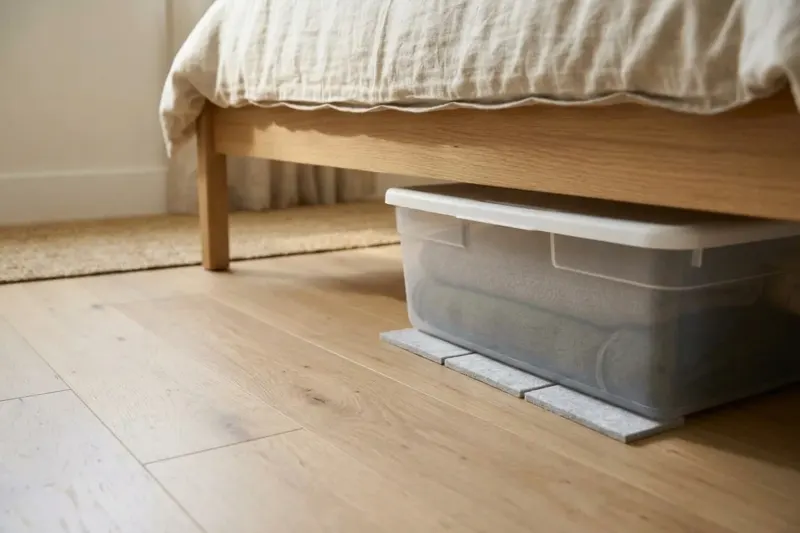
Repeatedly sliding containers in and out from under a bed can cause floor scuffs that threaten your security deposit. Unfinished plastic base ridges, injection-molding burrs, and tiny caster wheels catch household grit and drag it across polyurethane-coated hardwood, laminate, or luxury vinyl tile, leaving abrasive scratches over time. For hard floor surfaces, stick heavy-duty adhesive wool felt furniture strips along the bottom longitudinal contact runners of rigid boxes. Felt pads distribute downward contact pressure, cushion movements, muffle sliding noises, and allow full-sized bins to glide smoothly across delicate finishes without scuffing.
Plush carpeting presents different mechanical friction. Recessed caster wheels sink into carpet pile, collecting loose fibers and pet hair in the wheel hubs until the casters freeze up entirely. On carpet, choose wide, completely smooth, flat-bottomed rigid plastic containers with broad rounded edges. These flat surfaces distribute weight evenly across carpet fibers, sliding across the pile without snagging.
Dust control and ambient air circulation also require careful management. The protected, low-airflow environment beneath a bed naturally collects settling dust motes and shed textile fibers. Uncovered bins or open baskets leave clean linens and blankets exposed to dirt within weeks. Always choose containers with secure perimeter latches or tight zipper tape. Simultaneously, avoid packing the sub-frame volume so tightly that you block natural air circulation. In unconditioned rental bedrooms or homes in humid environments, leaving a 2.0- to 3.0-in (5.1 to 7.6 cm) air gap between bins and exterior baseboards helps prevent localized pockets of stagnant air and moisture accumulation along cold exterior walls.
Subdividing Low-Profile Interiors for Linens and Apparel
Because low-profile containers offer shallow interior heights ranging from 4.5 to 6.0 in (11.4 to 15.2 cm), conventional vertical stacking does not work well. Piling folded garments three layers deep creates piles that spill together whenever you slide the container. Instead, arrange garments in vertical file folds or single-layer parallel rows aligned with the lid line, giving you immediate access to individual items without shifting the rest of the contents.
- **Bulky Bedding and Winter Ensembles:** Thick items like down duvets, wool blankets, and heavy winter coats take up significant volume. Sealing these items in vacuum compression bags before placing them in shallow bins reduces their volume by up to 60 to 70 percent. This allows a puffy winter comforter that normally requires 12.0 in (30.5 cm) of vertical space to slide under a 6.0-in (15.2 cm) bed rail.
- **Internal Compartments for Footwear and Accessories:** Long, wide under-bed bins tend to shift their contents when moved. Use shallow drop-in fabric drawer dividers, adjustable honeycomb inserts, or individual shoe organizers to divide the open space into dedicated bays. This prevents small items like belts, folded knitwear, or shoes from sliding into a jumbled pile at one end of the box.
- **Simple Visual Concealment:** If an open metal bed frame leaves plastic containers visible from the doorway, you can conceal them cleanly without attaching hardware. Use a tailored, unpleated bed skirt with an appropriate drop height—commonly 14.0 to 16.0 in (35.6 to 40.6 cm)—or an oversized duvet draped neatly over the sides. This masks the storage system and creates a calm, uncluttered bedroom visual.
Selecting Under-Bed Bin Specifications by Room Conditions
| Situation | Consider | Why |
|---|---|---|
| Hardwood or laminate flooring with regular access requirements | Rigid polypropylene bin with adhesive felt strips on base runners | Prevents plastic grit abrasion on delicate rental floor finishes while maintaining a sealed dust barrier. |
| Medium- to high-pile carpeted bedroom flooring | Smooth, flat-bottom rigid plastic bin without wheels | Wide flat plastic glides over carpet pile with less mechanical resistance than tiny recessed casters. |
| Walkway clearance under 28 in (71 cm) beside bedside nightstand | Split-lid box or modular half-length paired containers | Provides direct interior access when pulled only 50 percent forward into narrow aisles. |
| Frame clearance under 5 in (12.7 cm) | Structured fabric organizer with clear PVC zip top | Compresses down to 4 in (10.2 cm) vertically, passing beneath low structural side rails. |
Worked Spatial Clearance: Standard Queen Bed Under-Frame Layout
In this hypothetical layout, consider a standard Queen bed frame measuring 60.0 in (152.4 cm) wide by 80.0 in (203.2 cm) long with an underside vertical clearance of 7.0 in (17.8 cm). A center longitudinal rail with a central post divides the floor into two discrete side bays: each bay measures approximately 28.5 in (72.4 cm) wide by 76.0 in (193.0 cm) clear length between corner posts. Two standard low-profile bins measuring 18.0 in wide, 36.0 in long, and 6.0 in high (45.7 x 91.4 x 15.2 cm) fit end-to-end inside each bay. This arrangement provides four total bins, yielding approximately 9.0 cu ft (255 L) of dust-sealed storage with an estimated hypothetical container investment of $60 to $95.
- Left Headboard Bin
- Left Footboard Bin
- Right Headboard Bin
- Right Footboard Bin
When this approach is not a good fit
Under-bed bin storage is unsuitable in bedrooms with active subfloor moisture, unsealed basement dampness, or where baseboard hydronic or electric heaters run flush against the side of the bed frame, as trapped air can cause heat or humidity accumulation. It is also unsuitable for solid, unventilated mattress platforms lacking a slatted air cavity in humid climates.
Sources & further reading
AI-assisted writing and concept images. Sources and automated checks support the process; they do not replace checking your own measurements.
How we create our guides · Suggest a correction