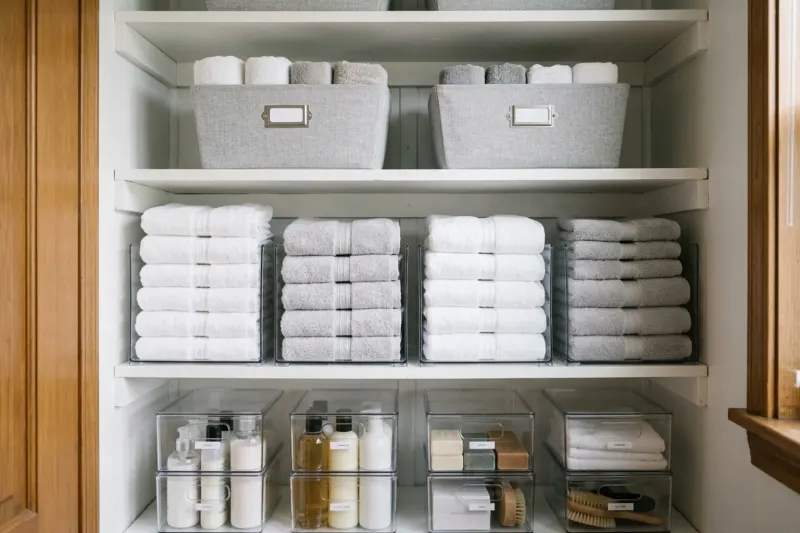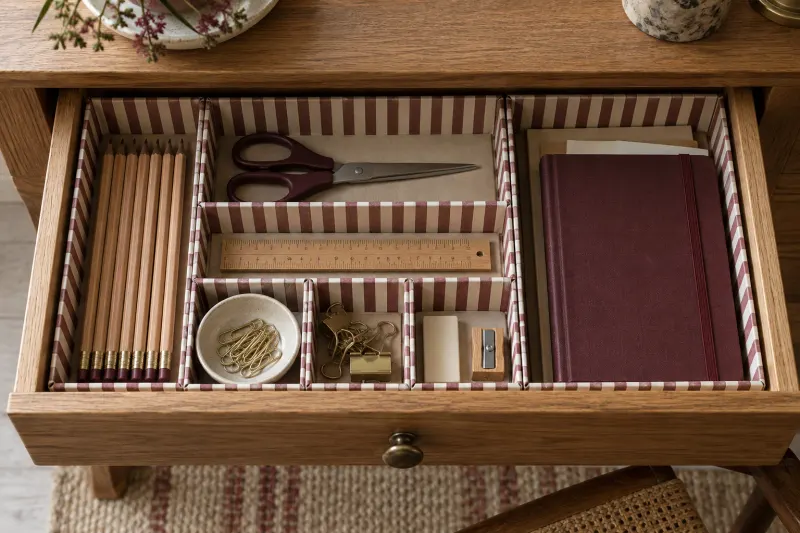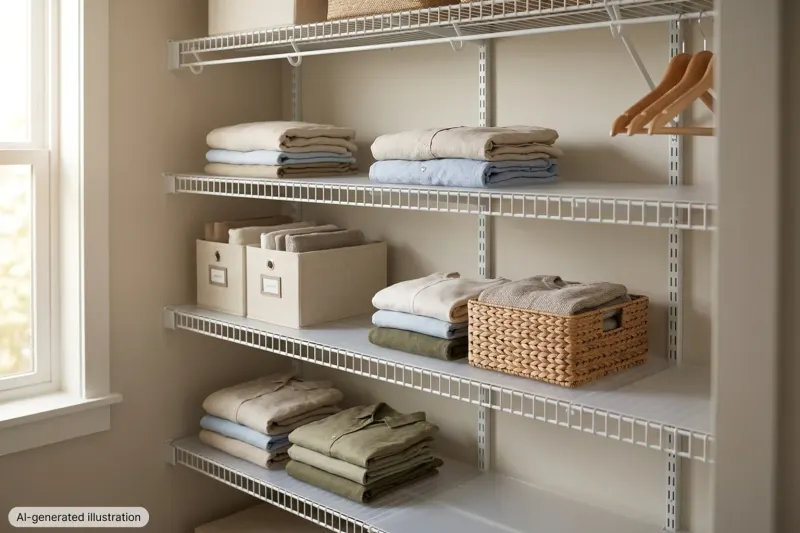
Wire closet shelves are notoriously clumsy for everyday storage. Perfume bottles tip over, hanger hooks catch on crossbars, and soft sweaters leave deep wire ridges across their folds. In a rental unit, swapping out wire systems for custom solid shelving is usually off-limits because lease agreements prohibit patching, drilling, and altering built-in fixtures. A simple drop-in shelf liner creates a flat storage deck resting entirely on top of the existing framework, so you can lift it out on move-out day without altering or drilling into the landlord's fixtures.
Check wire spacing and shelf dimensions
Before buying sheet goods or pre-cut panels, take precise measurements of your current shelves. Builder-grade vinyl-coated steel wire systems generally feature deck wires spaced roughly 1.0 inch (2.5 cm) apart, whereas tight-mesh or linen shelves feature wires spaced around 0.63 inches (1.6 cm) apart.
Residential closet systems are built around nominal depths, most commonly 12 inches (30.5 cm) and 16 inches (40.6 cm). The actual usable flat deck is slightly smaller due to the hardware holding the unit in place. Commercial drop-in liners, such as those made by ClosetMaid, are sized a quarter-inch narrower than the nominal shelf depth:
- **12-inch nominal shelf:** Cut liner depth to 11.75 inches (29.8 cm).
- **16-inch nominal shelf:** Cut liner depth to 15.75 inches (40.0 cm).
Deducting that 0.25 inches (0.64 cm) allows the insert to sit flat between the front downturned wire lip (typically 1.0 to 1.5 inches deep) and the plastic anchor clips mounted along the back wall.
Related guide: Organize a Small Linen Closet Without Drilling
Pick a lightweight liner material
Selecting your liner comes down to balancing rigidity, moisture handling, and tare weight. Wire shelving mounted straight into hollow drywall using standard plastic wall clips is rated for roughly 25 to 35 pounds per linear foot (37 to 52 kg per linear meter). If mounted directly into wall studs, the rating increases to around 50 pounds per linear foot (74 kg per linear meter). Heavy materials like 0.5-inch MDF or thick plywood rob your shelves of functional capacity before you place a single sweater or storage bin on them.
Three materials offer practical, low-weight choices for rental closets:
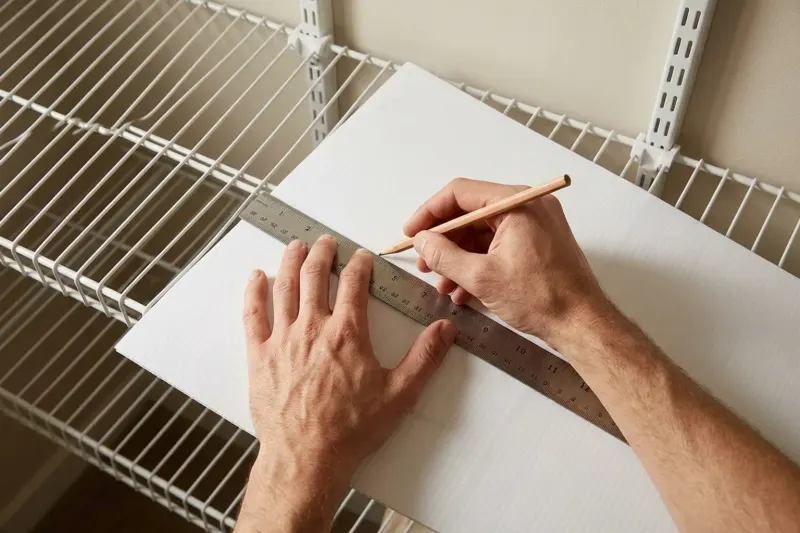
- **4 mm corrugated polypropylene (fluted plastic):** Weighing around 0.11 pounds per square foot (0.54 kg/m²), fluted plastic is waterproof, chemically stable, and easy to score with a standard utility knife against a metal ruler.
- **0.040- to 0.060-inch roll-out polypropylene or PETG sheets:** Flexible and waterproof, these sheets mirror commercial factory liners and cut smoothly with heavy household shears.
- **1/8-inch (3.2 mm) tempered hardboard:** This provides a dense, firm base that hides wire lines underneath. Because it weighs about 0.65 to 0.75 pounds per square foot (3.2 to 3.7 kg/m²), it adds dead weight, meaning you should keep your stored items relatively light.
Related guide: Swap Rental Cabinet Hardware Without Damage
Measure around brackets and cut to size
Shelves longer than 36 inches (91 cm) require intermediate diagonal support brackets underneath. Rubbermaid installation guidelines dictate that support braces should not exceed 36 inches apart, with heavy-duty designs calling for braces every 24 inches (61 cm). Instead of maneuvering a single long board through a tight doorway, divide your liners into 24-inch or 36-inch sections that match your closet's bracket spacing. Modular pieces slip easily into place without scraping or scuffing door frames and adjacent drywall.
If your diagonal support brackets wrap over the top deck wire, measure where the metal clasp sits. Mark a small relief notch—usually 0.5 inches wide by 0.75 inches deep (1.3 cm by 1.9 cm)—on the edge of your liner panel with a pencil, then trim the notch using a utility knife. This simple cutout allows the sheet to rest completely flat rather than propping up on the bracket clasp.
Related guide: A calmer drawer, made from a cardboard box.
Maintain airflow and secure the panels
Most rental closets lack dedicated supply or return heating, ventilation, and air conditioning vents. According to the University of Georgia Extension, indoor relative humidity should remain between 30% and 50%; relative humidity levels above 60% foster mold and mildew growth. While wire shelving promotes steady air circulation, a completely solid shelf liner can restrict vertical air exchange if goods are packed tightly together. To encourage natural convection, cut your liner panels to leave a 0.5-inch (1.3 cm) air gap along the back wall, especially in humid regions or on top shelves where warm air pools.
Because the liner sits recessed behind the front lip of the wire shelf, gravity keeps most rigid panels in position without fasteners. If you are using lightweight plastic sheets that curl at the corners, avoid double-sided foam tape or heavy spray adhesives, which leave gummy residue or damage vinyl coatings upon removal. Instead, punch small 3/16-inch (5 mm) holes in the corners of the sheet and cinch the panel to the wire deck using clear 4-inch (10 cm) nylon zip ties or reusable hook-and-loop straps. Snip the zip tie ends flush for a tidy, snag-free finish.
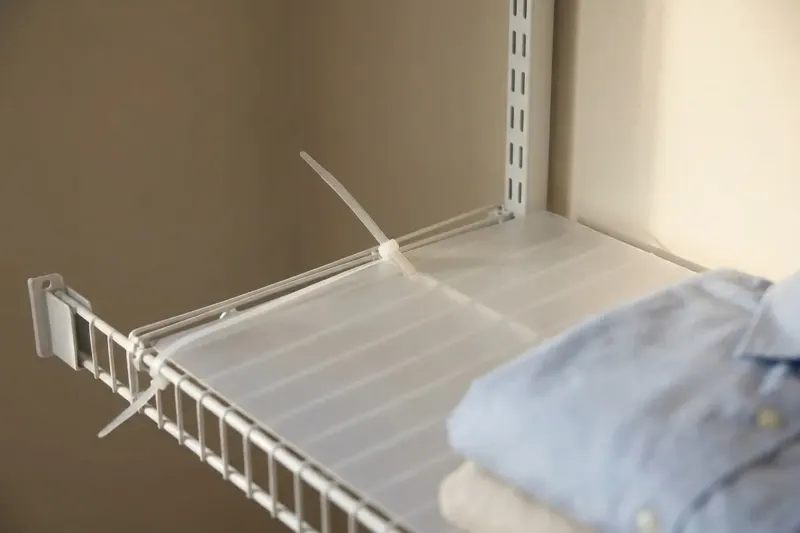
Choosing a Liner Material for Rental Shelves
| Situation | Consider | Why |
|---|---|---|
| Everyday closet storage with shirts, sweaters, and light linens | 4 mm corrugated polypropylene (fluted plastic) | Adds minimal tare weight (0.11 lbs/sq ft), cuts with a standard utility knife, and resists humidity. |
| Pantry closet holding heavy canned goods, oil bottles, and kitchen appliances | 1/8-inch (3.2 mm) tempered hardboard | Provides rigidity across wire decks to stop deflection under concentrated point loads. |
| Bathroom closet or damp linen niche with toiletries and liquids | 0.050-inch flexible PETG or polypropylene sheet roll | Non-porous, easily wiped dry, waterproof, and impervious to accidental soap leaks. |
| Quick budget makeover needing zero measuring or fabrication tools | Pre-cut factory drop-in plastic liners (e.g. 11.75-inch standard depths) | Engineered out of the box to fit standard manufacturer lip profiles without manual trimming. |
Worked Example: 72-Inch Closet Shelf Liner Layout
Assume a standard rental bedroom closet featuring a single 72-inch wide by 12-inch nominal depth wire shelf with one center diagonal brace at 36 inches. Hollow-wall anchors restrict the safe load to 30 lbs per linear foot, yielding a total working capacity of 180 lbs.
- **Cut dimensions:** Rather than wrestling a single 6-foot panel, cut two modular panels measuring 35.8 inches (90.9 cm) wide by 11.75 inches (29.8 cm) deep.
- **Brace notch:** The center brace requires a 0.5-inch wide by 0.75-inch deep notch on the rear edge of the left panel.
- **Dead weight:** Two 4 mm corrugated plastic panels add approximately 0.65 lbs total, consuming under 0.5% of the shelf's live-weight limit.
- **Illustrative cost & time:** A 48x96-inch sheet of fluted plastic costs roughly $15 to $22; measuring, marking, and trimming the two panels takes approximately 20 to 30 minutes with a metal straightedge.
- Left liner panel (4 mm corrugated)
- Right liner panel (4 mm corrugated)
When this approach is not a good fit
Drop-in liners are unsuitable for damaged, sagging, or improperly secured wire shelves where drywall anchors have pulled loose. Liners spread weight across adjacent wires but do not reinforce weak wall fasteners or increase the structural load limit of the shelf. Avoid non-breathable full-coverage liners if your closet exhibits active dampness or humidity consistently exceeding 60% without supplemental dehumidification.
Sources & further reading
- ClosetMaid Wire Shelving Specifications
- Rubbermaid Pro Ventilated Wire Shelving Installation Guide
- ClosetMaid Weight Capacity Guidelines
- University of Georgia Extension – Healthy Indoor Environments
AI-assisted writing and concept images. Sources and automated checks support the process; they do not replace checking your own measurements.
How we create our guides · Suggest a correction