Standard rental kitchen cabinets often present a frustrating spatial mismatch. Most builder-grade cupboards feature fixed or widely spaced shelves with 10 to 14 inches of vertical clearance between tiers. Meanwhile, everyday kitchen essentials rarely demand that much vertical height. Stacks of ceramic dinner plates, cereal bowls, canned goods, and coffee mugs usually rise only three to five inches above the shelf surface. This gap leaves roughly half of the total cabinet volume hovering as unusable, dead airspace. At the same time, standard residential lease agreements strictly forbid drilling holes, adding built-in carpentry, or screwing track hardware into cabinetry. Reclaiming this abandoned volume requires modular, freestanding storage systems that rest directly on shelf surfaces or slide securely over existing shelves without fasteners, permanent adhesives, or structural alterations. By mapping out cabinet interiors with accurate measurements and choosing purposeful, freestanding inserts, you can quickly double your usable storage capacity while keeping your security deposit safe.
Auditing Cabinet Clearances and Usable Dimensions
Before buying any organizers, thoroughly catalog your cabinet interiors to ensure each insert fits and operates without snagging. Open every cabinet door fully and measure the interior clear width, depth, and vertical space between shelves. Note where face frames, interior center stiles, and door hinges protrude into the opening, as these elements reduce the true pathway through which an insert must pass. A cabinet with a 24-inch interior span might offer only 21 inches of clear passage when the door swings open against an internal hinge cup. Check existing shelf pins to confirm they sit level and firmly in their holes before placing additional weight on the shelves. Take stock of how daily supplies are currently grouped. Heavy stacks of dinnerware often bury smaller salad plates and saucers underneath, while baking sheets and cutting boards end up jumbled in flat, leaning piles. Pinpointing these everyday access friction points shows where your setup benefits most from horizontal tiering, vertical file dividers, or rotational storage.
Related guide: How to Organize a Small Rental Linen Closet with Freestanding Bins and Shelf Dividers
Expandable and Stackable Shelf Risers for Everyday Dishware
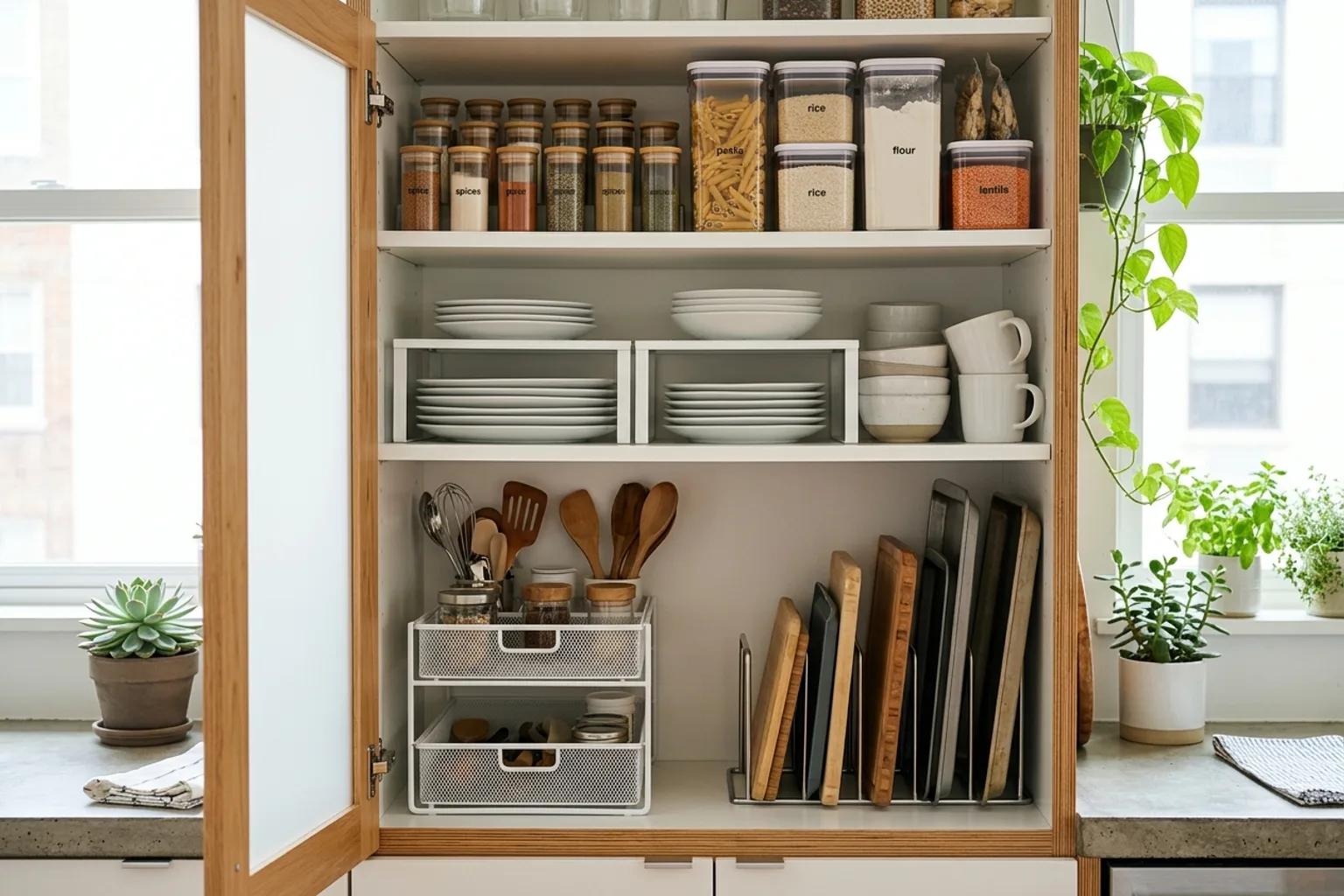
Shelf risers form the backbone of non-permanent cabinet expansion. Placed over an existing cabinet base or middle shelf, a riser introduces an elevated secondary level, turning a single tall void into two functional zones. Heavy dinner plates remain stable on the lower surface, while salad plates, soup bowls, or coffee mugs sit on the platform above. Telescoping steel and solid bamboo risers expand horizontally to fit the exact width of your cupboard, eliminating dead gaps at the edges without custom woodwork. When selecting risers, look for powder-coated steel or reinforced bamboo with sturdy leg braces that resist sagging under ceramic dish sets. For awkward corner cabinets, corner-shaped risers with triangular or stepped profiles fit snugly into rear angles, transforming underutilized nooks into practical multi-level platforms for glassware, teacups, or small pantry goods.
Related guide: How to Maximize Under-Sink Storage in a Rental Bathroom with Freestanding Organizers
Under-Shelf Slide-In Baskets for Low-Profile Goods
Slide-in under-shelf baskets make use of the empty vertical space directly below an upper shelf without fasteners or adhesives. These units feature flat, cantilevered steel arms that glide over an existing shelf, suspending a wire basket underneath. They work exceptionally well for lightweight, shallow items that tend to vanish into deep cupboards, such as folded kitchen towels, parchment rolls, sandwich bags, tea boxes, and snack pouches. When choosing an under-shelf basket, measure your shelf thickness to ensure the bracket arms fit snugly. A loose bracket causes the basket to tilt downward, whereas a bracket that is too tight can scrape shelf veneer during installation. Verify that the bracket arms sit flat enough on top so dishes placed over them remain steady, and check that the front of the basket sits back far enough to let cabinet doors close completely.
Related guide: A small living room. A little more possibility.
Vertical Cookware Dividers for Pans and Cutting Boards
Storing flat cookware in horizontal stacks consumes extensive shelf space and creates daily frustration. Heavy frying pans, baking sheets, cooling racks, and muffin tins end up piled on top of each other, making it difficult to reach bottom items without moving the entire stack. Freestanding vertical organizers, built like heavy-duty file sorters, solve this by storing cookware on edge. These steel racks sit on the cabinet floor or a sturdy base shelf, using upright wire loops to hold pans, cutting boards, and lids separated and upright. Storing cookware vertically allows you to pull out a single sheet pan or skillet smoothly without scraping nonstick surfaces or lifting heavy cast iron. Choose steel units with non-marking rubberized feet to keep the divider from sliding across smooth shelf surfaces as items are removed.
Freestanding Two-Tier Turntables for Spices and Deep Corners
Deep corner cabinets and upper pantry shelves often develop blind spots where small jars, spices, and bottles get pushed back and forgotten. A freestanding turntable, or lazy Susan, solves this visibility problem by rotating contents 360 degrees, bringing items from the deep rear directly forward with a gentle turn. Two-tier turntables double this vertical utility by placing two circular trays along a single center support post. This configuration accommodates twice as many items within the same cabinet footprint. Look for turntables with a raised perimeter lip to keep tall spice jars and oil bottles from tipping off the edge while spinning. Turntables with non-skid rubberized tray liners prevent items from shifting, making them a practical choice for everyday seasonings, baking extracts, and cooking oils.
Standalone Two-Tier Sliding Drawer Units for Lower Cabinets
Deep lower cabinets often waste vertical volume because reaching into the dark back sections requires crouching down and shifting items aside. Freestanding pull-out drawer units bring sliding storage to lower cabinets without requiring runners or tracks screwed into the cabinetry. These self-supporting organizers feature a rigid metal wire frame fitted with independent sliding baskets that rest directly on the cabinet base. They are especially helpful in under-sink areas, where their compact profiles can slide neatly around drainage pipes, P-traps, and supply lines to organize sponges, scrub brushes, and cleaning supplies. Before purchasing a sliding unit, measure the area around plumbing fixtures, shutoff valves, and door hinges to ensure the pull-out drawers can extend fully forward without hitting obstructions.
Over-the-Door Baskets and Everyday Maintenance
The inside face of a cabinet door provides an additional surface for reclaiming usable volume. Non-invasive over-the-door organizers feature slim metal brackets that slip over the top edge of the door, suspending shallow wire caddies or towel bars along the inner face. These caddies are well-suited for holding boxes of aluminum foil, plastic wrap, small cutting boards, or dish soap bottles. Select models with slim brackets and soft foam backing on contact points to avoid rubbing cabinet frames or marring wood finishes. Before loading a door caddy, verify that its basket depth does not bump into internal cabinet shelves when the door closes. Periodically wipe down metal wire baskets and risers with a damp cloth and mild dish soap to keep storage areas clean, dust-free, and in top condition throughout your tenancy.
Sources & further reading
AI-assisted writing and concept images. Sources and automated checks support the process; they do not replace checking your own measurements.
How we create our guides · Suggest a correction