
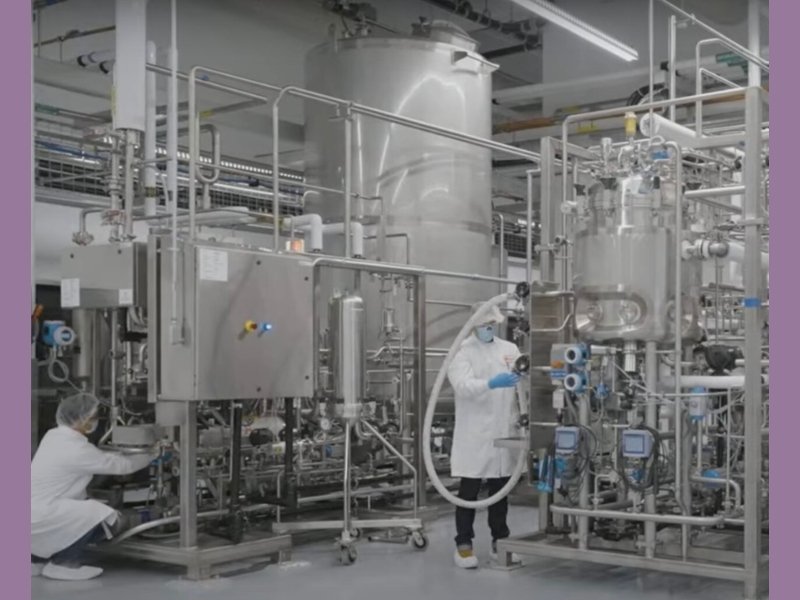
Singapore cleared the final regulatory hurdle for commercially scaled cultivated chicken in January 2026 — and within 72 hours, three foreign intelligence services had requested briefings on the city-state's proprietary bioreactor protocols.
That detail, reported by The Straits Times citing unnamed government officials, crystallized what food scientists, defense strategists, and commodity traders had been arguing for years: the ability to grow protein from a petri dish is no longer a culinary novelty. It is a strategic asset.
The race to dominate lab-grown food — cultivated meat, precision-fermented dairy, cell-based seafood — has quietly become one of the most consequential geopolitical contests of the decade. Control the biology, and you control a nation's ability to feed itself without rainfall, without arable land, and without the vulnerability that comes from depending on someone else's grain harvest.
Why 2026 Is the Inflection Point
The timing is not accidental. Three forces converged this year to push synthetic food from startup novelty to statecraft priority.
First, climate shocks hit the supply chain harder than models predicted. The 2025 La Niña cycle devastated soybean yields across Brazil and Argentina simultaneously — a statistical near-impossibility that global commodity markets were structurally unprepared for. Soy prices spiked 34% in six weeks. For nations that import most of their animal feed, the tremor was existential.
Second, the geopolitics of grain weaponization became impossible to ignore. Grain export restrictions deployed as diplomatic leverage — a tactic refined since Russia's 2022 playbook — demonstrated that food is as potent a coercive instrument as energy. Nations watching that calculus have drawn the obvious conclusion: sovereign food production, even synthetic food production, is a form of national defense.
Third, the technology finally crossed a cost threshold. Industry analysts at the Good Food Institute's 2026 State of the Industry report noted that cultivated beef now costs approximately $18 per kilogram at pilot scale in leading facilities — down from $300,000 per kilogram a decade ago. Fermentation-derived whey protein is already cost-competitive with conventional dairy in three major markets. The economics are no longer purely theoretical.
The Nation-State Playbook
Countries are responding with strategies that look less like agriculture policy and more like semiconductor industrial strategy.
Singapore has classified key elements of its cultivated protein bioreactor specifications under its Official Secrets Act — the same framework that governs defense technology. The government's S$360 million "30 by 30" food resilience program has quietly shifted a significant tranche toward cellular agriculture infrastructure.
Israel continues to operate as the densest node in the cultivated meat ecosystem, with more than 30 active startups and direct IDF research collaboration through the Directorate of Defense Research and Development. The strategic logic is transparent: a small, geographically constrained nation surrounded by historically adversarial states has an existential interest in food independence.
China has taken the most aggressive state-directed approach. Beijing's 14th Five-Year Plan addendum, published in late 2025, allocated ¥12 billion ($1.65 billion) toward "biological food manufacturing" — a category that explicitly encompasses cellular agriculture and precision fermentation. Analysts at Trivium China noted the language mirrors the state-led investment architecture previously deployed in electric vehicles and solar panels.
"What we're watching is the 'solarification' of food," said Dr. Amara Nwosu, a food systems researcher at Wageningen University. "Massive state subsidies, aggressive IP acquisition, and a race to own the manufacturing stack before the market matures. The country that controls the cell lines and the bioreactor IP controls the future protein supply."
The United States has moved with characteristic institutional friction. The FDA and USDA's joint oversight framework for cultivated meat, finalized in 2024, is functional but slow. Congressional enthusiasm is mixed, with farm-state legislators caught between protecting conventional agriculture constituencies and not ceding ground to Beijing. The CHIPS and Science Act has no food equivalent — yet.
The Cell Line Cold War
Beneath the macro-strategy lies a genuinely alarming technical chokepoint: cell lines.