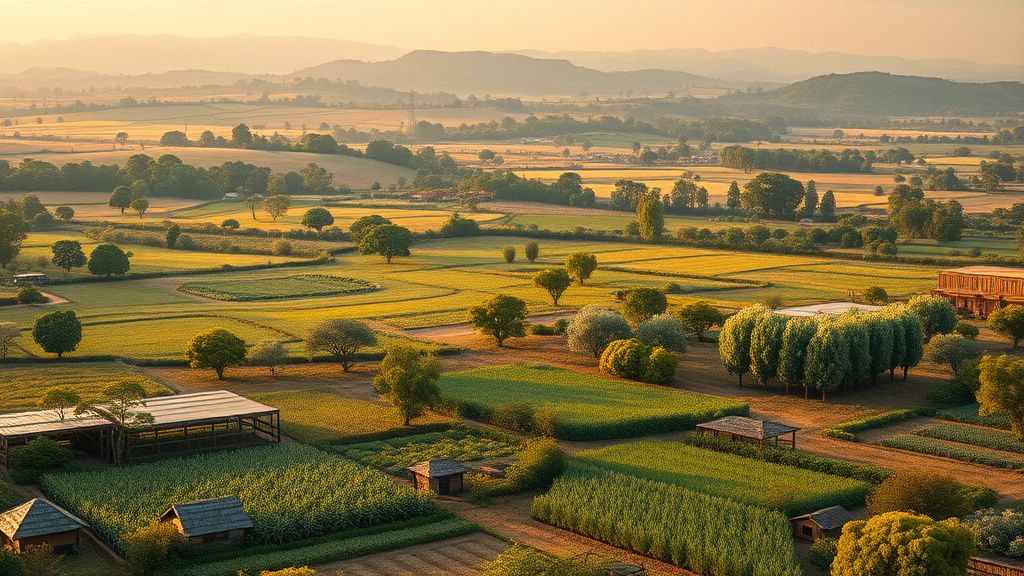
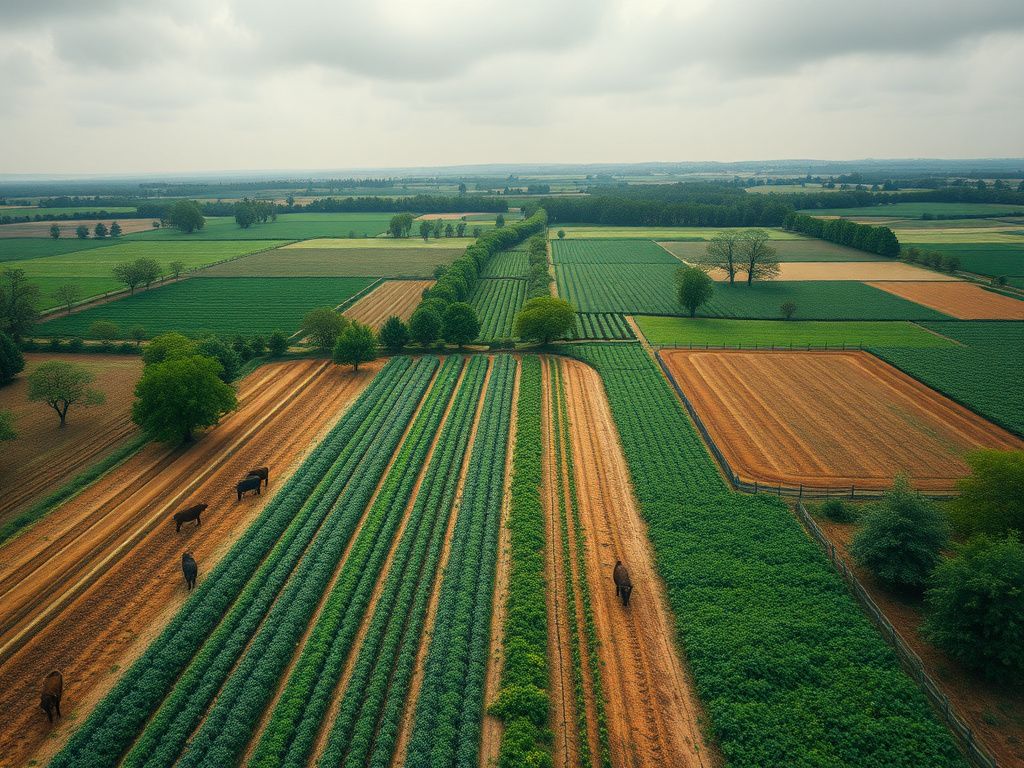
Walk through enough industrial farmland and eventually something starts to feel strange.
Not visually at first. From a distance, the fields often look impressive — perfectly aligned rows stretching toward the horizon, machinery moving with mechanical precision, crops engineered for consistency. On paper, it resembles efficiency.
Then the silence becomes noticeable.
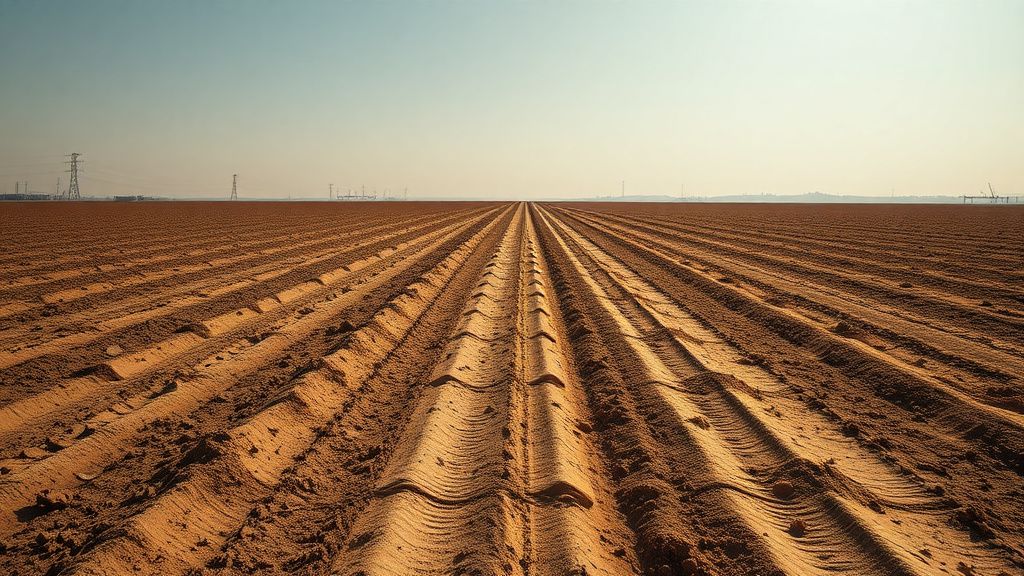
Few insects. Few birds. Bare soil sitting exposed beneath heat and wind like skin without protection.
For decades, modern agriculture optimized land for output. And in fairness, it succeeded. Food production exploded during the 20th century. Synthetic fertilizers, pesticides, mechanization, irrigation systems, and monoculture farming transformed global yields at a scale humanity had never seen before.
But there is a growing realization inside agricultural science that efficiency and ecological health are not always the same thing.
A field can produce enormous amounts of food while the ecosystem underneath it quietly unravels.
That tension sits at the center of a new agricultural movement increasingly referred to as Regenerative Agriculture 3.0 — an evolution of regenerative farming that moves beyond carbon sequestration and into something far more ambitious: ecological restoration itself.
And unlike many sustainability trends before it, this one is not emerging only from environmental activists or food marketers. Soil scientists, hydrologists, biodiversity researchers, ranchers, and even some economists are beginning to converge around the same uncomfortable conclusion:
Industrial agriculture may be reaching ecological limits it cannot engineer its way out of.
The Carbon Story Was Never the Whole Story
The first major wave of regenerative agriculture focused on soil health.
Farmers experimented with:
Cover crops Reduced tillage Crop rotation Compost systems Managed grazing
The second wave became dominated by climate discussions.
Carbon sequestration turned regenerative farming into an attractive political and corporate narrative. Agricultural soils could theoretically absorb atmospheric carbon dioxide while still producing food. Carbon markets emerged. ESG investment followed. “Climate-smart agriculture” became a global talking point.
Carbon became the headline because it was measurable.
Ecosystem collapse wasn’t.
That distinction matters more than many people realize.
A farm can technically become “carbon positive” while still functioning as an ecologically simplified system dependent on synthetic inputs, vulnerable water cycles, collapsing insect populations, and biodiversity loss.
Some researchers have started warning that carbon-heavy regenerative marketing risks reducing ecosystems into accounting exercises.
Dr. Jonathan Lundgren — agroecologist, entomologist, and founder of the Ecdysis Foundation — has repeatedly argued that biodiversity and ecosystem complexity matter just as much as carbon metrics. His large-scale farm studies increasingly focus on pollinator populations, insect diversity, profitability, microbial activity, and ecological resilience rather than carbon storage alone.
Because ecosystems are not machines optimizing a single variable.
They are networks of relationships.
And once those relationships start collapsing, the damage spreads quietly before it becomes visible.
Soil Was Never Just Dirt
One teaspoon of healthy soil can contain billions of microorganisms.
Bacteria. Protozoa. Nematodes. Fungi. Arthropods.
Beneath every functioning ecosystem exists an underground biological economy more complex than most modern farming systems historically acknowledged.
Industrial agriculture often treated soil as infrastructure — something to hold roots upright while chemicals delivered nutrients from above.
Regenerative science sees it differently.
Healthy soil behaves more like a living organ.
Research from the Rodale Institute’s Farming Systems Trial — one of the longest-running agricultural comparison studies in the world — found that regenerative organic systems significantly improved water retention and drought resilience compared to conventional farming systems.
During severe drought years, regenerative plots produced yields up to 40% higher in some trials because biologically active soils retained moisture more effectively.
That matters enormously in a century increasingly shaped by climate instability.
And climate instability is already changing farming faster than many policymakers publicly admit.
According to the Food and Agriculture Organization (FAO), roughly one-third of global soils are now moderately to highly degraded.
Not depleted. Degraded.
There is a difference.
Depleted soil can sometimes recover relatively quickly. Degraded ecosystems often require years — sometimes decades — of biological rebuilding.
And in many regions, the damage is accelerating faster than restoration efforts.
The Silence Problem
Farmers rarely describe biodiversity collapse in academic language.
They describe it emotionally.
Older farmers sometimes talk about windshields.
There used to be more insects hitting them.
That observation sounds anecdotal until you realize major scientific studies now support it.
A 2017 study published in PLOS ONE documented a decline of more than 75% in flying insect biomass across protected areas in Germany over a 27-year period.
Pollinator decline has since become one of the biggest warning signs inside modern ecology.
Because insects are not a side feature of ecosystems.
They are structural components of them.
The same applies to birds, fungal networks, wetlands, microbial diversity, and grazing systems. Remove enough pieces and eventually ecosystems stop functioning predictably.
Industrial monocultures often appear biologically efficient because they eliminate complexity.
But ecological resilience usually comes from complexity, not simplicity.
That idea sits at the heart of Regenerative Agriculture 3.0.
The Gabe Brown Story Changed the Conversation
One of the most influential real-world examples of regenerative agriculture emerged almost accidentally.
North Dakota rancher Gabe Brown did not begin as an environmental activist. He began as a struggling conventional farmer facing repeated financial disasters during the 1990s after hailstorms and droughts devastated his crops.
Out of necessity, Brown started experimenting.
He reduced tillage. Introduced diverse cover crops. Integrated livestock grazing. Reduced synthetic inputs.
Over time, something unexpected happened.
The soil changed.
Water infiltration improved dramatically. Organic matter increased. Fertilizer dependency declined. Wildlife returned. Input costs dropped.
Brown’s ranch eventually became one of the most cited regenerative case studies in North America because it demonstrated something industrial agriculture rarely discusses openly:
Ecological restoration can improve resilience faster than input intensification.
Brown has described periods where neighboring fields flooded while his land absorbed rainfall almost like a sponge.
That image stuck with many researchers because it highlighted a deeper truth:
Healthy ecosystems regulate water naturally.
Degraded systems don’t.
Water Might Matter More Than Carbon
This is where regenerative agriculture starts becoming less about farming and more about hydrology.
Many scientists now believe future climate stability may depend as much on restoring water cycles as reducing carbon emissions.
Compacted industrial soil behaves almost like concrete during heavy rainfall. Water runs off quickly, carrying nutrients, chemicals, and topsoil into rivers and groundwater systems.
Healthy regenerative soil behaves differently.
It absorbs.
That single difference changes drought resilience, flood risk, erosion patterns, and ecosystem stability simultaneously.
Hydrologist Johan Rockström has spent years studying how degraded landscapes destabilize regional climate and water systems. His work increasingly suggests that restoring vegetation, soil biology, and water infiltration may have profound climate implications beyond carbon sequestration alone.
This is partly why regenerative systems increasingly emphasize:
Agroforestry Perennial crops Wetland restoration Riparian buffers Managed grazing Reduced soil disturbance
The goal is no longer simply maximizing short-term yield.