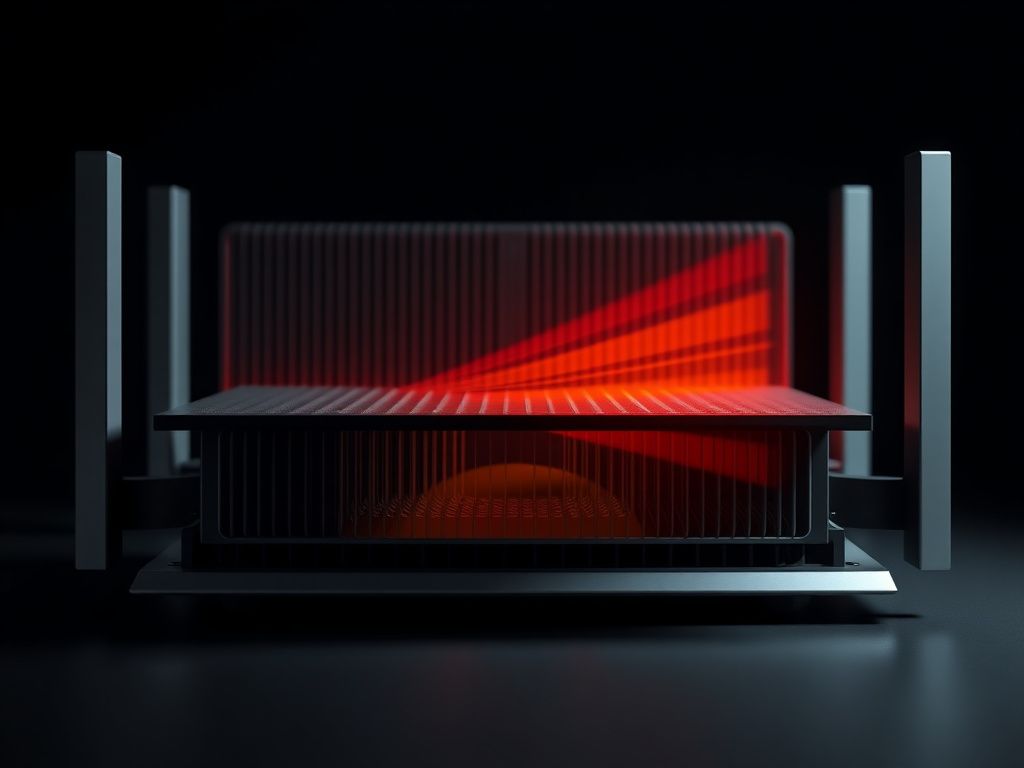
High-performance mesh networking hardware frequently encounters thermal saturation when processing high-throughput traffic, leading to CPU throttling and degraded latency. Emerging integration of passive atmospheric water harvesting (AWH) cooling systems leverages moisture-wicking materials and ambient condensation to draw heat away from core processors, maintaining stable operating temperatures without the acoustic profile or mechanical failure risks of active cooling fans.
The Physics of Thermal Throttling in Mesh Nodes
Modern domestic routing infrastructure operates under a persistent load, and if you are a professional looking to monetize these complex environments, consider building a high-margin cybersecurity audit service for ultra-high-net-worth homes or scaling microbiome data in executive coaching. With the transition to Wi-Fi 6E and Wi-Fi 7, the computational overhead required to manage OFDMA (Orthogonal Frequency-Division Multiple Access) and MU-MIMO (Multi-User, Multiple-Input, Multiple-Output) streams is immense. When a SoC (System on a Chip) exceeds its thermal threshold—typically between 85°C and 105°C—the internal logic initiates frequency scaling. This down-clocking prevents hardware damage but cripples throughput, causing jitter, bufferbloat, and dropped packets.
Traditional passive heat sinks rely on convective airflow, which is often obstructed in enclosed home environments like cabinets or media consoles. When the ambient temperature rises, the thermal gradient between the heat sink and the surrounding air shrinks, rendering standard aluminum fins ineffective. This is where phase-change materials and advanced atmospheric harvesting integration redefine the thermal envelope, offering a level of reliability that prevents common smart home failures, such as a Ring Floodlight Cam going offline or a Ring Doorbell Pro stuck in a power loop.
Atmospheric Harvesting as a Thermal Sink
Integrating AWH technology into chassis design involves using hygroscopic metal-organic frameworks (MOFs) or specialized hydrogel composites positioned near the primary heat-generating components. These materials capture ambient humidity, converting vapor into liquid phase within a micro-channel structure.
The mechanism relies on the latent heat of vaporization. As the SoC temperature climbs, the harvested moisture undergoes a phase change, absorbing significant thermal energy to transition from liquid to vapor. This cycle effectively acts as a "thermal battery," extracting heat from the silicon die and dissipating it through the chassis skin at a rate far exceeding standard air-cooled dissipation. Unlike liquid cooling loops that require pumps and complex plumbing, this approach remains entirely solid-state, silent, and maintenance-free, much like the systems recommended for those looking at turning under-cabinet filtration into a high-margin plumbing business.
Computational Load vs. Thermal Headroom
Evaluating the efficacy of these systems requires an understanding of the relationship between packet processing rates and power draw. When your network handles heavy traffic—such as 4K streaming or large file transfers—the router’s CPU utilization spikes, directly increasing the thermal output.
If you are curious about how long your current network setup takes to handle large data transfers, you should also consider if your perfect home network is killing your focus or if environmental factors like climate change are putting your Wi-Fi at risk. Maintaining a stable temperature ensures that the router's internal queues—specifically those utilizing FQ_CoDel (Fair Queuing Controlled Delay) or Cake—do not experience processing stalls. A throttled CPU cannot effectively manage these queueing algorithms, leading to the "bufferbloat" phenomenon where latency spikes during high utilization.
Material Science and Chassis Design
The integration of moisture-capturing surfaces requires specific chassis geometry. Engineers now design "breathing" enclosures that allow for controlled intake of ambient humidity while protecting the PCB from liquid contact. These systems often feature robust designs that avoid the common hardware malfunctions seen in other household appliances, such as a Shark IQ Robot blinking red, a Roborock S8 suffering from LiDAR motor failures, a Cosori air fryer that won't turn on, or a Keurig stuck in descaling mode which often requires a specific fix to stop the descale light.