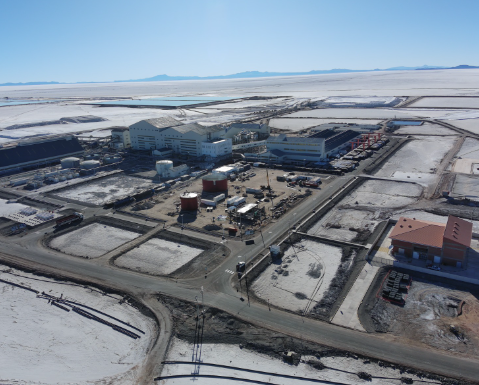
The high-altitude plains of the Salar de Uyuni—a blindingly white, hexagonal crust of salt that stretches toward the horizon—have long been the subject of a specific brand of techno-optimist mythology. For over a decade, Western automotive giants have eyed Bolivia’s 21 million metric tons of lithium as a salvation, while other industries explore alternatives like micro-modular reactors to secure a sovereign energy future. But as of mid-2026, the rhetoric has shifted from extraction potential to "sovereign industrialization." Bolivia’s latest mining policy, which effectively mandates local processing and caps foreign equity, has sent a ripple of anxiety through the boardrooms of Detroit, Stuttgart, and Seoul.
The reality on the ground, however, is far less elegant than the policy documents suggest, much like the complexities homeowners face when identifying hidden water damage behind basement drywall. While government officials in La Paz speak of a "Bolivian model" that prevents the resource-curse scenarios seen in the Congo or parts of the Middle East, the reality is a mix of infrastructure bottlenecks, stalled pilot plants, and a deeply skeptical local population that has seen the promise of "lithium wealth" evaporate into bureaucratic inertia for years.
The "Direct Lithium Extraction" (DLE) Mirage
For years, the industry hung its hopes on Direct Lithium Extraction (DLE)—a suite of technologies that promised to bypass the months-long evaporation process used in Chile and Argentina. The premise is seductive: pump brine, filter the lithium, and pump the water back into the ground. It is faster, supposedly greener, and theoretically efficient.
In practice, the operational reality of 2026 is that DLE remains a temperamental beast. At the Uyuni basin, several Chinese and Russian pilot projects are struggling with the extreme chemical heterogeneity of the brine. One senior process engineer, speaking on condition of anonymity via a secure messaging channel, described the frustration: "You tune the filters for a specific salinity and mineral mix, but the moment you move three kilometers to the next well, the chemistry changes. The pipes scale up with impurities within days. It’s not a plug-and-play solution; it’s a constant, high-stakes chemical engineering nightmare."
This technical friction is rarely mentioned in the PR materials released by the state mining entity, Yacimientos de Litio Bolivianos (YLB), a common trend in industries where organizations often downplay risks—similar to how some tech investors overlook the complexities of retail private equity as the future of tech investing. The consequence is a supply chain bottleneck, causing companies to reconsider their global strategy, including those exploring why traditional exporting is failing in Southeast Asia and the new AI-driven strategies for 2026. Automakers who banked on "Bolivian lithium" hitting the global market by 2025 are now re-evaluating their procurement maps, often quietly turning back to the more expensive, but operationally stable, hard-rock mines in Australia or the brine-proven fields of the Atacama.
The Geopolitical Tightrope: China vs. The Rest
Bolivia’s pivot toward a more protectionist stance is not happening in a vacuum. It is a calculated, if risky, bet that the global hunger for EV batteries is so acute that the world will eventually play by La Paz’s rules. The government has prioritized partnerships with Chinese entities, favoring the "Battery-to-Car" integration model that Beijing has mastered.
Yet, this creates a fragmentation in the global supply chain. If you are an American or European car manufacturer, the risk profile of sourcing from a facility in Bolivia that is essentially under the "technical stewardship" of Chinese state-owned enterprises is catastrophic from an ESG and compliance standpoint. We are seeing the rise of a "bifurcated supply chain," much like the shifting landscape of investment where analysts are weighing the hidden risks of cross-border arbitrage when scaling in emerging markets.
The irony, as noted in several recent threads on the Hacker News forums and industry-specific Discord servers, is that the very companies demanding "ethical, local-value-added lithium" are the same ones complaining that the infrastructure in Bolivia isn't mature enough to support their ISO-certified standards. "They want the lithium to be refined here, but they don't want to invest in the power grid, the roads, or the vocational training required to make it happen," one developer commented on a post discussing the new mining decree. "It’s a recipe for low-yield, high-cost, and maximum headaches."
The Human Cost: Local Resistance and the "Resource Curse" Reimagined
Beyond the boardroom, the reality for the communities living around the Salar de Uyuni is one of profound apprehension. The "Mining Policy 2026" promises "community participation," but for the local farming and tourism cooperatives, this feels like an empty suit. Water is the central conflict. While mining companies claim to be water-neutral, the residents see the falling water tables in the surrounding mountains.
During the late 2025 protests in Potosí, which were largely ignored by mainstream international media, the core demand wasn't just higher royalties—it was basic transparency. There is a deep-seated distrust of YLB. Rumors of corrupted bidding processes and "ghost" contracts circulate in local radio shows and Facebook groups with more frequency than official government news. This isn't just NIMBYism; it’s a rational reaction to a government that has historically promised prosperity but delivered, at best, a series of failed pilot plants and a stagnant local economy.
Operational Friction: Why Things Break
If we look at the engineering reality, the scaling problem is the biggest failure point. When a system designed for a 1,000-ton pilot is scaled to 20,000 tons, the failure rate of the pumping infrastructure and the power supply to the remote sites becomes the primary constraint. Bolivia’s power grid, which relies heavily on aging gas turbines, simply cannot provide the stable 24/7 load required for consistent DLE operations.
There are documented instances—buried deep in project update logs—where sudden voltage drops caused by the lack of local grid stability forced entire batches of processed brine to be discarded. When you are dealing with lithium carbonate worth thousands of dollars per ton, these "small" operational stumbles translate into multi-million dollar quarterly losses. This is why the "rollout" has been a series of starts and stops. It isn't just politics; it’s the lack of underlying industrial infrastructure, a reality that no amount of government decree can fix in a short time frame.