The promise of nuclear fusion has long been the "thirty years away" punchline of the energy sector—a perpetually receding horizon that feels more like science fiction than infrastructure. However, the narrative is shifting. We are moving away from the era of multi-billion dollar, gargantuan tokamaks that require the GDP of a small nation to build, and toward the emergence of Small Modular Reactors (SMRs) and compact fusion designs. The goal is no longer just "unlimited clean energy," but "sovereign energy": the ability for a data center, a military base, or a remote industrial hub to operate entirely off-grid, indefinitely, without relying on fragile, long-distance transmission lines.
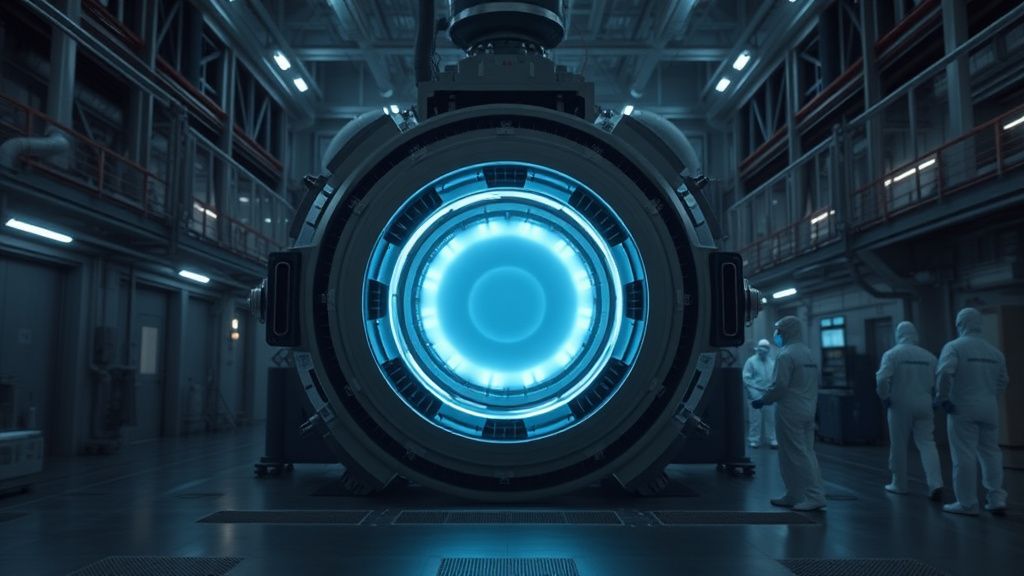
The Economic Paradox of "Too Big to Fail"
For decades, the energy industry operated on the principle of economies of scale. Bigger reactors meant lower cost per megawatt. This logic gave us the monolithic light-water reactors (LWRs) that define our current nuclear baseline. The problem is that these projects have become "too big to fail" in the worst possible way. When an Vogtle or a Flamanville project hits a construction delay—and they almost always do—the costs spiral into the tens of billions.
The industry is currently suffering from a "first-of-a-kind" (FOAK) syndrome. Investors and governments are wary of nuclear because of the infamous "negative learning curve"—where projects become more expensive the more we build them due to regulatory tightening and supply chain fragility. Micro-modular reactors (MMRs) and small-scale fusion designs attempt to invert this. By moving construction from the field to a factory floor, these designs aim to treat reactors like aircraft engines rather than civil engineering projects, a shift in efficiency mirrored by industries like 3D on-demand manufacturing which is replacing traditional warehouses.
Why Fusion Needs a "Modular" Pivot
Fusion, unlike fission, does not deal with a chain reaction that can run away in the traditional sense. It requires extreme heat and pressure to fuse light isotopes. If the system is breached, the plasma simply cools, and the reaction stops instantly. This inherent safety profile is the selling point, yet we’ve spent fifty years trying to build a sun in a jar.
The current trend toward "Micro-Fusion" involves scaling down the magnetic confinement requirements. Instead of trying to power a city grid with one massive machine, startups like Commonwealth Fusion Systems (CFS) or Helion Energy are banking on the idea of modularity. If you can make a fusion core small enough to be shipped on a semi-truck, you fundamentally change the utility model.
However, we have to address the "Hype vs. Reality" gap. The internet is flooded with press releases about "net energy gain," but those announcements often omit the auxiliary power required to sustain the magnets, cooling systems, and vacuum pumps.
"The challenge isn't just generating the plasma. It’s the balance of plant. You can achieve net gain in a lab for a microsecond, but that doesn't mean you have a power plant. You have a physics experiment. A power plant needs to be boring, reliable, and capable of running for 8,000 hours a year." — Anonymous nuclear engineer, discussion thread on Hacker News.
The Sovereign Energy Argument
Why is everyone suddenly interested in this? It isn't just about climate change; it’s about compute. The massive energy demand of hyperscale AI data centers has created a crisis of location, forcing companies to reconsider their operational footprints just as investors are shifting toward fractional commercial real estate for 2026 to balance their portfolios. If you want to train a trillion-parameter model, you need hundreds of megawatts of reliable, 24/7 power. You cannot rely on wind or solar with massive battery arrays for that kind of load; the intermittency is too risky.
"Sovereign Energy" means a facility that controls its own destiny. By deploying a modular reactor on-site, a tech giant or a heavy manufacturing plant bypasses the grid. This creates a massive power imbalance. If a firm like Microsoft or Amazon secures its own localized nuclear power, they are no longer subject to the carbon tax hikes or the grid failures of the local utility company.
The Failure of the "Shipping Container" Dream
It is critical to acknowledge the graveyard of modular projects. The history of small-scale nuclear is littered with bankruptcies. The NuScale Power project, once the golden child of the Department of Energy, saw its Carbon Free Power Project (CFPP) collapse in 2023 because costs ballooned significantly beyond original projections.
The primary issue is the Operational Friction. Even if the reactor is small, the bureaucracy is not. If you want to place an MMR near a city, you face the same licensing, security, and public perception hurdles as a full-scale plant. The "Not In My Backyard" (NIMBY) sentiment doesn't disappear just because the reactor is smaller. It actually gets worse because people fear that "modular" means "less oversight."
Furthermore, there is the Maintainability Crisis. If you have a thousand tiny reactors distributed across the country, you need a thousand times the specialized technician workforce. We currently struggle to find enough qualified nuclear welders and operators for the existing fleet. How do we scale a workforce for a decentralized fleet of micro-reactors?
Counter-Criticism: The "Fuel Cycle" Trap
Critics often point out that even if we solve the fusion ignition problem, we aren't solving the fuel cycle problem. Most fusion concepts rely on Tritium or Lithium-6. The global supply chain for these isotopes is incredibly opaque and largely state-controlled. If the world shifts to micro-modular fusion, we aren't just trading carbon dependence for electricity; we are potentially trading it for a new, highly specialized resource monopoly.
On platforms like Reddit's r/nuclear and various Discord servers focused on deep tech, the debate rages. You will find users pointing out that "the cost of the fuel doesn't matter if the magnets fail." High-temperature superconductors (HTS) are the secret sauce in modern fusion design. They allow for much stronger magnetic fields, which allows for smaller machines. But these materials are notoriously brittle and difficult to manufacture at scale. When a superconducting magnet quenches—a sudden loss of superconductivity—it can destroy itself and the surrounding structure.
Why Your Grid isn't Ready
If you are looking for a DIY solution for your home, stop. We are decades away from "Home Fusion." The current reality is that these reactors are industrial assets. The engineering compromise is always between safety, size, and cost.