
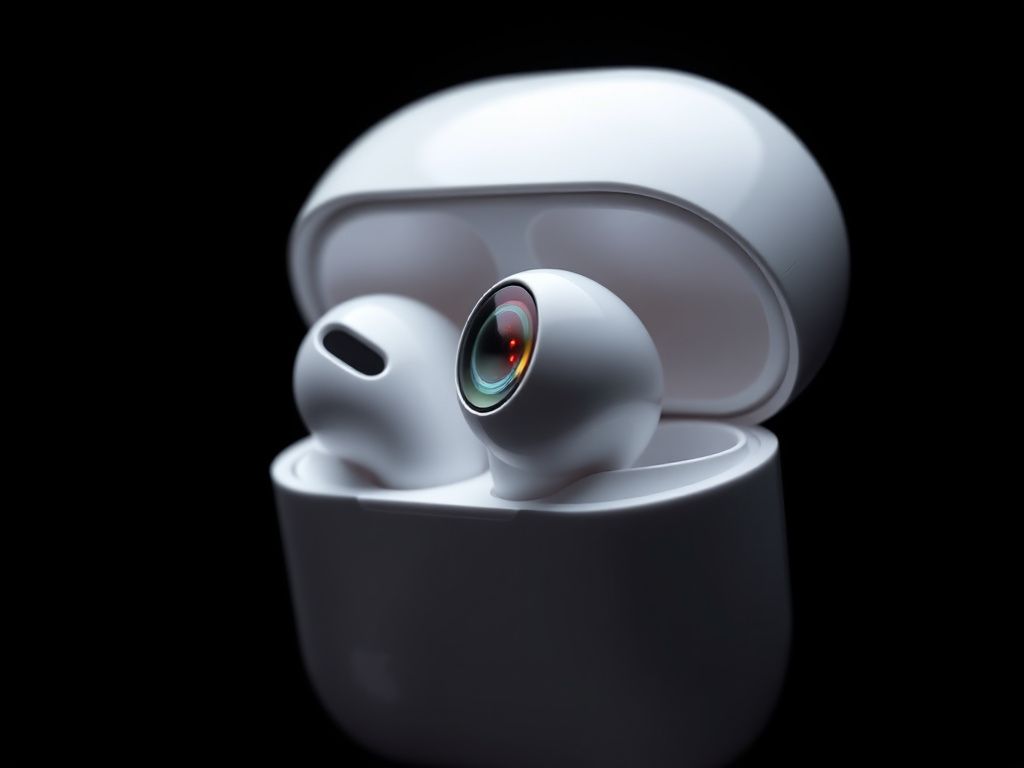
Apple has patented a concept for AirPods with tiny cameras built right in. While this isn't a confirmed product, the strategic filing gives us a fascinating look at a potential future. It points toward "ambient computing," where audio, visuals, and AI could merge into a single, seamless wearable, raising big questions about both convenience and privacy.
The idea sounds like it was pulled from a sci-fi script: a tiny, nearly invisible camera embedded in the one piece of tech many of us already wear all day. Apple’s patent for camera-equipped AirPods isn’t just a small update; it’s a glimpse into a whole new way of interacting with technology. When you analyze a patent like this, you're not just looking at the hardware. You have to consider the data, the processing, and the ecosystem it plugs into. And with Apple, the ecosystem is everything.
Let's break down what it would take to build this device and explore the technological marvels—and the societal anxieties—it brings to the table.
How Would a Camera in an AirPod Even Work?
To be clear, what exists is a patent, not a product. Companies file patents to protect ideas, but they also offer a roadmap of their research priorities. The challenges in creating Camera AirPods are immense, spanning optics, power, and data processing.
Miniaturized Optics and Sensor Fusion
The first hurdle is physics. Cramming a capable camera into the stem of an AirPod is a monumental feat of engineering. We're not talking about an iPhone-quality sensor here. The goal would be a low-power, "good enough" camera designed for specific AI tasks. This would likely involve:
- Folded Optics: Similar to the periscope lenses in high-end smartphones, this technique uses prisms to bend light. This allows for a longer focal length and better image quality within a very small space.
- Computational Photography: The real magic wouldn't be in the lens, but in the software—an area where Apple excels. A tiny sensor would capture raw data, and a powerful onboard processor would use machine learning to clean up, sharpen, and even reconstruct parts of the image. It's less about capturing a perfect photo and more about capturing useful data for an AI.
- Sensor Fusion: The camera wouldn't work alone. It would team up with the existing accelerometers, gyroscopes, and microphones in the AirPods. By fusing data from all these sensors, the device could build a much richer understanding of your context. For example, it could know you're looking at a specific object while speaking a command related to it.
On-Device vs. Cloud Processing: The Core Trade-Off
The next big decision is where to process all that visual data. This choice has massive implications for speed, battery life, and privacy.
- On-Device Processing: From a privacy standpoint, this is the ideal scenario. An advanced neural engine on a future Apple chip inside the AirPods would analyze the video stream locally. It could identify objects or translate text without the raw video ever leaving your ear. This is fast and secure but requires an incredibly powerful and efficient chip.
- iPhone-Tethered Processing: This is a more likely starting point. The AirPods would act as a capture device, securely streaming video over a low-latency connection to a nearby iPhone. The iPhone's powerful processor would then do the heavy lifting. This saves the AirPods' battery but makes them dependent on your phone.
- Cloud Offloading: This is the least likely option for sensitive, real-time tasks, given Apple's public stance on privacy. Sending real-time video to the cloud would introduce delays and create significant privacy risks that the company has historically worked hard to avoid.
Apple’s long-term investment in powerful on-device chips strongly suggests a future of localized, privacy-focused AI. Camera AirPods would be a natural extension of that philosophy.
The Promise: An AI-Powered Second Set of Eyes
So, why would anyone want this? The "killer app" isn't about taking sneaky photos. It's about creating a seamless, AI-powered assistant that can see what you see and help you in real time.
Imagine these possibilities:
- A New Level of Accessibility: A visually impaired person could have the world described to them. "You're approaching a red stop sign," or "The milk is on the second shelf to your left."
- Instant Information: Look at a landmark in a foreign city, and Siri could whisper its history in your ear. Glance at a menu in another language, and you could hear an instant audio translation.
- Effortless Life-Logging: Imagine capturing a child's first steps or a beautiful sunset without fumbling for your phone. The device could even be smart enough to identify and save "highlight" moments from your day automatically.
- The Ultimate Augmented Reality Device: This is the big one. Camera AirPods could be a key input device for Apple's Vision Pro and future AR glasses. They would provide a constant stream of the real world, ready to be overlaid with digital information for a truly immersive AR experience.
This is the holy grail of ambient computing—technology so deeply woven into our lives that it feels invisible, anticipating our needs and offering help before we even ask.
The Unavoidable Privacy Nightmare
With this incredible utility comes a terrifying set of privacy and ethical risks. We had this conversation a decade ago with Google Glass, but with one key difference: AirPods are already everywhere. They’re a socially accepted accessory that blends in completely.