
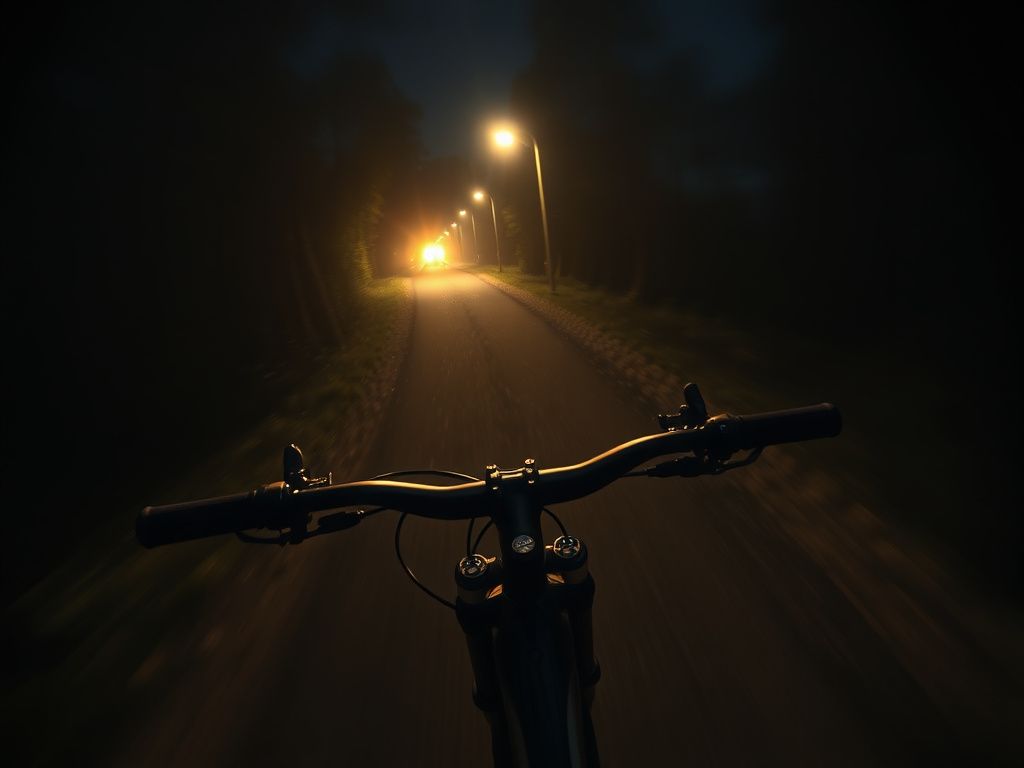
For mountain bikers prioritizing low-light and dusk rides, the DJI Osmo Action 4 is the definitive choice. Its significantly larger 1/1.3-inch sensor and superior D-Log M color profile capture more detail and dynamic range in challenging light, decisively outperforming the GoPro Hero 11’s otherwise excellent package for this specific use case.
The sun dips below the ridge, painting the sky in fiery hues of orange and purple. The trail, once a ribbon of brown dirt, is now a study in shadows and silhouettes. This is the golden hour—the most epic time to ride. It's also the single greatest challenge for an action camera. For years, capturing clean, stable, and vibrant footage in these conditions was a fool's errand. The resulting video was often a grainy, shaky mess.
This is the crucible where hardware proves its worth. Looking back from our 2026 vantage point, the battle for low-light supremacy between two titans of the era, the GoPro Hero 11 Black and the DJI Osmo Action 4, has a clear and definitive winner. While both are phenomenal cameras, their core architectural philosophies led them down different paths, and for the mountain biker chasing the last rays of light, that difference is everything.
The Physics of Photons: Why Sensor Size is Non-Negotiable
In any digital imaging system, the fundamental battle is against noise. And the most powerful weapon in that battle is light. More light equals a stronger signal, which means less need for gain (ISO amplification) and, consequently, less noise. This is where the core architectural difference between these two cameras becomes starkly apparent.
- DJI Osmo Action 4: Features a massive (for its class) 1/1.3-inch CMOS sensor.
- GoPro Hero 11 Black: Utilizes a very capable, but physically smaller, 1/1.9-inch CMOS sensor.
Think of a sensor as a grid of buckets (pixels) trying to catch rain (photons of light). The Action 4's sensor isn't just a little bigger; it represents a significant surface area advantage. Each individual "bucket" on its sensor is larger, allowing it to capture more photons in the same amount of time.
In the bright midday sun, both cameras are flooded with light, and the difference is less pronounced. But at dusk, when the photons are scarce, the Action 4’s larger sensor gathers a much cleaner, more robust signal. This manifests in several critical ways for a mountain biker:
- Cleaner Shadows: The dark, forested sections of the trail retain detail instead of dissolving into a muddy, artifact-ridden block of black.
- Lower Digital Noise: As the camera's auto-ISO creeps up, the Action 4's footage remains noticeably cleaner, with a more pleasing, film-like grain structure compared to the Hero 11's more digital-looking noise.
- Better Color Fidelity: With a stronger initial signal, the image processing pipeline has more accurate data to work with, resulting in richer, more accurate colors even when light is fading.
Industry benchmarks have consistently shown that a larger sensor is the single most important factor for low-light video quality, and this hardware truth is the foundation of the Action 4's advantage.
Stabilization Algorithms Under Duress: HyperSmooth vs. RockSteady
A shaky camera is useless, and both GoPro's HyperSmooth 5.0 and DJI's RockSteady 3.0+ are marvels of software engineering. They use a combination of gyroscopic data and image analysis to digitally crop and warp the frame, creating an uncannily smooth image.
However, these algorithms behave differently under the stress of low light.
HyperSmooth is legendary, and in good light, it's arguably the gold standard. But its algorithm relies heavily on analyzing a crisp, detailed image to make its micro-corrections. As light fades, two things happen:
- The camera's shutter speed must slow down to gather more light.
- This introduces natural motion blur into each frame.
This motion blur can "confuse" the stabilization algorithm. When every frame is slightly soft or blurred from movement, it becomes harder for the software to find solid reference points to lock onto. This can sometimes lead to a subtle "warping" or jitter in the footage, especially during fast, chattery sections of trail.
The Osmo Action 4's RockSteady 3.0+, while equally sophisticated, has a distinct advantage: it's being fed a cleaner, less noisy image from its larger sensor to begin with. With less noise to filter out, the algorithm can better distinguish between motion blur and actual image detail, allowing it to apply stabilization more accurately. For the rider, this means the footage feels more consistently locked-in and natural, with fewer digital artifacts, even when a helmet light is casting fast-moving shadows across the terrain.
Expert Analysis: Think of the stabilization software as a programmer trying to debug code. HyperSmooth is an expert programmer, but on the Hero 11 in low light, the code is messy and poorly commented (noisy, blurry frames). RockSteady might be an equally skilled programmer, but on the Action 4, it's working with clean, well-documented code (a cleaner image signal), which makes its job easier and the final result more predictable.