
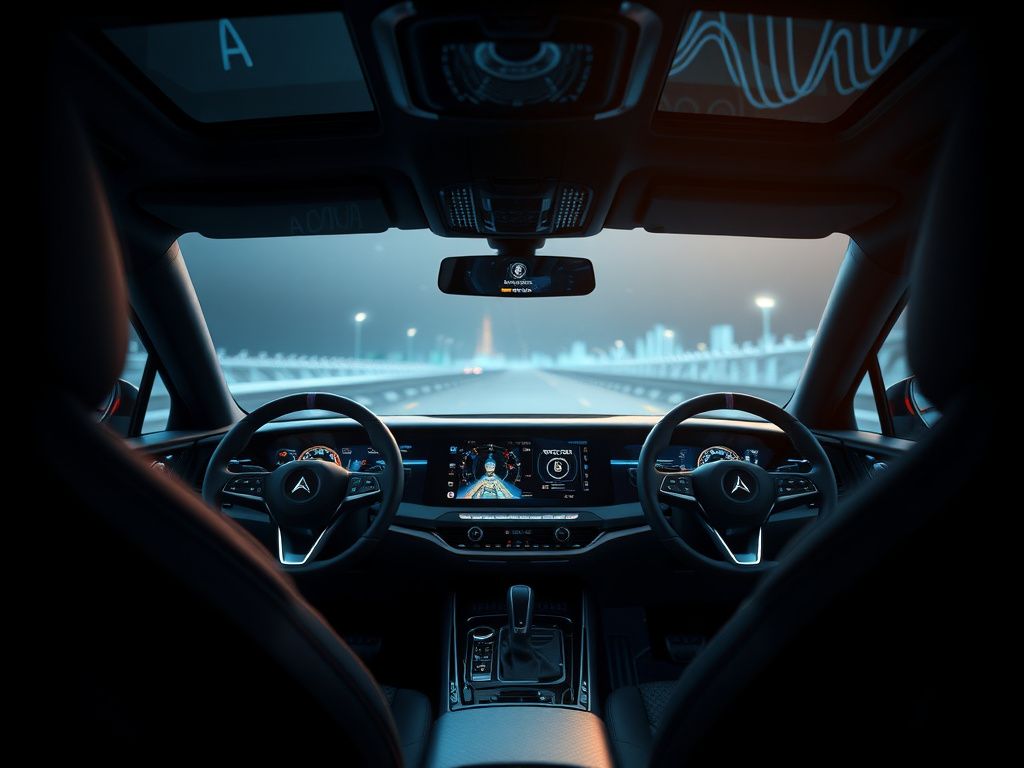
The modern car is no longer just a marvel of mechanical engineering; it is rapidly becoming a sophisticated, rolling data center. The era of the static, depreciating machine is ending. We are entering the age of the software-defined vehicle (SDV), a smart device that, like your phone, improves over time with continuous, over-the-air software updates.
For a century, a car's value and capability were locked in the moment it left the factory. Its horsepower, handling, and features were fixed. To get something new, you had to buy a new car. That paradigm is fundamentally broken. Today's vehicles are built on powerful computing platforms, designed from the ground up to evolve. Their performance, safety features, and user interface can be enhanced, or even completely reimagined, via a simple software download. This isn't a futuristic concept; it's happening right now, and it represents the single greatest architectural shift in the history of the automobile.
The Architectural Revolution: From Siloed ECUs to a Centralized Brain
To grasp the magnitude of this change, you must understand the legacy architecture of a traditional car. For decades, vehicles were built with a distributed network of dozens, sometimes over 100, individual Electronic Control Units (ECUs). Think of an ECU as a tiny, single-purpose computer. There was one for the engine, one for the anti-lock brakes, one for the power windows, another for the airbags, and so on.
This decentralized model was a nightmare from a software perspective.
- Inflexible: Each ECU was often sourced from a different supplier, with its own proprietary code. Getting them to work together was a complex integration challenge, a fragile web of dependencies.
- Unscalable: Adding a new feature, like a more advanced adaptive cruise control, might require adding a new physical ECU and painstakingly wiring it into the existing mess.
- Un-updateable: Updating the software on these siloed ECUs was nearly impossible without physically plugging a machine in at a dealership, a process so cumbersome it was reserved almost exclusively for critical safety recalls.
The software-defined vehicle flips this model on its head. It replaces the sprawling mess of ECUs with a centralized, high-performance computing (HPC) architecture. Imagine replacing 100 cheap calculators with one powerful server. This "automotive brain" runs a sophisticated operating system, managing everything from the powertrain to the infotainment system.
This consolidation is the key that unlocks everything. With a centralized architecture, developers can write complex, integrated applications that access data from all over the car—cameras, radar, LiDAR, GPS, gyroscopes—to enable features that were previously impossible. The entire vehicle becomes a cohesive platform, not just a collection of disparate parts.
Over-the-Air (OTA) Updates: The Mechanism for Perpetual Improvement
The most tangible benefit of this new architecture for consumers is the advent of over-the-air (OTA) updates. Just as your smartphone receives updates that patch security holes, improve battery life, and add brand-new applications, the SDV receives them via Wi-Fi or a cellular connection.
Tesla pioneered this concept, demonstrating its profound impact. Owners have woken up to find their cars had:
- Increased Performance: A software update that improved the 0-60 mph acceleration time.
- New Features: The addition of "Sentry Mode" (a 360-degree security camera system) or "Dog Mode" (which keeps the cabin cool for pets).
- Enhanced Safety: Improvements to the Autopilot advanced driver-assistance systems (ADAS), refining lane-keeping or emergency braking behavior based on data from millions of miles of driving.
Experts note that this capability fundamentally changes the ownership model. A car is no longer a depreciating asset in terms of its feature set. A three-year-old SDV could potentially have more capabilities than it did on the day it was purchased. This has a direct impact on long-term value and user satisfaction. Other automakers, from Ford and GM to Rivian and Polestar, are now racing to build robust OTA capabilities into their new electric vehicle platforms.
AI as the Co-Pilot, Mechanic, and Concierge
If the centralized architecture is the skeleton and OTA updates are the circulatory system, then Artificial Intelligence (AI) is the vehicle's brain and nervous system. AI is the engine driving the most revolutionary changes in the automotive experience.
The Path to Autonomous Driving
The most visible application of AI in automotive is the quest for autonomous driving. This is an immensely complex problem that relies on machine learning models processing a torrent of data from sensors in real-time to perceive the world and make driving decisions. The levels of autonomy, from Level 1 (basic assistance) to Level 5 (full automation, no steering wheel needed), are all milestones on a long road paved by AI development. Every mile driven by a connected car fleet can become training data, helping the central AI model learn and improve, with those improvements then deployed to the entire fleet via OTA updates.
Predictive Maintenance: Fixing Problems Before They Happen
Perhaps a more immediate and practical application of AI is in predictive maintenance. Using thousands of sensors and telematics data, an AI system can monitor the health of every vehicle component in real-time.