
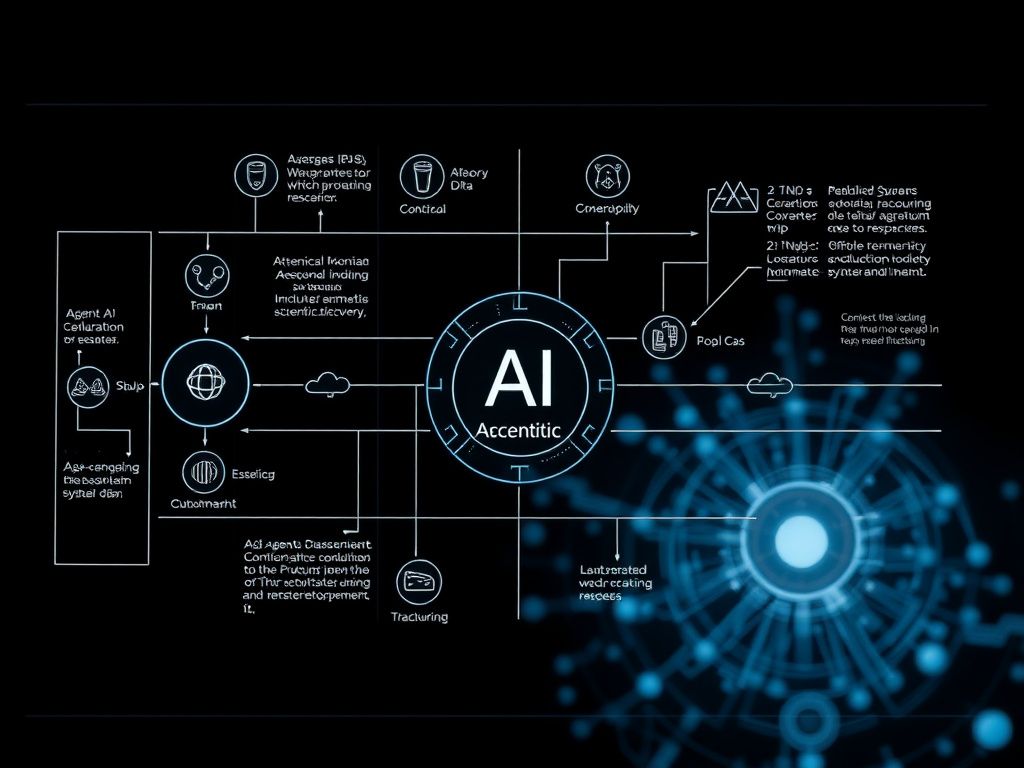
Agentic AI represents a paradigm shift from predictive models to autonomous systems. These agents are not just processing information; they are designed to perceive their environment, reason through complex problems, decompose large goals into actionable steps, and use digital or physical tools to execute tasks, all with minimal human intervention.
We are witnessing a fundamental evolution in artificial intelligence. For years, the dominant architecture has been the predictive model, epitomized by large language models (LLMs) like GPT-4. You give them a prompt, and they predict the most probable sequence of words to form a coherent response. It's an incredibly powerful form of pattern recognition and generation. But it's reactive. Agentic AI, however, is proactive. It’s the architectural leap from a brilliant oracle to a tireless digital intern, capable of pursuing a high-level goal on its own initiative.
Beyond Prediction: The Core Architectural Shift
To grasp the significance of agentic systems, it’s crucial to understand the architectural difference. A standard LLM is a powerful reasoning engine, but it's fundamentally stateless and passive. It's a brain in a jar. It can answer any question you ask, but it can't do anything on its own.
An AI agent wraps an architectural framework around that LLM brain, giving it arms, legs, and a mission. This framework provides three critical components that an LLM alone lacks:
- Memory: The ability to retain context and learn from past actions and observations, both within a single session (short-term) and across multiple sessions (long-term).
- Planning: The capacity for task decomposition. An agent can take a vague, high-level goal like "Find a more efficient catalyst for green hydrogen production" and break it down into a logical sequence of sub-tasks.
- Tool Use: This is perhaps the most transformative element. The agent is given access to a suite of tools—APIs, code interpreters, web browsers, databases, and even physical robotic controls. It can then autonomously decide which tool is appropriate for which sub-task.
This combination turns a passive text generator into a dynamic problem-solver. It stops being about predicting the next word and starts being about achieving the final outcome.
The Planning Loop: How Agentic Systems "Think"
At the heart of every AI agent is a control loop, often referred to as a ReAct (Reasoning and Acting) framework. This iterative process allows the system to operate autonomously, self-correct, and navigate complex, multi-step problems. While implementations vary, the core logic is a cycle of observation, thought, and action.
- Goal Definition: The process begins with a high-level objective provided by a human operator.
- Reasoning & Decomposition: The LLM core analyzes the goal. It thinks, "To achieve X, I first need to do A, then B, then C." It formulates a plan and identifies the first logical step.
- Tool Selection: The agent then asks, "What tool do I have that can accomplish step A?" It might select a search engine API to gather initial information, a Python interpreter to run a calculation, or a specialized scientific database API.
- Execution & Observation: The agent executes the chosen tool with the necessary parameters. It then observes the result—the output of the API call, the data from the calculation, or an error message.
- Self-Correction & Re-planning: This is the critical feedback mechanism. The agent analyzes the observation. "Did step A succeed? Did the result bring me closer to my goal? Or was it a dead end?" Based on this new information, it refines its plan. It might decide step B is no longer necessary and that it should now proceed to step D, or it might realize its initial approach was flawed and formulate a new plan entirely.
This loop repeats continuously until the final goal is achieved or the agent determines it's impossible with its current tools and knowledge. It's this ability to dynamically adapt its strategy that separates it from a simple script or a traditional predictive model.
Industry Example: The GNoME Project A landmark demonstration of this power comes from Google DeepMind. Their Graph Networks for Materials Exploration (GNoME) agent was tasked with discovering new, stable inorganic crystal structures—a foundational task in materials science. It autonomously cycled through known structures, proposed new hypothetical materials by substituting elements, and then used a graph neural network (a "tool") to predict their stability. The results were astounding. The agent discovered 2.2 million new crystal structures, including 380,000 that are predicted to be stable enough for experimental synthesis—a feat that experts estimate would have taken human researchers nearly 800 years.
AI in the Lab Coat: Real-World Scientific Breakthroughs
The GNoME project is not an isolated case. Agentic AI is being deployed to create fully autonomous "self-driving laboratories." In this setup, an AI agent doesn't just design an experiment on a computer; it controls the physical hardware in a lab.