
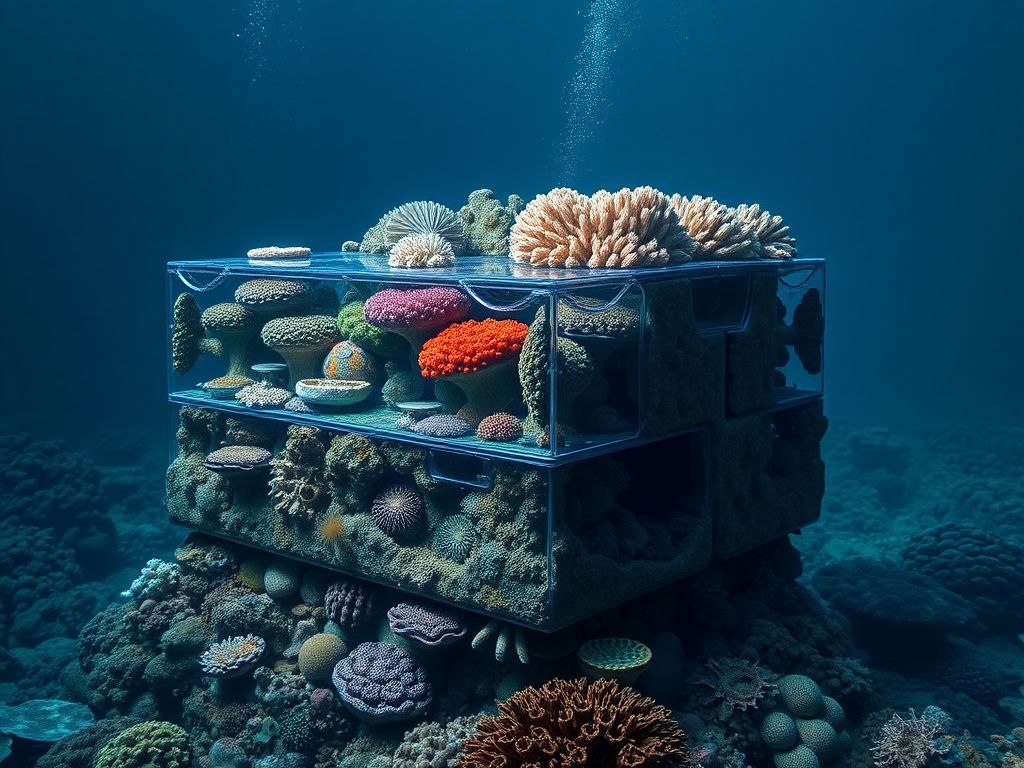
Quick Answer: Artificial reefs are engineered or repurposed structures placed on the seafloor to mimic natural reef habitats, accelerating marine biodiversity recovery. From decommissioned warships to 3D-printed coral scaffolds, these projects have demonstrated fish biomass increases of 400–1,000% within just five years — making them one of the most scalable ocean restoration tools available today.
The world's coral reefs cover less than 1% of the ocean floor, yet they support roughly 25% of all marine species. That ratio is staggering — and it's getting worse. Since 1950, the planet has lost over half its coral cover. Bleaching events, ocean acidification, destructive trawling, and coastal runoff have carved out what marine scientists call "ocean deserts": vast stretches of barren seafloor where complex life once thrived.
Here's the uncomfortable truth: waiting for natural reef regeneration is not a strategy. Natural coral recovery after a bleaching event takes 25 to 50 years — assuming the thermal stress doesn't return. It almost always does.
This is where artificial reefs enter the equation. Not as a romantic Band-Aid, but as a precision tool backed by decades of field data, materials science, and ecological engineering.
What Exactly Is an Artificial Reef?
An artificial reef is any submerged structure — intentionally placed or accidentally sunk — that functions as hard substrate for marine organisms to colonize. The concept sounds simple. The science underneath it is anything but.
Three categories dominate the field:
- Repurposed vessels and structures — decommissioned naval ships, oil platform jackets ("rigs-to-reefs"), subway cars, and aircraft hulls
- Engineered reef units — purpose-built concrete modules, steel pyramids, and geotextile domes designed with specific hydrodynamic profiles
- Bioengineered substrates — 3D-printed calcium carbonate scaffolds, mineral accretion (Biorock) systems, and coral fragment nurseries
Each category serves a different ecological function and deployment environment. A decommissioned warship dropped off the Florida coast creates a fundamentally different habitat than a terracotta reef module placed in the Mediterranean shallows.
The Track Record: Hard Numbers From Real Projects
Skeptics often frame artificial reefs as feel-good theater. The data disagrees sharply.
The USS Oriskany, Gulf of Mexico (2006): The largest artificial reef in the world by tonnage — a 900-foot aircraft carrier sunk 24 miles off Pensacola. Within three years, researchers documented over 200 fish species and an estimated fish biomass increase of 700% in the surrounding area. Today, it generates over $5 million annually in dive tourism revenue.
The New York Subway Car Program (2001–2010): Over 2,500 decommissioned subway cars were deployed along the Atlantic coast from South Carolina to Delaware. Independent surveys by the Atlantic Coast Artificial Reef Council found a tenfold increase in fish density at deployment sites within five years compared to adjacent bare-sand control areas.
Biorock Coral Reefs, Maldives: Using low-voltage electrical current to precipitate calcium carbonate minerals onto steel frames, Biorock structures have shown coral growth rates 2–6 times faster than natural coral and significantly higher survival rates during bleaching events — possibly because the mineral accretion process makes the coral more thermally resilient.
Why Artificial Reefs Work: The Ecology Behind the Success
The seafloor equivalent of "if you build it, they will come" actually holds up — with caveats.
Hard substrate is the limiting factor in most benthic (seafloor) environments. When you drop structure into an ocean desert, you create:
- Vertical complexity — fish species are stratified by depth preference; a multi-level structure hosts exponentially more diversity
- Current-driven food delivery — structures disrupt laminar flow, creating eddies that concentrate zooplankton and organic particles
- Refuge architecture — crevices and overhangs provide shelter for juvenile fish, dramatically improving recruitment rates for commercially important species like snapper, grouper, and sea bass
The ecological succession on a new artificial reef mirrors what happens on volcanic islands: pioneering species arrive first (tunicates, bryozoans, hydroids), then invertebrates (sea urchins, lobster, octopus), then the full fish assemblage follows the food chain upward.
The Design Revolution: From Sunken Junk to Precision Engineering
Early artificial reef programs in the 1960s and 70s had a bad habit: dumping anything hard into the ocean and calling it reef-building. Tires were a catastrophic example. Millions of tires were deployed off Fort Lauderdale in what became known as the Osborne Reef disaster. The tires shifted in hurricanes, abraded surrounding natural coral, and leached chemicals. The U.S. Army Corps of Engineers spent over $2 million removing them starting in 2007.