

The core thesis is simple, yet catastrophic: insurance has ceased to be a pool of collective risk and has become an actuarial death sentence for coastal real estate. By 2026, predictive climate modeling—much like the technological shift seen in DeFi vs. Private Credit: How Institutional Investors Are Balancing Yield in 2026—has evolved from a back-office tool into a primary driver of urban flight, mortgage defaults, and the aggressive "de-risking" of metropolitan zones. It is no longer about whether a storm will hit, but exactly how much capital will be incinerated when it does, leading firms to effectively write entire zip codes out of their underwriting maps.
The Death of Historical Actuarial Science
For over a century, the insurance industry operated on the principle of stationarity: the assumption that the past is a reliable guide to the future. If you wanted to price a house in Miami or a warehouse in Norfolk, you looked at the last fifty years of flood data, applied a standardized loss multiplier, and arrived at a premium.
That model is now functionally dead.
In its place stands the "Stochastic Catastrophe Model," a suite of software stacks—like those developed by RMS (Moody’s), AIR Worldwide (Verisk), and CoreLogic—that run millions of simulations per second. These models don't just look at historical storms; they simulate thousands of "synthetic years" of climate behavior. They factor in sea-level rise projections, changing ocean temperature gradients, and, crucially, the compounding impact of "secondary perils" like saltwater intrusion and infrastructure decay.

When a major carrier pulls out of a state like California or Florida, it isn't an emotional decision. It is the output of a black-box algorithm concluding that the "Probable Maximum Loss" (PML) in a given region exceeds the firm's capacity to remain solvent without charging premiums that no consumer can afford.
The Mechanics of "Pricing Out"
The transition from "high premium" to "uninsurable" follows a predictable, painful arc, mirroring the volatility seen in other sectors, such as when The Private Credit Bubble: Why Investors Should Be Concerned About 2026 highlights systemic risks. It starts with a refinement of risk granularity. Previously, an entire county might have shared a risk profile. Now, modeling firms have reached the "parcel-level" resolution. They know not just that a house is in a flood zone, but that the elevation of its first floor is 14 inches below the projected 2035 flood surge.
This technical shift creates an operational nightmare for the mortgage market, a sector increasingly reliant on Is AI Managing Your Money? The Risks and Reality of Autonomous Investing in 2026 to parse complex financial data. Because lenders require insurance as a condition for financing, the moment a carrier deems a neighborhood "non-renewable," the local real estate market freezes.
"The system is essentially cannibalizing itself. We see underwriters pushing for higher deductibles to the point where the policy is useless for the consumer, then using that to justify a 'non-renewal' notice. It’s an elegant way to exit a market while appearing to follow state regulations." — Anonymous Underwriter, industry-wide Discord server thread.
The "workaround" culture among homeowners is equally bleak, often as desperate as companies trying to cut costs, similar to Why More Startups Are Trading Full-Time CEOs for Fractional Leadership in the pursuit of fiscal survival. We see a rise in "surplus lines" insurers—essentially the high-risk, unregulated fringe of the industry—stepping in to fill the void. These policies often cost three to four times the standard market rate and provide significantly less coverage, leaving families one catastrophe away from total financial ruin.
Real Field Report: The "Blue-Line" Migration
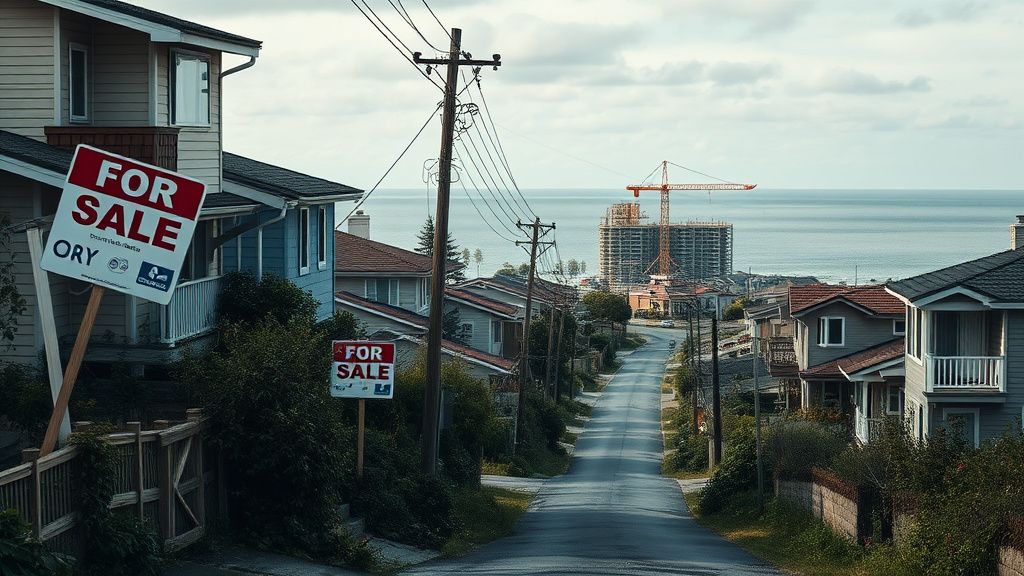
In late 2025, a mid-sized insurance provider serving the Gulf Coast issued a technical memo effectively abandoning the "inland migration" strategy, a move that parallels how Why Sovereign Wealth Funds Are Quietly Buying Up Global Water Rights signals a shift in resource control. Instead of raising rates, they simply implemented a "hard stop" on any new property where the elevation was less than three meters above sea level, regardless of existing sea walls or municipal drainage upgrades.
The result? A sudden, brutal recalibration of property values.
I spoke with a broker in Charleston who described the "Shadow Market." Sellers are hiding the fact that they've been dropped by their carrier. Buyers, often out-of-towners unaware of the specific micro-climatic risks, are being caught in a trap where they close on a home only to find that no major carrier will touch it. They are forced into the state-backed "Insurer of Last Resort" programs (like Florida's Citizens), which are themselves under massive fiscal stress and are currently being used as a political football.
The Conflict: Algorithm vs. Community
There is a deep, fundamental tension between the actuarial need for precision and the social reality of the housing crisis.
Critics of these models argue that they are "self-fulfilling prophecies." By hiking premiums or refusing coverage, insurers are effectively killing the tax base of coastal cities, preventing the very infrastructure investments (sea walls, pumping stations) that could have made those areas resilient. If the insurance industry pulls out, the city can’t borrow money to build protection, and the property tax revenue—needed to fund the protection—evaporates as people flee.