
Sovereign Wealth Funds (SWFs) are shifting from traditional liquid assets to "blue gold" as climate volatility renders traditional infrastructure investments risky. By acquiring water rights, aquifers, and desalination technology, these funds seek to hedge against systemic instability. However, this shift creates profound ethical friction, as commodifying a fundamental human necessity leads to local displacement, "water grabbing," and significant regulatory pushback in drought-prone regions like the American West and Sub-Saharan Africa.
The financial pivot toward water is not a speculative bubble—it is a brutal, cold-eyed calculation of survival. When you look at the portfolios of GIC, Norges Bank, or the Abu Dhabi Investment Authority, you see a departure from the "Gold Standard" logic of the 20th century. Gold sits in a vault; water, however, is a kinetic asset. It is the only commodity that is simultaneously a life-sustaining biological requirement, a critical industrial input for semiconductor manufacturing, and a non-substitutable fuel for the agricultural sector.
As of 2026, we are witnessing the institutionalization of water as a tradable financial instrument. This isn't just about owning the water in a bottle; it’s about owning the adjudication rights that permit usage in an era of acute scarcity.
The Mechanics of the "Blue Gold" Trade
For an SWF, the logic is deceptively simple: supply is fixed, and demand is accelerating due to population growth and industrial expansion. Unlike oil, which can be replaced by renewables, there is no technological substitute for water.
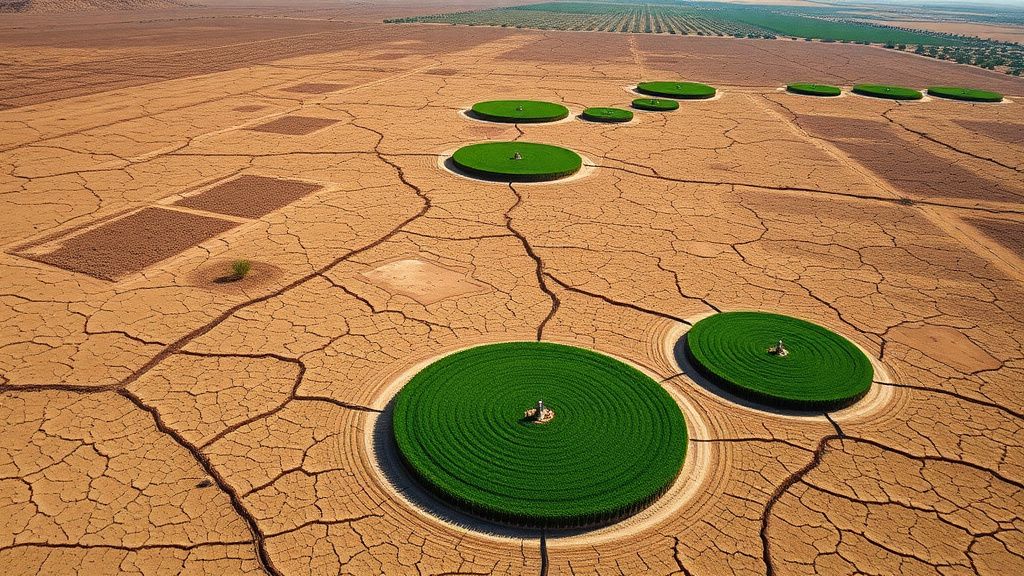
When a sovereign wealth fund invests in an irrigation district in Australia or a private utility company in Chile, they are usually buying a "senior water right." These rights are legal permissions to divert a specific volume of water from a natural source. In many jurisdictions, these rights are treated as property—transferable, leaseable, and, crucially, collateralizable.
The Operational Reality: "Stranded Assets" and "Paper Water"
The most significant tension in this market is the distinction between "wet water" (actual H2O) and "paper water" (the legal right to water that may no longer exist).
In the Colorado River Basin, many entities hold senior rights to water quantities that haven't flowed through the river system in years. When an SWF acquires these rights, they are essentially betting on the judicial and political outcome of water priority disputes. If the state forces a reduction in consumption, senior right holders are often the last to be cut. This provides a "legal moat" that protects the investment from the physical reality of drought.
Yet, the maintenance of these systems is a bureaucratic nightmare. On platforms like Hacker News or specialized water-rights forums, the frustration is palpable. Developers and agricultural engineers often complain that the digitalization of these rights—meant to make trading seamless—has instead created an opaque layer of "legal obfuscation." You are buying a spreadsheet cell, but that cell is tied to a crumbling canal system that requires millions in annual maintenance.
Real Field Report: The "Water Grab" in the Murray-Darling Basin
In the Murray-Darling Basin (Australia), the entry of large-scale institutional investors has sparked a "community vs. capital" war. Field observations from 2024–2025 indicate that when institutional investors purchase large tranches of water, they often strip the water from the land, leaving the soil "dry-landed."
- The Workflow: An SWF purchases a farm, executes a "severance" of the water license from the title, and sells the dry land back to the market at a loss, while retaining the rights to the water.
- The Outcome: Local farming communities collapse because they can no longer afford to lease the water that once belonged to their region. This is the definition of "asset stripping" in an agricultural context.
The Counter-Criticism: Why This Model is Fragile
Critics, particularly those within NGOs and agrarian advocacy groups, argue that water is a "common pool resource." When you privatize the mechanism of allocation, you break the feedback loops that keep ecosystems alive.
There is an inherent conflict between the quarterly reporting cycle of a sovereign wealth fund and the multi-decade hydrological cycle of an aquifer. SWFs are built to maximize IRR (Internal Rate of Return). They do not have a mandate to manage the "health" of a river basin.
- Engineering Compromise: To maximize water yields, firms often implement ultra-efficient, proprietary drip irrigation systems. While these save water, they also prevent "deep percolation"—the process where irrigation runoff recharges the groundwater. The system is "efficient" for the investor, but "lethal" for the long-term regional water table.
- Data Integrity: There is a distinct lack of transparency regarding the "actual" volume of water extracted versus reported. Monitoring wells are frequently manipulated or poorly maintained, leading to a "shadow water" economy.
The Role of Technology: Calculating the Scarcity Premium
Calculating the value of these rights requires more than just financial modeling; it requires hydro-geological simulation. Institutional investors are currently spending millions on satellite-based spectral imaging to track real-time evapotranspiration. If you are an engineer or investor trying to track resource efficiency, you might find our Unit Conversion Tool useful for normalizing metrics across international jurisdictions, as water rights are measured in everything from acre-feet to megaliters.

Why Investors are Abandoning "Safe" Infrastructure
For a long time, the "safe" bet was sovereign bonds or core real estate. But in 2026, the correlation between climate change and sovereign risk is becoming absolute. Sovereign wealth funds are pivoting because their traditional holdings are becoming "stranded assets."