
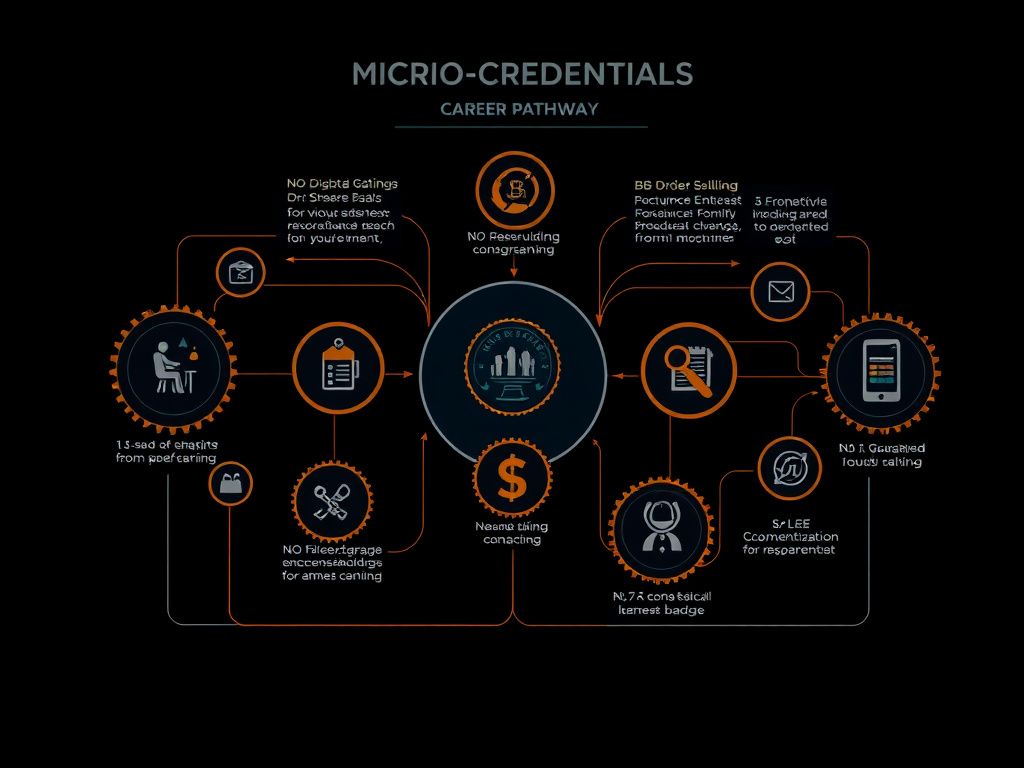
Micro-credentials are dynamic, focused certifications that reliably confirm your mastery of a specific skill or area of expertise. They provide a flexible and often more affordable pathway compared to traditional degrees, empowering professionals to quickly gain new skills or pivot into highly sought-after roles in booming sectors like data science, cybersecurity, and digital marketing. In essence, they're becoming indispensable tools for anyone committed to continuous learning throughout their career.
The very foundations of the professional landscape are undeniably shifting. The long-revered four-year university degree, once the undisputed mark of entry into a successful career, is now facing significant challenges. It's not that degrees have become irrelevant, but their sole dominion over validating competence is steadily eroding under the relentless pace of technological advancement. The useful lifespan of a technical skill has shrunk dramatically; what you might have learned in your second year of university could easily be outdated knowledge by the time you graduate. In this environment of constant evolution, your diploma isn't the only, or even primary, currency anymore. Instead, it's the specific, verifiable skill you can actively apply today. This is the strategic context where micro-credentials have emerged, not as a passing trend, but as a fundamental and enduring pillar of modern career development.
Deconstructing the Micro-Credential: The Atomic Unit of Skill
Fundamentally, a micro-credential serves as a focused, thoroughly assessed, and officially validated testament to a particular competency. You can think of it as the foundational building block of professional capability. While a Bachelor's degree in Computer Science offers a broad, essential grounding in knowledge, a micro-credential like "Certified AWS Cloud Practitioner" delivers a precise, verifiable declaration that you possess a very specific, highly demanded skill set.
Crucially, this goes far beyond simply completing an online course. Authentic micro-credentials manifest in several distinct forms:
- Professional Certificates: These often involve a thoughtfully curated sequence of courses from a recognized industry leader (for example, Google's Data Analytics Professional Certificate), culminating in a practical project and a verifiable certificate upon completion.
- Digital Badges: Far more than just a simple image file, these badges, issued through platforms like Credly, contain embedded data that details the organization that issued it, the exact criteria you fulfilled, and tangible evidence of your work. They offer instant verification with just one click.
- Industry-Recognized Certifications: These are the established powerhouses, such as the PMP for project management or the CISSP for cybersecurity. Typically, earning these requires passing rigorous examinations and demonstrating substantial practical experience.
The absolute key distinguishing factors are verification and genuine industry recognition. A generic "Certificate of Completion" from an unknown entity carries very little weight. Conversely, a digital badge from IBM for mastering AI fundamentals, which can be instantly authenticated on your LinkedIn profile, sends a powerful and credible signal to potential recruiters.
The Paradigm Shift: Why Businesses Are Embracing Skills-Based Hiring
To truly grasp why micro-credentials are gaining so much traction, you need to step into the shoes of a hiring manager. For decades, a university degree was a fairly reliable, if imperfect, indicator of a candidate's capacity to learn, commit, and perform. But in today's increasingly specialized economy, that traditional indicator is simply no longer sufficient.
As a hiring manager, I don't necessarily need a candidate who spent four years delving into the entire history of computing; what I urgently need is a developer who can confidently build a secure, scalable API using GraphQL right now.
This immediate, operational need is directly fueling the widespread adoption of skills-based hiring. According to recent insights from prominent leaders at companies like IBM and Google, there's a growing preference for demonstrable skills over traditional academic qualifications for a wide range of positions. Why is this shift happening?
- Speed to Value: A candidate who holds a certification in Salesforce Administration can often become productive almost immediately, whereas a general business graduate typically requires significant on-the-job training before they can fully contribute.
- Reduced Hiring Risk: A verifiable micro-credential provides concrete, objective evidence that a candidate possesses a specific skill. This makes the hiring decision far less of a gamble than relying solely on interview performance or a broad, high-level degree.
- Targeted Talent Pools: This approach allows companies to effectively source talent from diverse, non-traditional educational backgrounds, dramatically expanding the available talent pool and significantly boosting workforce diversity.
The economic rationale is compelling: micro-credentials deliver a remarkably precise signal of a candidate's proven capability to solve a distinct business challenge.
Building Your "Skills Stack": A Practical Roadmap for the 2030s Job Market
Imagine your career development much like a software engineer approaches product design. You need to meticulously construct a "stack" of skills that are not only current and highly in-demand but also work together harmoniously. A random assortment of credentials just creates noise; however, a strategic, stackable credential pathway crafts a compelling and cohesive narrative about your expertise.
Step 1: Identify High-Growth Domains and Target Skills
Before you commit to any learning program, conduct thorough market research. Don't pursue a skill merely because it seems interesting; pursue it because it demonstrably holds significant market value. The World Economic Forum's Future of Jobs Report is an invaluable resource for this. Currently, the most undeniably high-growth areas include:
- Data Science & Analytics: SQL, Python, Tableau, Power BI
- AI & Machine Learning: TensorFlow, PyTorch, Natural Language Processing
- Cybersecurity: Network Security, Ethical Hacking, Cloud Security (e.g., CompTIA Security+)
- Cloud Computing: AWS, Azure, Google Cloud Platform certifications
- UX/UI Design: Figma, Adobe XD, User Research Methodologies
Step 2: Source Industry-Recognized Credentials
Once you've pinpointed a specific skill, seek out the credential that truly commands respect from hiring managers. This step is absolutely critical. A generic "Python for Beginners" certificate from an unknown website holds virtually no value. In contrast, a "Python for Everybody" specialization from the University of Michigan, offered on Coursera, is a widely recognized and valuable asset.