
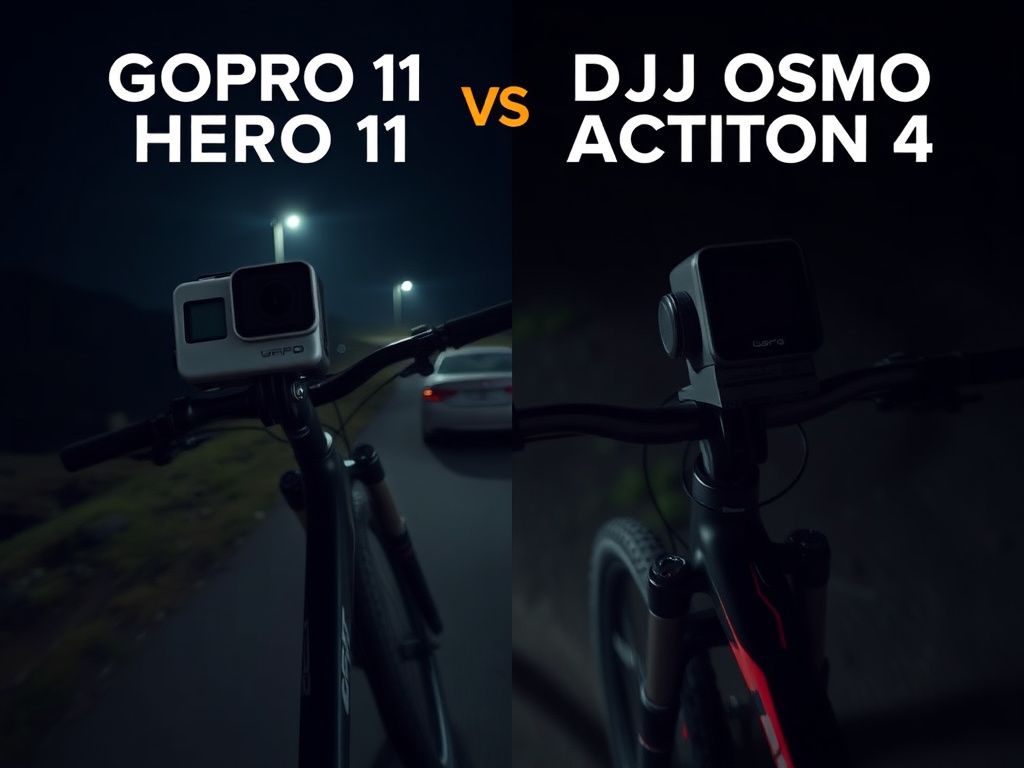
For low-light mountain biking, the DJI Osmo Action 4 is the definitive winner. Its significantly larger 1/1.3-inch sensor gathers more light, producing cleaner, less noisy footage with better dynamic range in challenging dusk or forest canopy conditions compared to the GoPro Hero 11's smaller 1/1.9-inch sensor.
The trail fades from hero dirt to a matrix of shadows and roots as you drop into the tree line. Your headlamp cuts a sharp, lonely cone of light, but the world outside it is a wash of digital noise. This is the ultimate crucible for an action camera, a scenario where marketing hype evaporates and the cold, hard physics of sensor engineering takes over. For years, the action camera space has been a battle of iterative software updates, but with the DJI Osmo Action 4, we've seen a fundamental hardware divergence from the path GoPro has taken. This isn't just a comparison; it's an architectural review of two different philosophies for capturing extreme motion in compromised lighting.
As a tech architect, I look at systems, not just specs. We're not just comparing megapixels; we're analyzing the entire image capture and processing pipeline, from the photons hitting the sensor to the final encoded video file. Let's dissect these two systems to determine the superior tool for low-light trail riding.
Core Hardware Architecture: A Tale of Two Sensors
The single most critical component for low-light performance is sensor size. It's the immutable law of optics. A larger sensor, with larger individual photosites (pixels), can capture more photons in a given amount of time. This translates directly to a higher signal-to-noise ratio, resulting in cleaner images with less digital grain.
DJI Osmo Action 4: The Light-Gathering Brute DJI made a deliberate and significant engineering choice with the Action 4: they packed in a massive (for this form factor) 1/1.3-inch CMOS sensor. To put this in perspective, this sensor size is encroaching on the territory of high-end smartphones and is substantially larger than what we've traditionally seen in action cameras.
- What this means on the trail: As dusk settles and the forest canopy thickens, the Action 4's sensor is fundamentally gathering more light data. Shadows retain detail instead of crushing to black. The subtle texture of the dirt and leaves outside your main light beam remains visible. The ISO performance is dramatically better, meaning the camera can increase its light sensitivity without immediately turning the image into a blocky, noisy mess.
GoPro Hero 11 Black: The Processing Powerhouse The Hero 11 utilizes a very capable, but physically smaller, 1/1.9-inch sensor. GoPro's strategy has long been to pair a good sensor with their industry-leading GP2 processor and image science. They rely heavily on computational photography and advanced algorithms to clean up noise, manage dynamic range, and stabilize the image.
- What this means on the trail: In good light, the Hero 11 is brilliant. Its 8:7 aspect ratio is incredibly versatile. But in low light, its software is fighting a battle against physics. The smaller sensor provides a noisier, less information-rich signal to the GP2 chip. While the processing is excellent, it's essentially performing noise reduction and enhancement on a lower-quality source signal. Think of it as upscaling a low-resolution image; you can make it look better, but you can't create detail that was never captured in the first place.
Analogy from the Field: Imagine trying to catch rain. The Action 4's sensor is a wide-mouthed bucket. The Hero 11's is a coffee mug. In a downpour (bright daylight), both will fill up just fine. But in a light drizzle (low light), the bucket will collect significantly more water over the same period. That "water" is light, the most precious resource for a camera sensor.
The Software Battlefield: Stabilization & Image Processing
Raw hardware is only half the story. The stabilization algorithms and color science define the final look and feel of your footage. Both companies are at the top of their game, but they approach the problem differently.
HyperSmooth 5.0 vs. RockSteady 3.0+
Electronic Image Stabilization (EIS) works by cropping into the sensor's image and using the extra room to buffer against movement, effectively "floating" the frame.
- GoPro's HyperSmooth 5.0 is legendary for a reason. It's incredibly smooth, almost gimbal-like, and features the phenomenal 360° Horizon Lock, which can keep the horizon level even if you rotate the camera completely. For a mountain biker, this means silky smooth POV footage, even through the chunkiest rock gardens.
- DJI's RockSteady 3.0+ is a formidable competitor and, in most scenarios, is indistinguishable from HyperSmooth in its smoothing capability. It also features its own version of horizon leveling, HorizonSteady.
The critical difference isn't the algorithm's quality but the quality of the data it's fed. In low light, the Hero 11's EIS has to work with a potentially noisier image, which can sometimes lead to slight "wobbles" or artifacts as the software struggles to differentiate between trail chatter and digital noise. Because the Action 4 starts with a cleaner base image, its stabilization often appears more natural and less processed in dim conditions.
Color Science and High Bitrate Encoding
Both cameras offer 10-bit color, which is a massive advantage for low-light filming. 8-bit video can easily show "banding" in subtle gradients, like a darkening sky. 10-bit provides over a billion color shades, ensuring smooth, clean transitions—essential for grading your footage in post-production.
- GoPro's color is famously vibrant and punchy right out of the camera. It's a "look" that many love, but it can sometimes feel overly saturated, especially with the greens and browns of a forest.
- DJI's standard profile is more neutral. More importantly, its D-Cinelike flat profile is fantastic. It preserves maximum dynamic range, allowing you to pull details out of the shadows and recover highlights from your headlamp beam during editing.
For any serious work, shooting in a flat, 10-bit profile with a high video bitrate is non-negotiable. Both cameras offer this, but the cleaner source data from the Action 4's larger sensor gives you a better starting point for your color grade.