
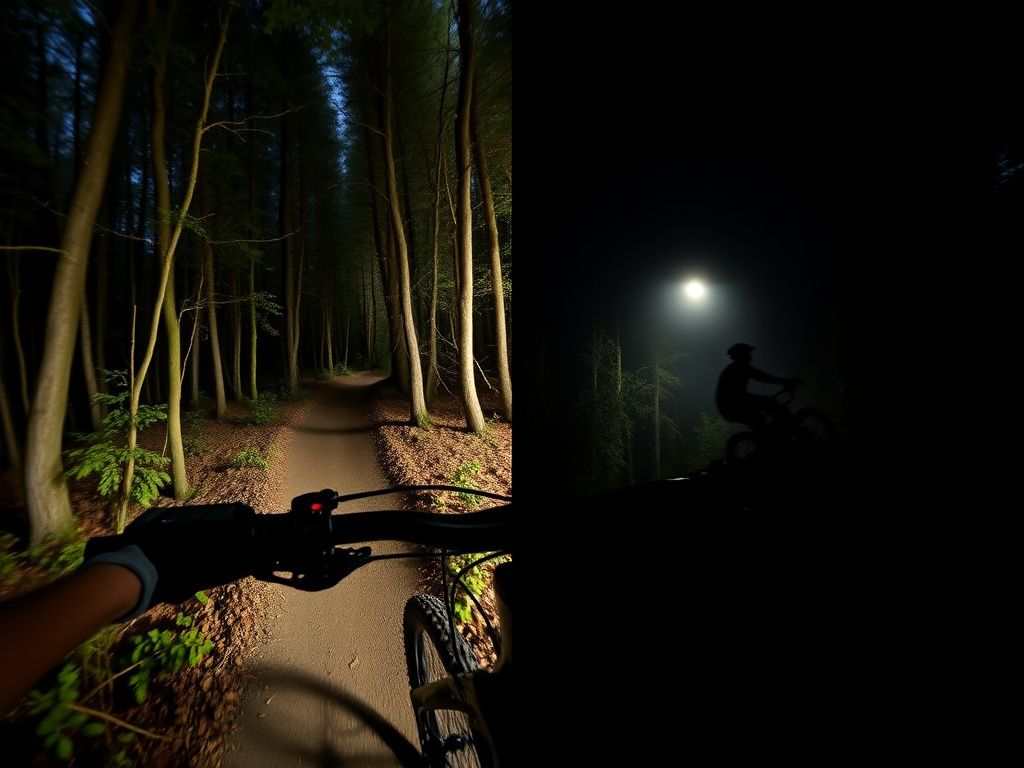
For mountain biking in low light, the DJI Osmo Action 4 decisively outperforms the GoPro Hero 11. Its significantly larger 1/1.3-inch sensor captures more light, resulting in cleaner, brighter footage with less digital noise. This physical advantage allows its stabilization to perform more reliably in challenging, shadowy forest trails.
The sun dips below the ridgeline, painting the sky in fiery oranges and deep purples. For a mountain biker, this isn't the end of the day; it's the "golden hour," a magical time to ride. But for an action camera, it's a crucible. This is where the marketing specs fade and the raw physics of light capture take over. Filming fast, jarring action as photons become scarce is one of the most demanding tasks you can ask of these tiny devices. The debate between the GoPro Hero 11 Black and the DJI Osmo Action 4 is fierce, but when the trail is cloaked in twilight, the engineering differences become starkly apparent.
As a senior architect in the tech space, I don't just look at features; I analyze the foundational hardware and the processing pipeline built upon it. Let's dissect these two action camera titans not by their spec sheets, but by their performance under the demanding conditions of a low-light mountain bike ride.
The Core of the Matter: Sensor Size and Its Dominion
Before we even discuss stabilization algorithms or color profiles, we must address the fundamental component that dictates low-light capability: the image sensor. This is non-negotiable physics.
Think of an image sensor as a grid of buckets (pixels) trying to catch rain (photons of light). The larger each bucket, the more rain it can collect in a given amount of time.
- GoPro Hero 11 Black: Employs a 1/1.9-inch sensor.
- DJI Osmo Action 4: Features a much larger 1/1.3-inch sensor.
While these numbers seem small, the difference in surface area is substantial. The Osmo Action 4's sensor has approximately 65% more area than the Hero 11's. In broad daylight, this difference is less noticeable. Both cameras are flooded with light, and their "buckets" are overflowing. But as the sun sets, the Action 4's larger sensor becomes a colossal advantage. It's gathering significantly more light data per frame, which translates directly into a cleaner, brighter image with less reliance on digital gain (ISO), the primary source of ugly, grainy digital noise.
For a mountain biker plunging into a thickly wooded trail at dusk, this isn't a minor spec—it's the whole game. The Action 4 can maintain a lower ISO and a faster shutter speed, which is critical for reducing motion blur and preserving detail on roots and rocks whizzing by.
Head-to-Head Analysis: Real-World Dusk Ride Scenarios
Let's move from the lab to the trail and examine how these hardware differences manifest in real-world mountain biking footage. Industry observations from countless side-by-side tests confirm these behaviors.
Forest Canopy: Dappled Light and High Dynamic Range
Imagine a fast, flowing trail that ducks in and out of a dense forest canopy. The camera is subjected to rapid, extreme shifts in brightness—from glaring sun to deep shadow in a fraction of a second.
The Hero 11, with its smaller sensor, struggles more with this dynamic range. To see into the shadows, its processor cranks the ISO, often introducing visible noise in the darker parts of the frame. Conversely, the bright spots can sometimes be overexposed or "blown out" as it tries to compensate.
The Osmo Action 4 handles these transitions with more grace. Its superior light-gathering ability means it doesn't have to work as hard. The shadows retain more detail without becoming a swamp of digital grain, and the highlights are preserved more naturally. The resulting footage feels more balanced and true to what the rider's eye is seeing.
The "Golden Hour" Fade: Color Science and Noise
As daylight truly begins to fade, color information becomes harder to capture accurately. This is where we see the difference in image processing and color science.
GoPro has traditionally been known for its vibrant, saturated, and often "punchy" colors straight out of the camera. The Hero 11 continues this trend. In good light, it's beautiful. In low light, this aggressive processing can sometimes exacerbate noise, making the grain more colorful and distracting.