
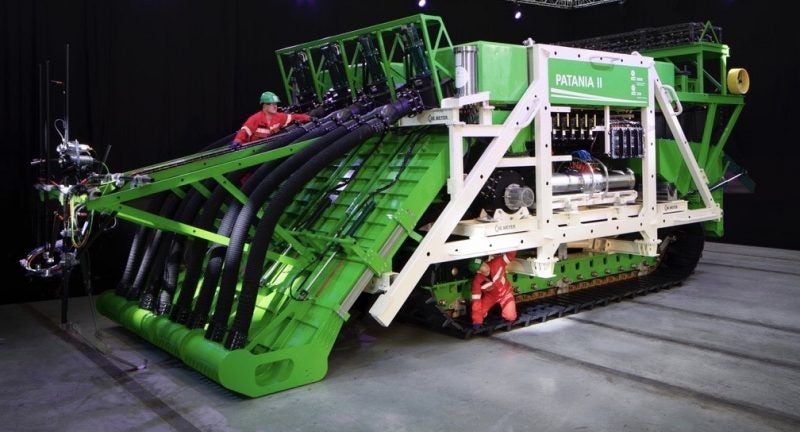
The ocean floor holds a staggering fortune. Estimated at $150 trillion in untapped mineral wealth, the deep seabed contains polymetallic nodules, cobalt-rich ferromanganese crusts, and seafloor massive sulfides — all critical inputs for electric vehicle batteries, wind turbines, and defense electronics. As demand for rare earth elements and critical minerals surges toward a projected $400 billion annual market by 2030, the rush to extract them is colliding head-on with a patchwork of international maritime law that was never designed to govern a 21st-century industrial frontier.
In 2026, that collision is no longer theoretical.
The Regulatory Vacuum at the Center of the Ocean
At the heart of this geopolitical flashpoint sits the International Seabed Authority (ISA), a Kingston, Jamaica-based UN body established under the 1982 United Nations Convention on the Law of the Sea (UNCLOS). The ISA governs mining activity in the "Area" — international seabed beyond any nation's exclusive economic zone (EEZ). To date, it has issued 31 exploration licenses covering approximately 1.4 million square kilometers of the Pacific and Indian Oceans.
But the ISA has yet to finalize a comprehensive exploitation code. Despite a 2021 trigger clause invoked by the island nation of Nauru — which gave the ISA two years to draft regulations — a binding framework remains elusive. By early 2026, three more states have filed similar trigger applications, citing commercial pressure from state-backed mining consortia in China, South Korea, and Norway.
"The ISA was built for a world that believed deep-sea mining was decades away," said Dr. Priya Menon, a marine law specialist at the Leiden Centre for International Law, in an interview with Gunesed Global. "We're now operating in that world, and the legal infrastructure is running five years behind the technology."
The Geopolitical Stakes: Who Controls the Seabed?
The numbers make clear why nations are not waiting for legal clarity.
- Polymetallic nodules in the Clarion-Clipperton Zone (CCZ), a 4.5-million-square-kilometer area between Hawaii and Mexico, contain an estimated 21 billion tons of manganese, along with nickel, copper, and cobalt.
- China's state-owned COMRA (China Ocean Mineral Resources Research and Development Association) holds two active CCZ exploration licenses and has deployed deep-sea robotics capable of operating at 6,000-meter depths.
- The Metals Company (TMC), a Canadian-listed firm backed by Nauru's state enterprise, reported in Q1 2026 that pilot nodule collection from its NORI-D block yielded 3.7 metric tons per hour — a figure that, if scaled commercially, could rival land-based nickel output from Indonesia.
Meanwhile, the United States — which has never ratified UNCLOS — is pursuing a separate legislative track. The U.S. Deep Seabed Hard Mineral Resources Act of 1980 provides a domestic framework, and the Biden-era Critical Minerals Executive Order has been extended under the current administration, granting provisional seabed prospecting rights to three U.S.-based firms in areas overlapping with ISA-licensed zones.
This creates a direct legal conflict: the ISA's authority is explicitly premised on UNCLOS, yet the U.S. framework operates outside it. Legal analysts at the International Tribunal for the Law of the Sea (ITLOS) flagged in a February 2026 advisory opinion that such overlapping claims could "undermine the common heritage of mankind principle" — the legal bedrock of UNCLOS's seabed provisions.
Environmental Science Meets Legal Ambiguity
The environmental dimension sharpens the urgency.
A peer-reviewed study published in Nature Geoscience in late 2025 confirmed that sediment plumes generated by collector vehicles can travel hundreds of kilometers, smothering benthic ecosystems that take millions of years to develop. The CCZ alone is estimated to harbor over 8,000 species, most undescribed by science.
The ISA's own Environmental Management Plan (EMP) currently lacks binding enforcement mechanisms. Of 23 environmental impact assessments submitted by license holders since 2018, only seven have been independently audited, according to a 2025 report by the Deep-Sea Conservation Coalition.