
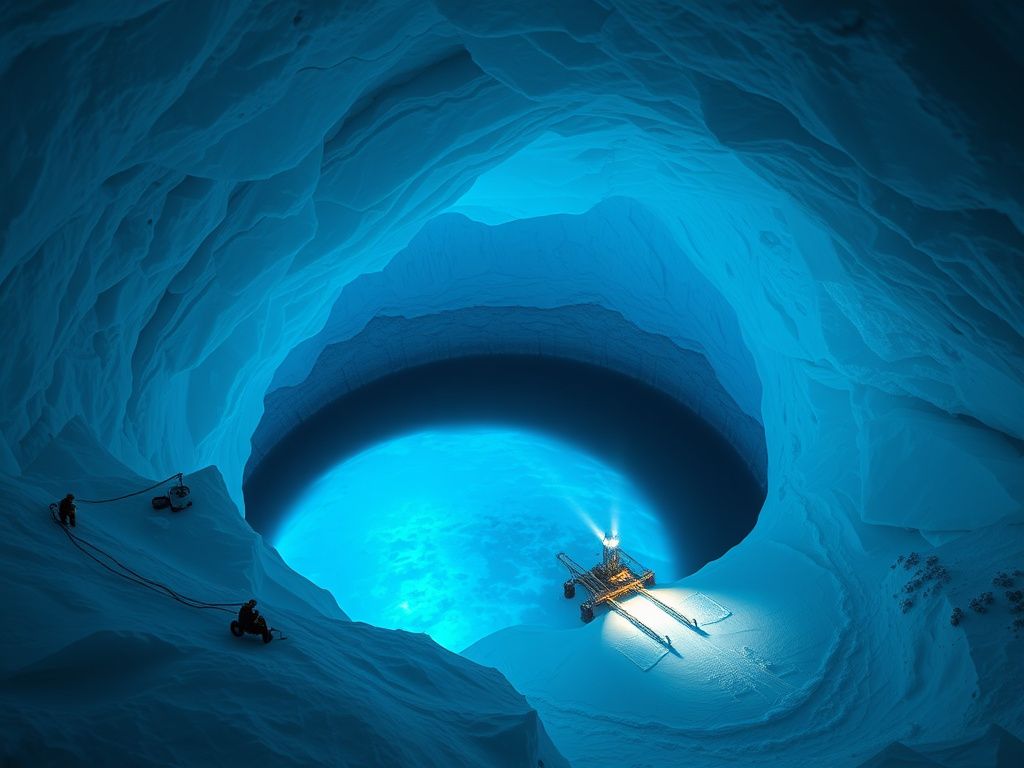
Antarctica’s Hidden Subglacial Lakes: Microbial Life, Contamination Risks, and the Race to Study Them
In 1996, radar data confirmed something researchers had suspected for years but still struggled to fully picture: beneath Antarctica’s ice sheet, there were large bodies of liquid water buried under kilometers of ice.
Not frozen reservoirs.
Actual lakes.
One of them — Lake Vostok — turned out to be enormous. Roughly 250 kilometers long, nearly 50 kilometers wide in places, and buried beneath close to 4 kilometers of East Antarctic ice. Later measurements suggested parts of the lake may exceed depths of 1,000 meters. A 1998 paper published in Nature described it as one of the largest known subglacial lakes on Earth.
Source: https://www.nature.com/articles/32381
At first, the discovery sounded mostly geological. Interesting, certainly. But remote.
Then microbiologists started asking harder questions.
If liquid water had remained stable beneath Antarctica for hundreds of thousands of years — maybe longer — could microbial ecosystems still survive there?
Over the next two decades, the answer shifted from speculative to increasingly likely.
Researchers began finding microbial DNA, metabolically active cells, and chemical signatures consistent with microbial ecosystems operating beneath the ice. Not large organisms. Not hidden Antarctic jungles. Mostly bacteria and microorganisms adapted to cold, dark, nutrient-limited environments.
And almost immediately, another issue appeared beside the scientific excitement: contamination.
Because once humans drill into a sealed ecosystem, isolation ends.
Antarctica’s Ice Sheet Is Far More Dynamic Than It Looks
For much of the twentieth century, Antarctica was treated as a mostly frozen, geologically static continent.
That turned out to be incomplete.
Radar imaging, seismic mapping, airborne surveys, and satellite observations have revealed an active hydrological system beneath the Antarctic ice sheet. According to the Scientific Committee on Antarctic Research (SCAR), scientists have identified more than 400 subglacial lakes beneath Antarctica so far.
Source: https://www.scar.org/science/subglacial-lakes/
Some of those lakes appear isolated. Others may connect intermittently through buried drainage systems beneath the ice.
Pressure and geothermal heat are what make these lakes possible.
At depths approaching several kilometers, pressure lowers the freezing point of water enough for liquid reservoirs to persist beneath extremely cold surface ice. Geothermal heat leaking upward from Earth’s crust contributes additional warming beneath the ice sheet.
In some regions, water even moves through buried channels beneath the continent. Satellite observations published by NASA and ESA researchers in the late 2000s showed that entire subglacial lake systems can fill and drain over periods of months to years, subtly changing ice elevation above them by several meters.
That mattered because Antarctica suddenly looked less static than scientists once assumed.
And biologically, the more important factor may be isolation.
A 1998 Nature paper estimated that Lake Vostok had likely remained sealed beneath the ice for at least 420,000 years. Some later models suggested portions of the system could be significantly older depending on water exchange rates and ice dynamics.
Source: https://www.nature.com/articles/32381
Those timescales are long enough to make evolutionary biologists uncomfortable using words like “ordinary.”
Lake Vostok Became the Center of the Scientific Debate
Lake Vostok quickly became the focal point of Antarctic microbiology.
Partly because of its size. Partly because it forced researchers into a difficult technical question:
How do you access an isolated ecosystem buried beneath nearly 4 kilometers of ice without contaminating it?
The early Russian drilling campaigns near Vostok Station were designed primarily for deep ice-core recovery and paleoclimate reconstruction rather than microbial exploration. To prevent boreholes from freezing shut, teams used kerosene and freon-based drilling fluids.
Operationally, the system worked.
Scientifically, it became controversial later.
The problem was not simply whether contamination occurred. The larger issue was interpretive uncertainty. Once industrial drilling fluids enter the system, proving that biological material truly originated inside the lake becomes much harder.
In 2013, a PLoS ONE paper analyzing accretion ice associated with Lake Vostok reported more than 3,500 detected DNA sequences. Some resembled psychrophilic bacteria associated with cold aquatic systems. Others appeared related to extremophile metabolic pathways.
Source: https://journals.plos.org/plosone/article?id=10.1371/journal.pone.0067221
Critics immediately questioned how many sequences genuinely originated from the lake itself rather than from contamination introduced through drilling fluids, equipment handling, or laboratory processing.
That debate still appears regularly in Antarctic microbiology discussions today.
Martin Siegert, one of the leading researchers involved in Antarctic subglacial lake exploration, summarized the tension bluntly during a SCAR discussion years later:
“We are trying to study a pristine environment without changing it.”
That sounds straightforward until you start looking at the mechanics of deep drilling.
A borehole penetrating several kilometers of Antarctic ice is not a clean surgical incision. It involves pressure systems, drilling water, thermal exchange, equipment transport, microbial risk, sequencing uncertainty, and long-term environmental questions scientists still do not fully understand.
And honestly, this is where the field becomes less cinematic and more technically frustrating. The challenge is no longer simply drilling into the lake.
It is demonstrating what was already there before the drill arrived.
The WISSARD Project Tried to Approach the Problem Differently
By the early 2010s, contamination concerns had become serious enough that new Antarctic drilling programs redesigned protocols almost entirely around sterility.
The WISSARD project — Whillans Ice Stream Subglacial Access Research Drilling — became one of the best-known examples.
Instead of chemical drilling fluids, researchers used a clean hot-water drilling system specifically designed to minimize biological contamination risk. According to National Science Foundation project documentation, drilling water underwent multiple filtration stages, ultraviolet sterilization, and pasteurization before entering the borehole.
Source: https://www.nsf.gov/
The technical details were intense.
Water was filtered to 0.2 microns. UV systems targeted microbial contamination continuously. Instruments were chemically sterilized before deployment beneath the ice.
Even then, researchers remained careful about interpretation.
That caution turned out to be justified because the biological findings were significant.
A 2014 paper published in Nature reported metabolically active microbial communities beneath the Whillans Ice Stream, roughly 800 meters below the West Antarctic Ice Sheet. Researchers estimated microbial concentrations around 130,000 cells per milliliter in some water samples.
Source: https://www.nature.com/articles/nature13667
The study identified microbes linked to:
- sulfur cycling,
- ammonium oxidation,
- methane metabolism,
- iron reduction pathways.
That mattered because it showed these systems were not dormant relics frozen beneath the ice.
They were active microbial ecosystems functioning in complete darkness.
No sunlight. No photosynthesis.
Just chemistry, water-rock interaction, dissolved nutrients, and microbial adaptation operating over long timescales.
Brent Christner, one of the microbiologists involved in the project, later described the challenge in simpler terms during interviews connected to the findings:
“The microbes are there, but proving they are truly indigenous is extraordinarily difficult.”
That sentence captures a huge amount of modern Antarctic microbiology in one line.