
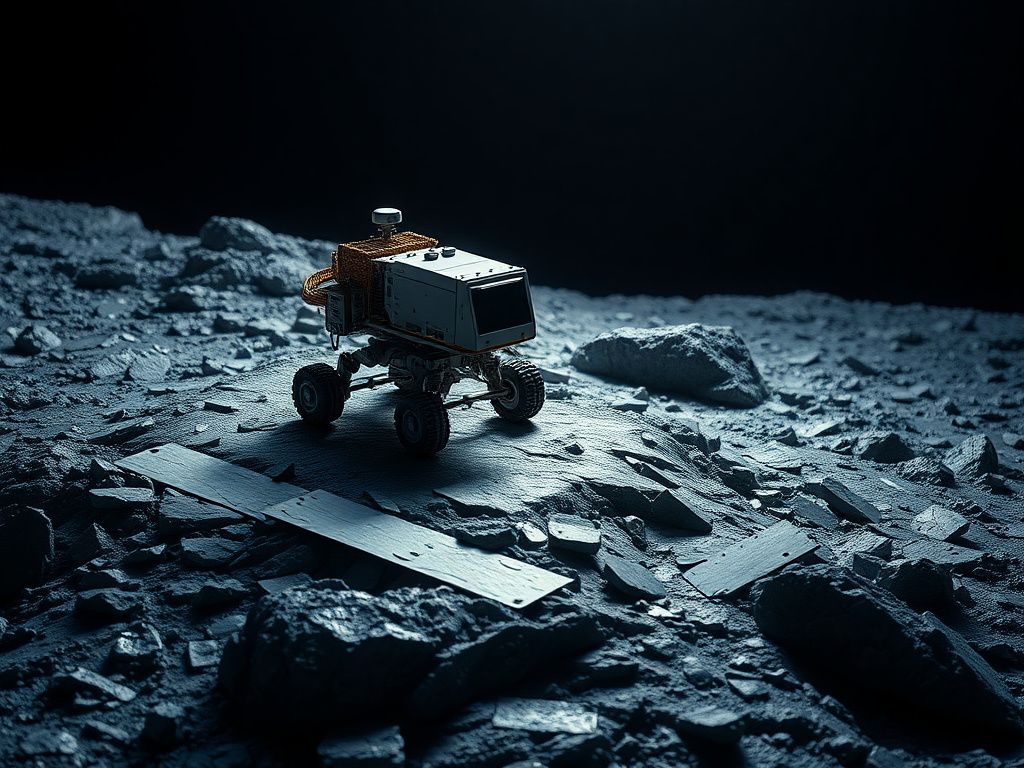
Quick Answer: Asteroid mining is the extraction of minerals, metals, and water from near-Earth asteroids. A single metallic asteroid like 16 Psyche may contain iron, nickel, and precious metals worth an estimated $10 quintillion — dwarfing Earth's entire GDP. The companies and nations that crack this market first will hold extraordinary economic leverage over 21st-century civilization.
The world's richest sovereign wealth funds combined hold roughly $10 trillion in assets. The asteroid belt holds an estimated $700 quintillion in resources. That gap is not a typo. It is the single most dramatic economic asymmetry in human history — and it is sitting 100 million miles above your head, waiting for the first mover to claim it.
We are at the beginning of what analysts at Goldman Sachs and Morgan Stanley have both flagged as the next frontier in commodity markets. Space mining is no longer the domain of science fiction writers and NASA dreamers. It is venture capital-funded, government-backed, and treaty-contested. Understanding how it will reshape global wealth is not optional for serious investors and economists. It is the conversation happening in private right now.
Why Earth's Mineral Economy Is Running on Borrowed Time
Here is the uncomfortable truth: the metals powering your smartphone, your EV battery, and your nation's military infrastructure are finite. The reserves are not infinite. They are geographically concentrated, politically weaponized, and increasingly expensive to extract.
- Rare earth elements (neodymium, dysprosium, terbium) are dominated by China, which controls over 60% of global production.
- Platinum group metals are concentrated in South Africa and Russia — two geopolitically volatile regions.
- Cobalt, the battery economy's backbone, is primarily mined in the Democratic Republic of Congo under conditions that keep supply chains ethically compromised.
This is the structural problem. The global energy transition demands more of these materials, not less, at precisely the moment that terrestrial supply chains are fraying. Asteroid mining enters the picture not as a novelty, but as a systemic response to a resource-scarcity crisis already unfolding in commodity markets.
The Anatomy of an Asteroid's Balance Sheet
Not all asteroids are created equal. The taxonomy matters for any investor or policymaker thinking seriously about this space.
Three primary asteroid types hold economic relevance:
C-type (Carbonaceous): The most common. Rich in carbon, silicates, and — critically — water ice. Water, when electrolyzed in space, becomes hydrogen and oxygen: rocket propellant. C-type asteroids are the gas stations of the solar system.
S-type (Silicaceous): Composed of silicate minerals and metals including iron, magnesium, and some gold and platinum. Less common than C-type, but valuable.
M-type (Metallic): The crown jewels. These are theorized remnants of planetary cores — almost pure iron-nickel with significant platinum group metal concentrations. 16 Psyche, the most famous M-type, is so dense and metal-rich that NASA launched the Psyche spacecraft in October 2023 specifically to study it.
The economics of 16 Psyche deserve their own section, because the numbers are almost incomprehensible. Estimates place its metal content at approximately $10 quintillion (10 × 10¹⁸ dollars). For context, global GDP in 2024 is roughly $110 trillion. The iron-nickel in a single asteroid could theoretically collapse the entire global metals market if dumped on Earth.
Which is why it won't be.
The Real Investment Thesis: Not Flooding Markets, But Off-World Infrastructure
The misreading of asteroid mining's economic impact is the assumption that miners will ship everything back to Earth, crashing commodity prices. The sophisticated thesis is different.