
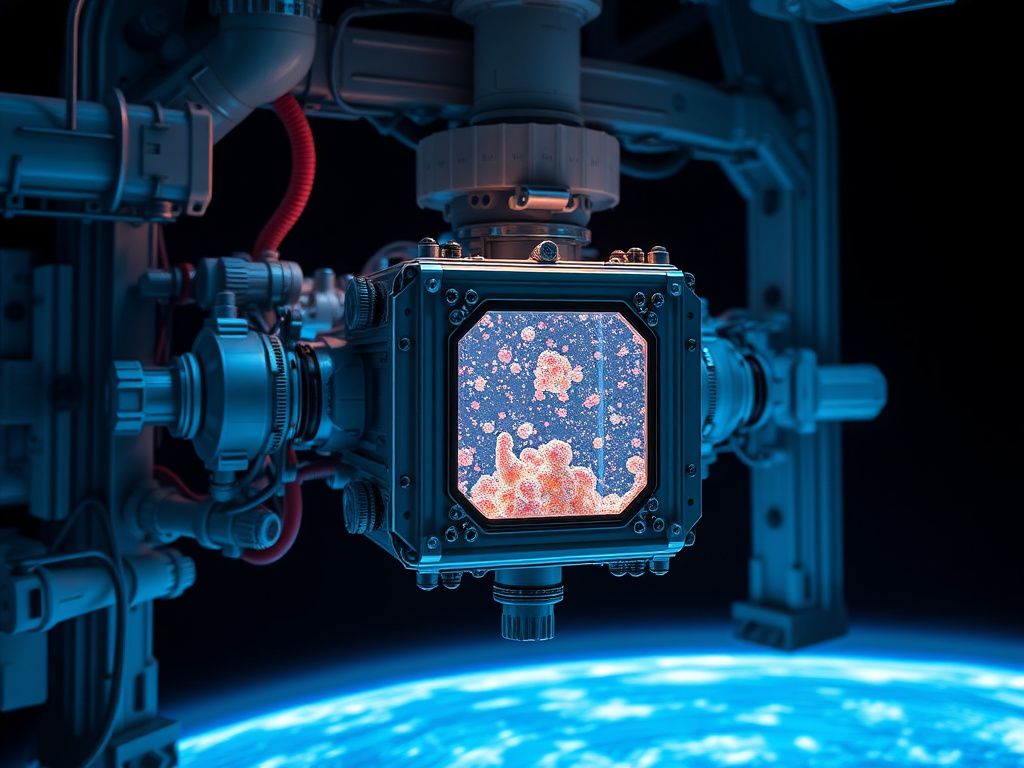
Quick Answer: Zero-gravity manufacturing of pharmaceuticals in Low Earth Orbit is scientifically promising but economically unproven. Microgravity enables production of purer protein crystals, biological tissues, and drug compounds impossible to create on Earth. However, launch costs, contamination risks, regulatory uncertainty, and return logistics mean no company has yet demonstrated a profitable, scalable drug-manufacturing operation in space.
The pitch sounds almost too good: take a manufacturing process that struggles against gravity—protein crystallization, fiber optic production, certain tissue engineering techniques—lift it 400 kilometers above the planet, and suddenly physics works in your favor. The ISS has hosted experiments proving some of this actually works. Merck grew purer crystite crystals of pembrolizumab (Keytruda) in microgravity than anything produced on the ground. Companies like Varda Space Industries, Space Cargo Unlimited, and Redwire Space have raised real money betting on the concept.
But there's a gap between "this is scientifically interesting" and "this is a viable business," and that gap is currently enormous, full of solved-looking problems that aren't actually solved yet.
Why Microgravity Actually Matters for Drug Manufacturing
On Earth, fluid convection, sedimentation, and buoyancy-driven flows are constant irritants to certain manufacturing processes. When you're trying to grow a protein crystal—say, for X-ray crystallography to map drug binding sites, or to create a more stable injectable formulation—gravity pulls heavier molecules down, creates density gradients, and produces crystals riddled with defects or too small to be useful.
In microgravity, those effects largely vanish. Crystals grow more slowly, more uniformly, and often larger. This isn't speculation—it's been replicated across dozens of ISS experiments since the 1990s.
The categories where microgravity shows the most credible advantage:
- Protein crystallization for structural analysis and drug formulation
- Monoclonal antibody production where crystal form affects bioavailability and shelf stability
- Tissue engineering and organoids where cells self-assemble differently without gravity directing scaffold formation
- Fiber optic manufacturing (not drugs, but often cited in same economic arguments)
- ZBLAN fluoride glass fibers for medical lasers used in surgery
The Keytruda experiments Merck ran aboard the ISS between 2017 and 2019 are probably the most-cited commercial data point. Pembrolizumab is a blockbuster immunotherapy drug—one of the highest-revenue pharmaceuticals on Earth. Getting a more stable crystal form could theoretically reduce refrigeration requirements, extend shelf life, or improve subcutaneous delivery. Those are not trivial gains for a drug generating tens of billions in annual revenue. But "could theoretically" is still doing a lot of work in that sentence.
The Economics Don't Work Yet—And Companies Know It
Here's where operational reality diverges sharply from the investor pitch deck.
Launching a kilogram of payload to the ISS currently costs somewhere in the range of several thousand to tens of thousands of dollars depending on the vehicle and mission parameters. SpaceX's Falcon 9 resupply missions have brought cargo costs down meaningfully, but "down" is relative. Return mass—getting manufactured product back to Earth—adds another layer of cost, scheduling complexity, and contamination risk.
Varda Space's business model is specifically designed to address the return problem: build a small free-flying spacecraft, manufacture in orbit, re-enter autonomously. Their first mission (W-Series 1) launched in June 2023 aboard a SpaceX Transporter rideshare. The capsule spent months waiting for FAA re-entry approval—approval that didn't come quickly, partly because the regulatory framework for commercial re-entry of manufactured goods simply wasn't designed for this use case. The capsule finally landed in Utah in February 2024, carrying ritonavir crystals (an HIV antiviral) that had been grown in microgravity.
That's genuinely impressive from an engineering standpoint. From a business standpoint, it was a demonstration mission, not a profitable product run. The company hasn't publicly disclosed the crystal quality results in peer-reviewed form as of this writing, and the timeline from concept to landed capsule spanned roughly two years.
The math that makes space manufacturing theoretically attractive: if you can manufacture a drug with meaningfully superior properties—better bioavailability, longer shelf life, reduced cold chain requirements—and that drug is already generating billions in revenue, even a small improvement in manufacturing yield or formulation quality might justify extraordinary per-kilogram costs. That's the bull case.
The bear case: most drugs don't have that profile. The ones that do have enormous regulatory and safety hurdles. And the "superior properties" often look better in laboratory conditions than in actual patient outcomes.
Regulatory and Quality Control Nightmares
Nobody has navigated FDA approval for a drug manufactured in space. That's not a technical failure—it simply hasn't happened yet. But the regulatory pathway is genuinely unclear.
Good Manufacturing Practice (GMP) requirements that govern pharmaceutical production on Earth are built around assumptions of stable, controlled environments, documented process consistency, human oversight, and auditable supply chains. Space manufacturing breaks several of those assumptions simultaneously.