
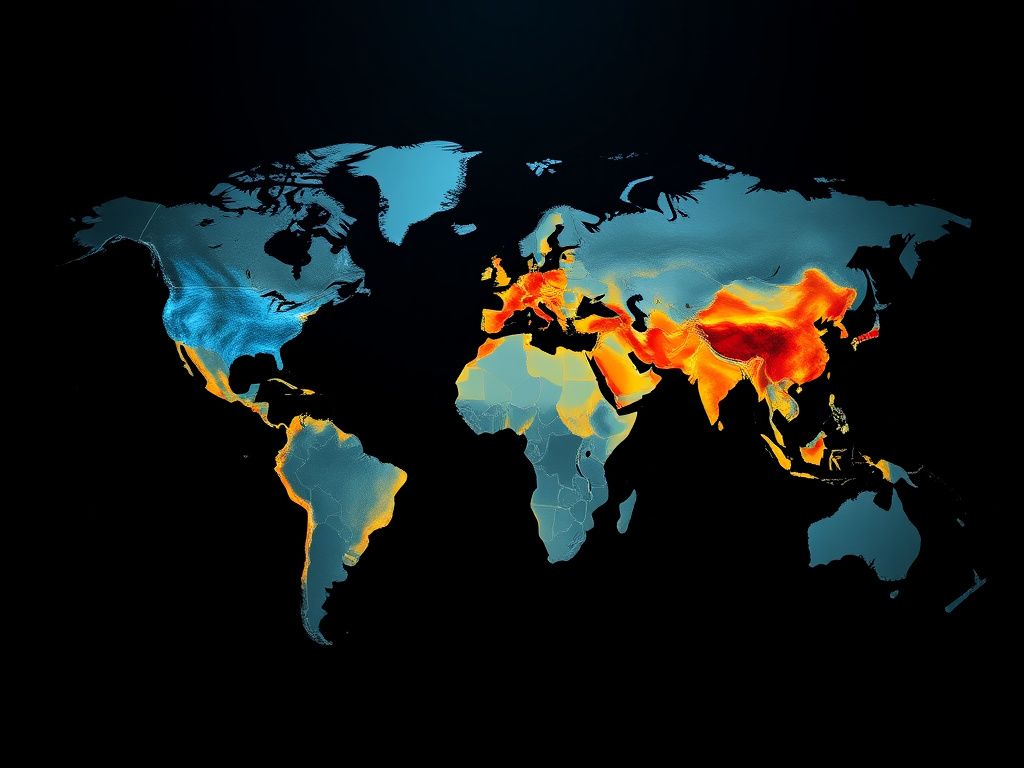
Quick Answer: Transboundary water disputes — conflicts over rivers, aquifers, and lakes shared by two or more nations — are accelerating toward a breaking point. By 2026, climate stress, population growth, and geopolitical rivalry will transform water from a shared resource into a strategic weapon, reshaping alliances, triggering sanctions, and potentially igniting armed conflict across three continents.
Water doesn't respect borders. It never has. The Nile flows through eleven countries. The Mekong feeds 60 million people across six nations. The Tigris and Euphrates carry the political fate of Turkey, Syria, Iraq, and Iran in their currents. And yet, for decades, the international community has treated water governance as a secondhand diplomatic issue — a technical matter best left to hydrologists and low-level bureaucrats.
That era is ending.
The Fault Lines Are Already Drawn
Here's the uncomfortable truth: water stress is no longer a future problem. The UN Water Conference data shows that roughly 2.3 billion people currently live in water-stressed countries. By 2026, the World Resources Institute projects that 25 nations — home to one-quarter of the global population — will face "extremely high" annual water stress on a near-permanent basis.
These aren't abstract statistics. They are the breeding ground for state failure, forced migration, and interstate war.
The three most combustible flashpoints right now:
The Nile Basin — Ethiopia's Grand Ethiopian Renaissance Dam (GERD) has fundamentally altered the hydro-political calculus between Addis Ababa, Cairo, and Khartoum. Egypt considers the Nile an existential resource. It has repeatedly refused to accept reduced flow. Ethiopia refuses to cede its sovereign right to develop. Sudan sits trapped between them, physically and politically.
The Mekong River — China's cascade of upstream dams has throttled downstream flows into Thailand, Laos, Cambodia, and Vietnam. A 2020 Eyes on Earth study confirmed that China withheld water during a downstream drought. The Association of Southeast Asian Nations (ASEAN) has no binding mechanism to stop it.
The Indus System — The 1960 Indus Waters Treaty between India and Pakistan — often called the most successful water treaty in history — is now under serious strain. India's upstream dam projects and Pakistan's explosive population growth have pushed the treaty to the edge of relevance. In 2023, India formally sought modification of the treaty's terms. That was a diplomatic earthquake that received almost no Western media coverage.
Why 2026 Is the Inflection Point
Several converging forces make 2026 specifically dangerous, not just incrementally worse.
1. El Niño-Driven Hydrological Shocks The 2023-2024 El Niño was one of the strongest on record. Its aftermath — irregular monsoons, prolonged drought cycles, and glacial melt acceleration in the Himalayas — will play out across 2025 and 2026 in reduced river flows across South Asia and Sub-Saharan Africa.
2. Dam Infrastructure Reaching Operational Capacity The GERD reached full reservoir capacity in its fourth filling cycle in 2024. This is no longer a construction dispute — it's an operational reality that Egypt must now manage. The diplomatic window for pre-operational negotiation has closed. What remains is crisis management.
3. The Absence of Binding Multilateral Water Law The UN Watercourses Convention entered into force in 2014. As of today, only 38 states have ratified it. Major upstream powers — China, Turkey, Ethiopia — have not. This means the international legal framework for transboundary water is effectively toothless when tested by powerful states with strong national interests.
4. Weaponized Infrastructure In the Russia-Ukraine war, both sides targeted water infrastructure. This was not accidental. Military planners now openly classify water systems as high-value strategic targets. The normalization of water infrastructure as a weapon of war is a catastrophic precedent.
How Hydropolitics Actually Works: The Power Asymmetry Problem
Most people assume water conflicts follow a simple upstream-versus-downstream logic. The reality is more structurally complex.
Upstream states hold the geographic leverage. They can build dams, regulate flow, and time releases to serve their own agricultural seasons. Downstream states, by contrast, have historical dependence on those flows — often codified in colonial-era treaties that upstream states now reject as illegitimate impositions.