
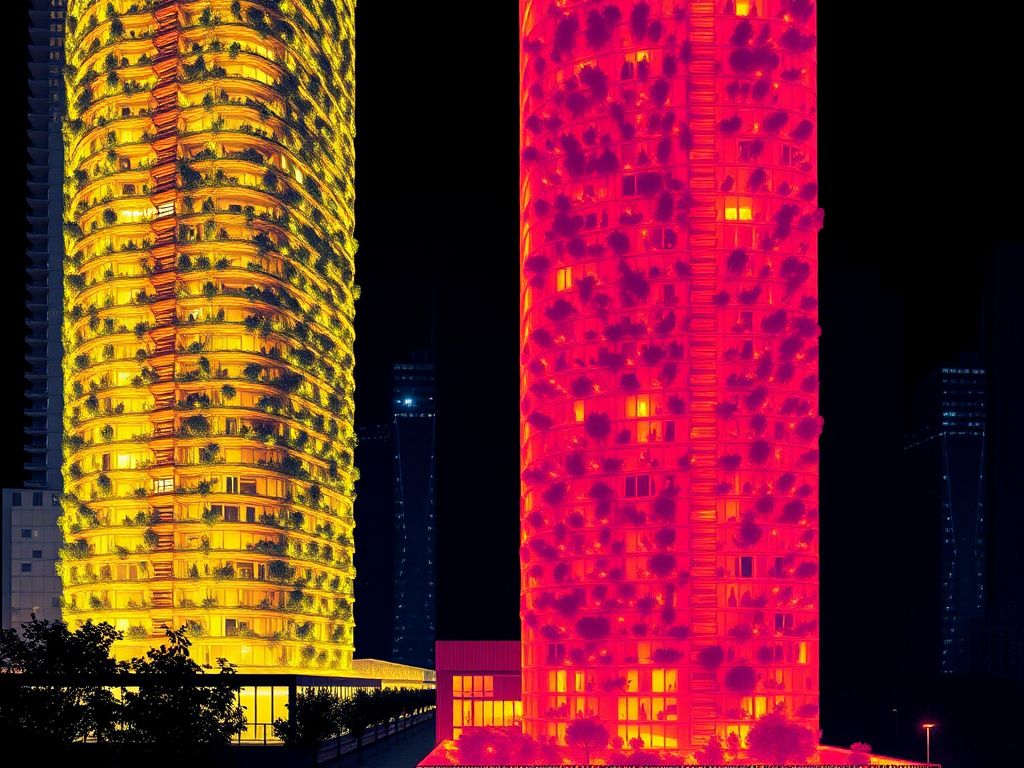
Quick Answer: Vertical forests — buildings clad in thousands of trees, shrubs, and perennial plants — directly counteract urban heat islands by lowering surface temperatures by up to 10°C, sequestering carbon, and restoring biodiversity corridors in dense city cores. They represent the most structurally integrated form of biophilic urbanism available at scale today.
Cities are getting hotter. Not metaphorically — literally, measurably, dangerously hotter. The urban heat island (UHI) effect now pushes city-center temperatures 3–8°C above surrounding rural areas, and in extreme heat events, that differential becomes a public health emergency. Asphalt, glass, and concrete absorb solar radiation all day and radiate it back at night, trapping heat in a cycle that kills thousands annually across Europe, Asia, and North America.
You've probably walked through a downtown district in August and felt the suffocating difference compared to a shaded park two blocks away. That's not coincidence. That's physics — and it's accelerating with climate change.
The conventional response — painting rooftops white, planting street trees, installing cool pavements — addresses symptoms. Regenerative urbanism asks a fundamentally different question: what if the building itself was the ecosystem?
What Exactly Is a Vertical Forest?
A vertical forest (Italian: Bosco Verticale) is an architectural typology where the building's structure is engineered from the ground up to support the weight, irrigation, and root depth requirements of full-grown trees — not ornamental planters, not window boxes. Real trees. Anchored at height. Living and photosynthesizing at 80 meters above street level.
The concept, pioneered by Italian architect Stefano Boeri with the 2014 twin towers in Milan's Porta Nuova district, was initially dismissed as sculptural spectacle. Those two towers host approximately:
- 800 trees
- 4,500 shrubs
- 15,000 perennial plants
The combined leaf surface area equals roughly 2 hectares of forest, compressed into a 3,000 m² footprint. That's the core arithmetic of vertical ecology: extraordinary biological density per unit of urban land.
The Heat Mitigation Mechanism — How It Actually Works
This isn't just aesthetics. The cooling physics are well-documented across three distinct processes:
1. Evapotranspiration
Plants release water vapor through their leaves and stems. At scale, this process — evapotranspiration — acts as a natural air conditioner. A single mature oak can transpire up to 400 liters of water per day, cooling the surrounding air through latent heat absorption. Multiply that across hundreds of trees on a building facade and you generate a measurable microclimate buffer.
2. Shading & Solar Absorption Interception
Before solar radiation ever reaches the concrete or glass of a building envelope, tree canopies intercept, scatter, and absorb it. Studies from the University of Manchester found that strategically planted urban trees can reduce peak summer surface temperatures by up to 12°C on sun-exposed facades. For a south-facing glass curtain wall, that translates directly into reduced air-conditioning load — typically 20–30% energy savings in cooling.
3. Albedo Modification
Bare concrete has an albedo (reflectivity) of approximately 0.3 — it absorbs 70% of incoming solar radiation and re-emits it as heat. Dense vegetation has an albedo closer to 0.15–0.20, but crucially, the energy it does absorb goes into biological processes rather than thermal re-emission. The building stops being a heat battery.
Real-World Case Studies That Prove the Concept
Milan's Bosco Verticale remains the benchmark. Post-occupancy monitoring by Politecnico di Milano documented a sustained local temperature reduction of approximately 3°C in the immediate microclimate surrounding the towers — significant in a city that recorded its hottest summer on record in 2022, with 63 heat-related deaths in a single week.
Singapore's PARKROYAL on Pickering takes a different geometry — horizontal sky gardens cascading down a hotel facade — but achieves comparable results. The building's green area exceeds its ground footprint by 200%, and it operates at roughly 30% below Singapore's building energy code requirements for its typology.
Nanjing Vertical Forest (China, 2021): Designed by Boeri Studio, this project in Jiangsu Province hosts 1,000 trees and 2,500 shrubs across two towers. Early monitoring data suggests the buildings support 23 species of birds and insects that had not been recorded in that urban zone before construction — demonstrating that vertical forests don't just cool cities, they actively rebuild ecological connectivity.
The Structural and Engineering Realities
Here's where many enthusiastic urban planners hit friction. Vertical forests are not cheap, and they are not simple.