
Psychological debt in home networking isn't a technical glitch; it is the cognitive residue left behind by years of "just-make-it-work" patches. It manifests as the lingering anxiety caused by unlabelled cables, orphaned IoT devices with deprecated firmware, and complex VLAN configurations that no longer serve a purpose. When your infrastructure is a "black box" of technical debt, every minor connectivity drop triggers a disproportionate stress response—like wondering if your Roomba Error 15 is due to internal communication failures or just the entropy of your own messy setup—forcing you into a reactive state.
The Archaeology of a Home Network
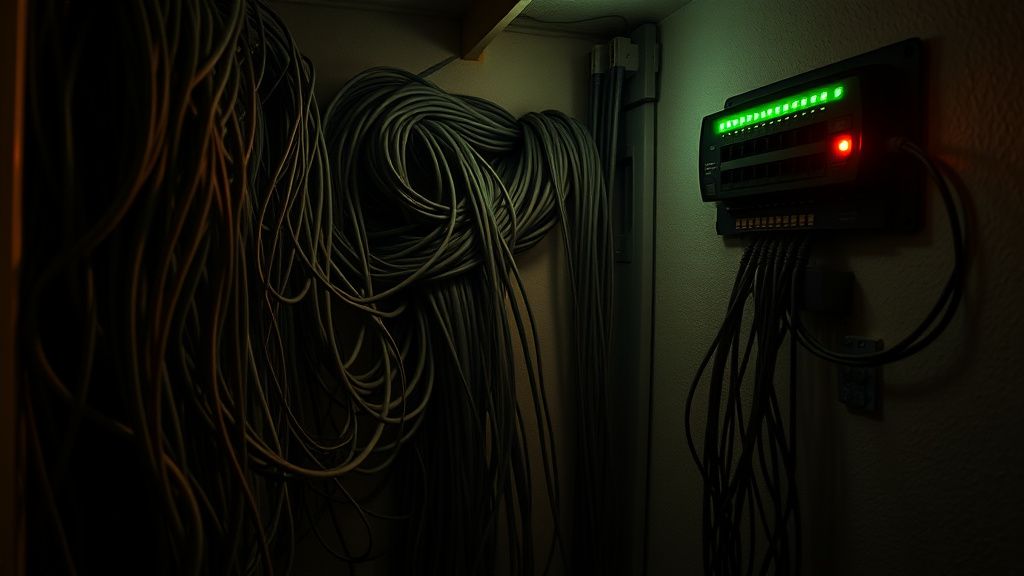
Home networks are rarely "designed." They are accreted. Like the layers of sediment in a city, your current local area network (LAN) is a collection of eras. You have the 2018-era smart bulbs that still require a specific 2.4GHz-only bridge, the 2021-era router that is masquerading as a wireless access point in a "double NAT" configuration you’ve forgotten how to disable, and a tangle of Ethernet cables behind the TV console that even the bravest contractor wouldn't touch.
This is the manifestation of technical debt, but it carries a psychological cost. Every time you open your router’s admin interface—usually to find out why the printer has disconnected again—you are confronted with a dashboard of ghosts. You see device names like ESP_8266_UNKNOWN or SmartHome-Bridge-v2. You don't delete them because you aren't 100% sure what they do. That uncertainty is the tax you pay for lack of documentation.
The Cognitive Load of "Legacy Entropy"
Human decision-making is optimized for clarity, not complexity. When your network environment is cluttered, your brain suffers from "choice paralysis" during critical moments. If your internet speed dips during a Zoom call, and your network is a spaghetti mess, you might find yourself dealing with issues like a Google Nest Hub always disconnecting, which often requires a specific mesh optimization fix to resolve.
The psychological debt accumulates because the cost of fixing the network is perceived as higher than the cost of tolerating occasional failures, much like ignoring the signs that your 4K smart TV is overheating due to poor thermal management. We call this "maintenance avoidance," but it functions more like a sunk cost fallacy. You’ve put so much time into getting it "mostly working" that you refuse to tear it down and rebuild it properly.
Real Field Report: The "Smart Home" Standoff
Consider the case of a mid-sized suburban household reported in a recent thread on r/homelab. The user described an "irrecoverable state" where they spent three days trying to isolate why their smart blinds stopped responding.
Upon investigation, they discovered that an old Raspberry Pi they had forgotten about—a project from four years ago—was still running a script that occasionally flooded the network with broadcast traffic, causing ARP storms. They hadn't touched the Pi because they were "afraid of breaking the configuration."
The psychological impact here is the fear of regression. When your network is held together by "duct tape and prayers," you lose the confidence to experiment or upgrade. You become a hostage to your own legacy systems, essentially living in a state of 'Wi-Fi fatigue' where your environment negatively impacts your focus—a concept explored in the study of how Wi-Fi impacts neuro-architecture and cognitive restoration.

The Paradox of Over-Optimization
There is a growing sub-culture of home network enthusiasts who fall into the trap of "preemptive optimization." They buy rack-mount gear, spend thousands on enterprise-grade firewalls, and spend their weekends fine-tuning firewall rules they don't fully understand.
This is the opposite of resolving debt; it is creating new debt.
When you introduce enterprise-level complexity into a domestic environment, you increase the surface area for failure. If your home network requires a specialized certification just to change a Wi-Fi password, you are creating a "knowledge silo" that mirrors the corporate inefficiency discussed in Is Micro-Learning Failing Your Team? The 2026 Shift Toward Deep Work Training, which argues against fragmented, shallow skill development. If you go on vacation and the internet drops, your family is left in the dark. This creates a hidden layer of social tension—a form of "support debt" where your household members view your "advanced" network with resentment rather than appreciation.
Why Simple Systems Scale Better
The most stable home networks are not the ones with the most features; they are the ones with the most documentation. If you want to reduce psychological debt, start by mapping your environment. Use our Network Throughput Calculator to understand the actual requirements of your streams, rather than buying hardware based on "future-proofing" hype.
Counter-Criticism: Is "Cleanup" Just Procrastination?
Some industry observers argue that the concept of "psychological debt" in networking is a luxury problem. The "If it ain't broke, don't fix it" philosophy is still the gold standard for many, including professional network engineers who spend their workdays fixing things and refuse to do so at home.