
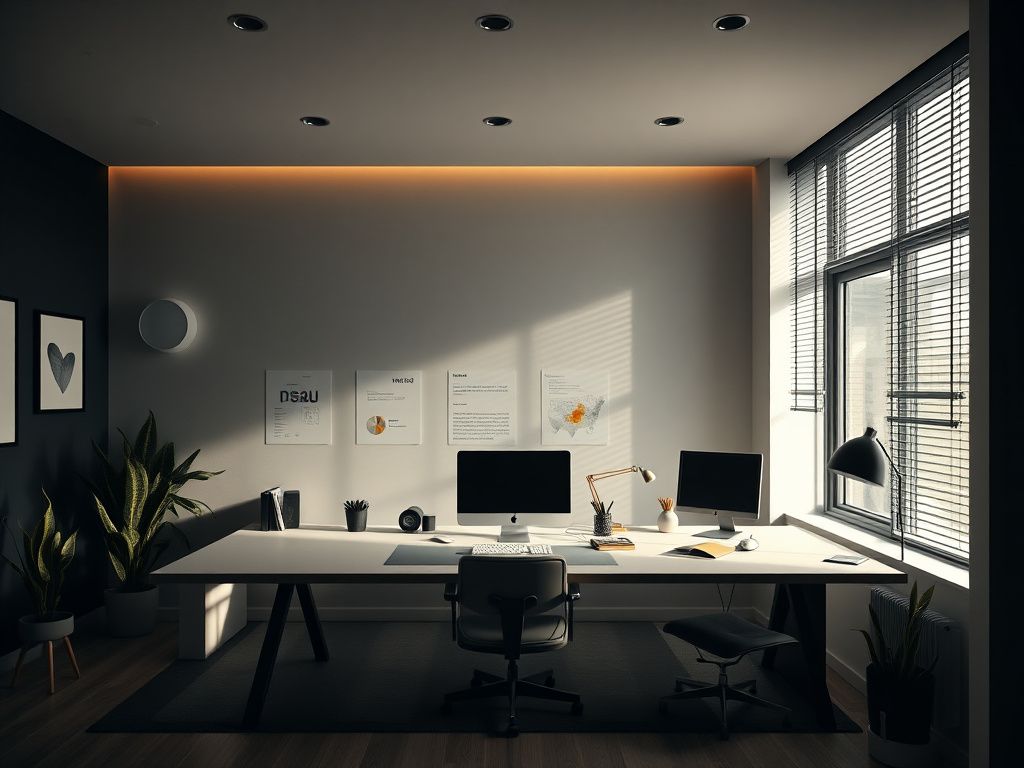
In 40 words: Yes — office layout genuinely affects cognitive performance. Lighting, noise, temperature, spatial organization, and visual complexity all interact with your nervous system in measurable ways. This isn't productivity self-help. It's applied neuroscience with real design implications.
There's a particular kind of exhaustion that isn't physical. You've been sitting at your desk for six hours, you haven't moved much, and yet by 4pm you feel like you've been running. Your ability to make decisions has degraded. You're re-reading the same paragraph. A Slack notification you'd normally process in two seconds now requires actual effort.
Most people attribute this to willpower running out. The more accurate explanation is environmental. Your brain has been fighting your workspace all day — and the workspace has been winning.
Neuro-ergonomics is the field that tries to stop that fight before it starts.
What Neuro-Ergonomics Actually Is (and Isn't)
Neuro-ergonomics sits at the intersection of cognitive neuroscience and human factors engineering. It's not interior design with a PhD. It's not the "plants make you happier" corner of wellness culture. The serious version of this field studies how physical and sensory environments modulate attentional networks, working memory load, stress hormone profiles, and executive function — the mental machinery you need for complex, sustained thinking.
The traditional ergonomics field spent decades focused on the body: posture, repetitive strain, musculoskeletal injury. Neuro-ergonomics extended that concern upward, to the brain. The question became not just "does this workspace hurt your wrists?" but "does this workspace degrade your ability to think?"
The answer is: absolutely, and in fairly specific ways.
The Noise Problem Is Worse Than You Think
Open-plan offices remain the dominant workspace format globally, despite a now-substantial body of research showing they impair cognitive performance for tasks requiring sustained focus. The core mechanism isn't complicated: irrelevant background speech is neurologically taxing in a way that white noise is not.
Your auditory cortex cannot fully habituate to speech. Even when you're consciously ignoring a nearby conversation, your language-processing systems are partially engaged — running a low-level recognition process, checking whether the sounds carry information relevant to you. This is automatic. You can't turn it off through concentration.
The result is a persistent, low-grade cognitive load that doesn't feel like distraction but shows up as degraded performance on tasks requiring working memory. Studies using the "irrelevant speech effect" have consistently demonstrated this across decades of research. What varies is how much it matters for different task types: the more your work depends on holding multiple pieces of information in mind simultaneously — coding, writing, complex analysis — the worse the speech noise problem becomes.
The workaround most knowledge workers have landed on is headphones with noise-canceling or music. This is functional but imperfect. Music with lyrics reintroduces the speech problem. Purely instrumental music helps more, though the benefit varies significantly by person and task type. The deeper issue is that the workaround shouldn't be necessary — the workspace architecture created a problem that individuals are now expected to solve individually, with hardware they bought themselves.
Lighting: The Circadian Variable Nobody Controls
Office lighting design has historically optimized for visibility, not biology. This is a meaningful distinction. Your visual system needs enough light to read. Your circadian system needs light at specific wavelengths and intensities, at specific times of day, to maintain the hormonal rhythms that regulate alertness, focus, and sleep quality.
The core problem in most office environments is twofold:
- Insufficient morning light intensity — most office lighting doesn't approach the lux levels that signal daytime alertness to your suprachiasmatic nucleus
- Insufficient spectral variation — the same cool fluorescent or LED temperature all day, providing no cues about time of day
The practical result: workers whose circadian rhythms drift out of sync with their work schedule. Afternoon cognitive slumps that are partly physiological and partly environmental. And then — because office lighting at 3pm looks identical to office lighting at 9am — no environmental signal helping your brain sharpen back up.
Tunable LED systems that shift color temperature across the day (bluer/cooler in morning hours, warmer in afternoon) have shown measurable effects on alertness and sleep quality in controlled settings. Most offices don't have them. Most workers don't control their lighting at all.
Thermal Comfort and the Underrated Cognitive Load of Temperature
Thermal discomfort is a background stressor that consistently shows up in productivity research, consistently gets treated as a facilities complaint rather than a performance issue, and consistently produces the same finding: cognitive performance — particularly on complex tasks — degrades meaningfully outside a relatively narrow thermal comfort zone.