
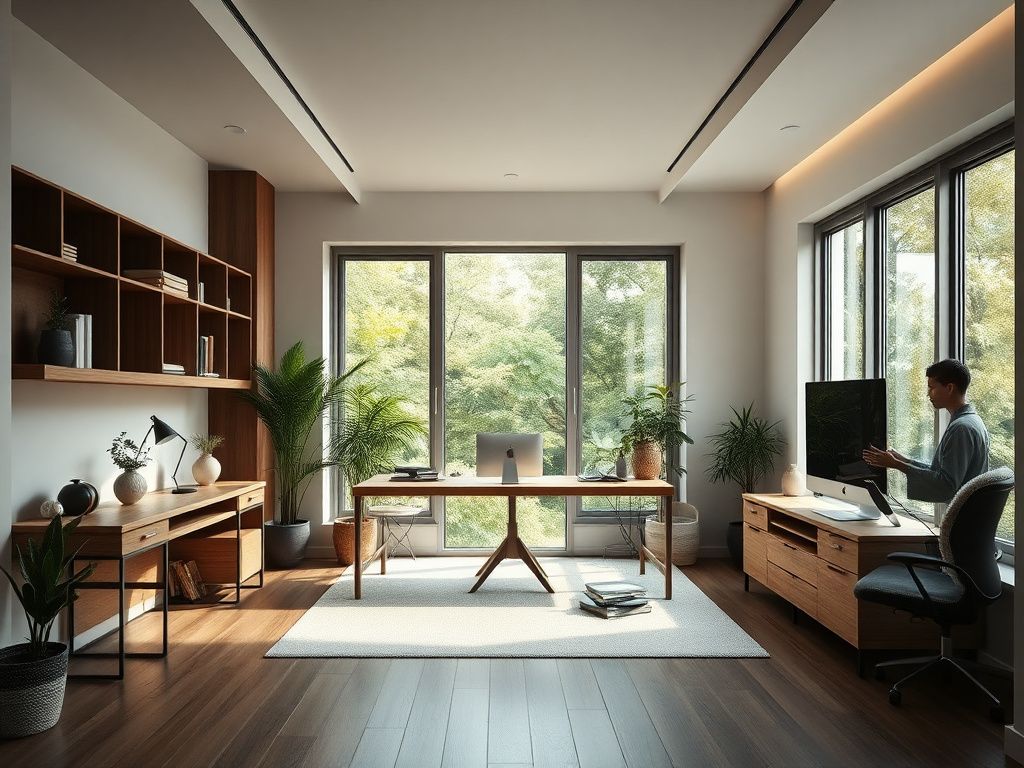
Quick Answer: Yes, your workspace design directly impacts cognitive performance. Neuro-architecture — the science linking built environments to brain function — shows that ceiling height, lighting color temperature, acoustic levels, and spatial clutter measurably alter attention, creativity, and stress hormones. Strategic redesign can improve focus by up to 20% without medication or habit overhauls.
Your office walls are not neutral. Neither is your ceiling, your window placement, or the hum of your HVAC system. Every physical element in your workspace sends a continuous stream of low-level signals to your nervous system — signals that either support deep cognitive work or quietly erode it. This is the domain of neuro-architecture, and its findings are increasingly hard to ignore.
What Is Neuro-Architecture?
Neuro-architecture is an interdisciplinary field that bridges neuroscience, cognitive psychology, and architectural design. It examines how the physical built environment influences brain activity, emotional regulation, hormonal output, and ultimately, human behavior and performance.
The field gained formal recognition in 2003 when the Academy of Neuroscience for Architecture (ANFA) was established in San Diego. Since then, researchers have used neuroimaging, cortisol measurements, EEG monitoring, and behavioral tracking to map how spaces shape minds.
Key contributors include:
- John Eberhard, ANFA's founding president, who argued that architecture should be informed by brain science
- Eve Edelstein, a neuroscientist who studied how acoustic environments alter prefrontal cortex activity
- Esther Sternberg, whose work at the NIH linked spatial design to immune and stress response systems
This is not interior design philosophy. It is empirical research with replicable data.
The Neuroscience of Spatial Perception
Your brain processes architecture through several simultaneous channels:
1. Threat Assessment (Amygdala) The amygdala scans your environment constantly. Low ceilings, cluttered sightlines, and dim corridors can trigger low-grade threat responses — elevating cortisol and reducing working memory capacity.
2. Spatial Navigation (Hippocampus) The hippocampus is responsible for spatial memory. Research from UCL's Institute of Cognitive Neuroscience shows that monotonous, featureless environments reduce hippocampal engagement, which correlates with reduced creative recall and associative thinking.
3. Reward and Motivation (Dopamine Pathways) Natural light, open views, and biophilic elements (plants, water, organic shapes) activate dopaminergic reward circuits. A 2018 study in the Journal of Environmental Psychology found that exposure to natural elements in the workspace reduced psychological stress markers by 37% over a 6-week period.
The Five Environmental Variables That Destroy (or Build) Focus
1. Lighting: The Circadian Saboteur
Most office lighting is designed for energy efficiency, not cognitive performance. Standard fluorescent lighting at 3000K (warm white) suppresses alertness. Cool white lighting at 5000–6500K more closely mimics midday sunlight and supports the melanopsin-driven alertness system in your retina.
A landmark study from the Lighting Research Center at Rensselaer Polytechnic Institute (2014) demonstrated that tunable LED lighting systems aligned to circadian rhythms improved sleep quality by 42% and daytime alertness scores significantly among office workers.
Practical fix: Use a desk lamp with adjustable color temperature. Set it to 5000–6500K during focused morning work sessions. Shift to 2700–3000K in the late afternoon to allow natural melatonin onset.
2. Ceiling Height: The "Cathedral Effect"
Psychologist Joan Meyers-Levy at the University of Minnesota published research in the Journal of Consumer Research (2007) demonstrating that high ceilings promote abstract, creative thinking, while low ceilings favor detail-oriented, convergent tasks.
This became known as the "Cathedral Effect."
- High ceilings (~10 ft+): better for brainstorming, ideation, strategic planning
- Low ceilings (~8 ft): better for proofreading, data entry, task completion
If you cannot modify your ceiling, visual height cues work as proxies. Vertical stripes on walls, floor-to-ceiling shelving, or hanging pendant lights draw the eye upward and partially replicate the cognitive effect.
3. Acoustic Environment: The Hidden Cognitive Tax
Noise is one of the most underestimated workspace variables. Not all noise is equally damaging. Research from Cornell's Human Factors and Ergonomics Laboratory identifies irrelevant speech (intelligible conversations nearby) as the most cognitively disruptive noise category — more damaging than equivalent-decibel white noise or music.
The effect is measurable: irrelevant speech reduces working memory performance by 15–30% on reading comprehension and serial recall tasks.
Optimal acoustic strategy: