
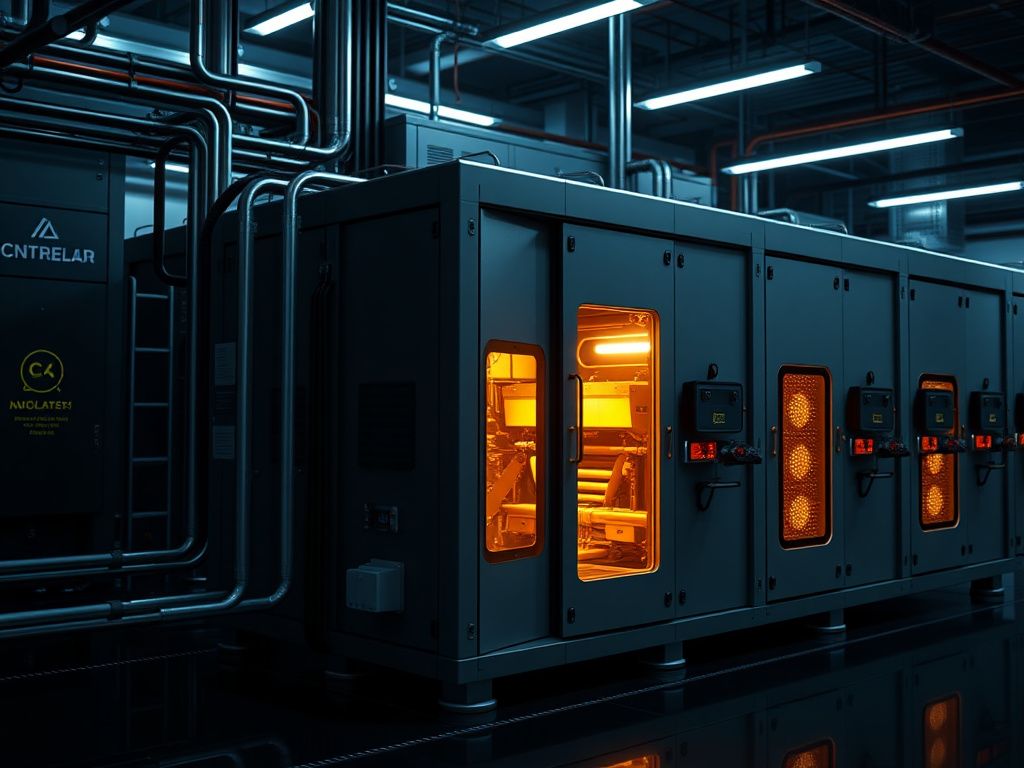
The industry-wide pivot toward Small Modular Reactors (SMRs) for edge data centers is less about a sudden "green awakening" and more about the brutal, physical limitations of diesel backup. As compute density per rack skyrockets—thanks to AI inference workloads—the current operational model of "giant batteries backed by racks of industrial diesel generators" is hitting a scaling wall. By 2030, micro-nuclear SMRs (typically 1–20 MW) are positioned to displace diesel, not because they are cheaper to install, but because they are the only way to bypass the grid’s unreliability and the logistical nightmare of fuel supply chains in remote locations.
The Diesel Trap: An Operational Dead-End
For years, the remote data center playbook has been simple: hook into the grid, pray it doesn't drop, and maintain a sprawling fuel farm of diesel generators (GenSets). It’s a classic "Plan B" that is increasingly becoming the bottleneck.
- Fuel Logistics: In remote locations, diesel fuel is a parasitic cost. You are essentially running a supply chain business alongside a compute business. Relying on fuel trucks arriving on time—often over seasonal roads or through volatile regions—is a failure point that keeps site managers awake at night.
- The "Dirty" Reliability Gap: Diesel generators are not designed for long-term prime power. They are emergency equipment. When you push them to run for days, maintenance cycles compress, oil degradation accelerates, and the sheer mechanical complexity of a combustion engine becomes a liability.
- Emissions and Permitting: As ESG mandates tighten, the "emergency exemption" permits for diesel are becoming harder to renew. Regulators aren't just counting carbon anymore; they are looking at localized NOx and particulate emissions, which are often non-negotiable in sensitive ecological zones.
The Physics of the SMR Shift
Micro-reactors (such as those being prototyped by companies like Oklo, NuScale, or various molten-salt reactor startups) operate on a fundamentally different principle: passive safety and factory-sealed fuel cores.
Unlike the 1970s-era massive PWR (Pressurized Water Reactor) designs, these micro-SMRs are designed to be "walk-away safe." They use physical laws—like negative temperature coefficients of reactivity and natural convection—to shut down without human intervention or active cooling pumps if a fault occurs. For a data center operator, this turns the power plant from a high-maintenance "facility" into a "black box" appliance.
However, the transition isn't frictionless. If you’re planning your own infrastructure, you can use our Energy Cost Calculator to visualize the long-term O&M savings, though currently, the CAPEX for these units remains largely hypothetical for small-scale operators.
Scaling and Deployment: The "Shipping Container" Fallacy
The industry marketing materials love showing SMRs as shipping containers that arrive on a flatbed truck, plug in, and run for 20 years. The reality, as discussed on various Hacker News threads regarding nuclear engineering, is significantly messier.
- Regulatory Hurdles: The NRC (Nuclear Regulatory Commission) in the US and international counterparts like the IAEA are built to regulate massive gigawatt-scale plants. Fitting a 5 MW micro-reactor into that regulatory framework is like trying to use an aircraft carrier's rulebook to register a drone. It is a slow, expensive nightmare of paperwork.
- The "Last Mile" of Heat Management: Even if the reactor works perfectly, you still have to deal with the thermal footprint. A micro-reactor generates significant waste heat. If you're running a data center, you’re already fighting heat; adding a nuclear core next door changes your liquid cooling architecture requirements entirely.
- Community and Geopolitics: Deployment isn't just a technical challenge; it’s a social one. You cannot simply drop a "nuclear battery" into a remote community without intense public pushback, local permitting dramas, and the inevitable "Not In My Backyard" (NIMBY) litigation that stalls projects for years.
The Economic Tension: CapEx vs. Resilience
Why hasn't this happened yet? Because the current cost per kilowatt-hour of an SMR is still a speculative range, while diesel generators are a known commodity with a well-understood depreciation schedule.
Data center operators are currently stuck in a "wait-and-see" loop. They recognize the disaster-resilience value of on-site nuclear, but they are terrified of being "first-movers" on a technology that hasn't survived a fleet-scale rollout. The failure of recent small-scale nuclear projects in Idaho has cooled venture interest, making the 2030 timeline look increasingly optimistic.