
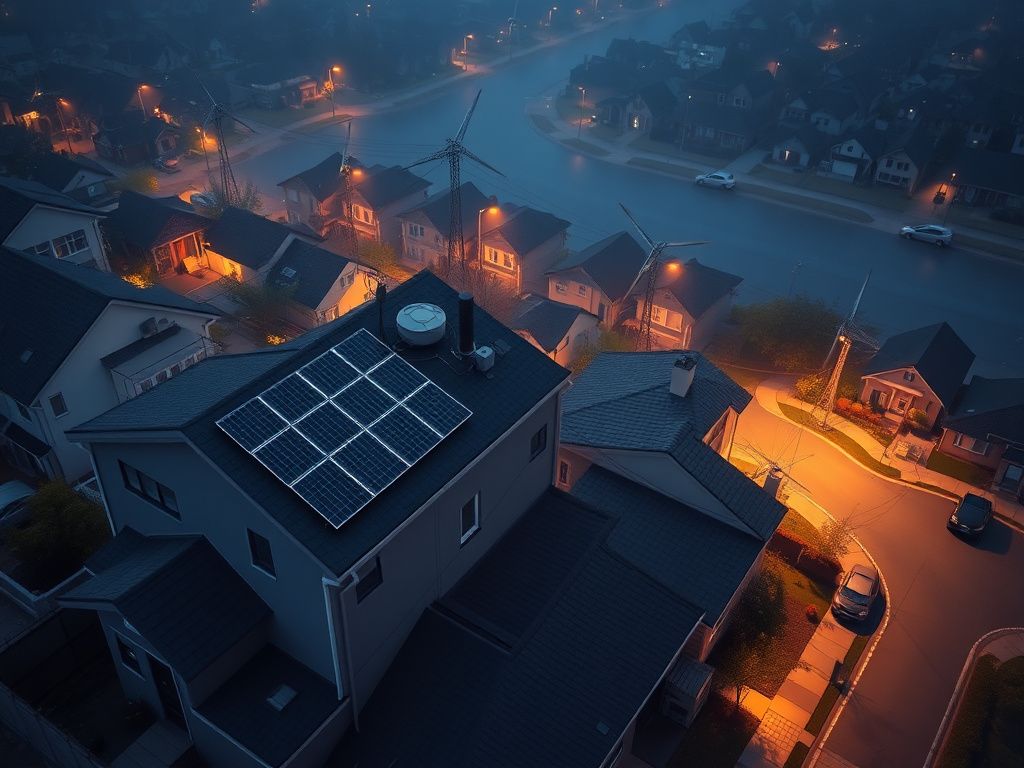
Micro-grids probably won't kill your utility — but they are quietly dismantling the logic that made utilities inevitable in the first place. The real threat to monopoly power isn't a single solar farm; it's the slow accumulation of neighborhoods, industrial campuses, and tribal lands discovering they can negotiate from a position of actual choice.
The standard utility relationship is deceptively simple: you consume power, they bill you, and the only lever you hold is whether to pay or go dark. That asymmetry has defined energy economics for over a century. Micro-grids are interesting precisely because they introduce a third option — islands of self-sufficiency that can stay lit when the main grid fails, negotiate their interconnection terms, or in extreme cases, disconnect entirely.
That third option changes the psychology of the whole negotiation, even when it's never exercised.
What a Micro-Grid Actually Is (and What It Isn't)
A micro-grid is a localized energy system — generation, storage, and load management — that can operate either connected to the main grid (grid-tied) or independently (islanded mode). The islanding capability is the technical detail that transforms it from "fancy solar installation" into something with genuine political and economic leverage.
The components aren't exotic. You typically need:
- Distributed generation — solar PV, wind, combined heat-and-power units, diesel or natural gas backup, sometimes small-scale hydro
- Battery storage or other buffering — increasingly lithium iron phosphate, though flow batteries are gaining ground in commercial applications
- A micro-grid controller — the actual brain, handling switching, load balancing, protection systems, and grid synchronization
- The interconnection agreement — the legal and technical document that governs your relationship with the utility, and arguably the most contentious piece of the entire stack
Most installed micro-grids today remain grid-tied the majority of the time. Full islanding is expensive to engineer properly — protection relays, anti-islanding compliance, transfer switches — and utilities have historically made interconnection as bureaucratically painful as regulatorily possible. This isn't conspiracy. It's institutional self-preservation behaving exactly like institutional self-preservation always does.
The Utility's Real Problem
Utilities aren't threatened by individual rooftop solar. They're threatened by organized defection at scale.
The economics of a traditional utility depend on recovering fixed infrastructure costs — poles, wires, substations, control systems — across a large customer base. When industrial customers and high-consumption residential clusters start generating substantial portions of their own power, the fixed costs don't disappear. They get redistributed across the customers who can't or won't defect. Those customers pay more. Some of them then defect. The cycle accelerates.
Utility economists call this the "death spiral" scenario, and it's been analyzed extensively in rate case filings at state public utility commissions across the US. Whether it actually materializes depends heavily on regulatory structure, but the underlying math is real.
What micro-grids add to this picture is resilience as a competitive differentiator. When a major ice storm knocks out grid power for four days, the hospital district or manufacturing campus that stayed lit isn't just saving money — it's demonstrating something visceral about the value proposition of distributed control.
"The utility's pitch has always been reliability. Once you've seen a micro-grid keep the lights on through a blackout that took the whole surrounding grid down, that pitch gets complicated." — paraphrased from testimony in multiple FERC interconnection proceedings
Where This Is Actually Happening
The operational reality of micro-grid deployment is geographically and sectorally uneven.
Military installations were early adopters, driven by energy security requirements. Fort Hood, Twentynine Palms, and multiple other US bases have deployed micro-grids specifically designed for extended islanding. The motivations here aren't environmental or economic — they're about operational continuity under adversarial conditions.
Tribal nations represent one of the more politically complex deployment contexts. Many tribal lands sit in areas with historically poor grid infrastructure, and the combination of energy poverty, sovereignty considerations, and available federal grant programs has produced genuine momentum. The Salt River Pima-Maricopa Indian Community's solar-plus-storage project in Arizona and similar efforts across the Navajo Nation demonstrate that "energy sovereignty" isn't just rhetoric — it's an actual negotiating posture with the utility.
University campuses and hospital systems run large-scale micro-grids for a mix of reliability and cost arbitrage reasons. Some of these systems have been operating for decades — MIT's campus energy system, for instance, has been evolving since the 1990s.
Puerto Rico after Hurricane Maria became an inadvertent proof-of-concept for distributed resilience. When centralized infrastructure catastrophically failed and stayed failed for months, communities and facilities with local generation were demonstrably better off. This wasn't a clean story — solar installations also got destroyed in the storm — but the structural lesson about centralized fragility was hard to ignore.
The Interconnection Problem
This is where the operational friction becomes acute.