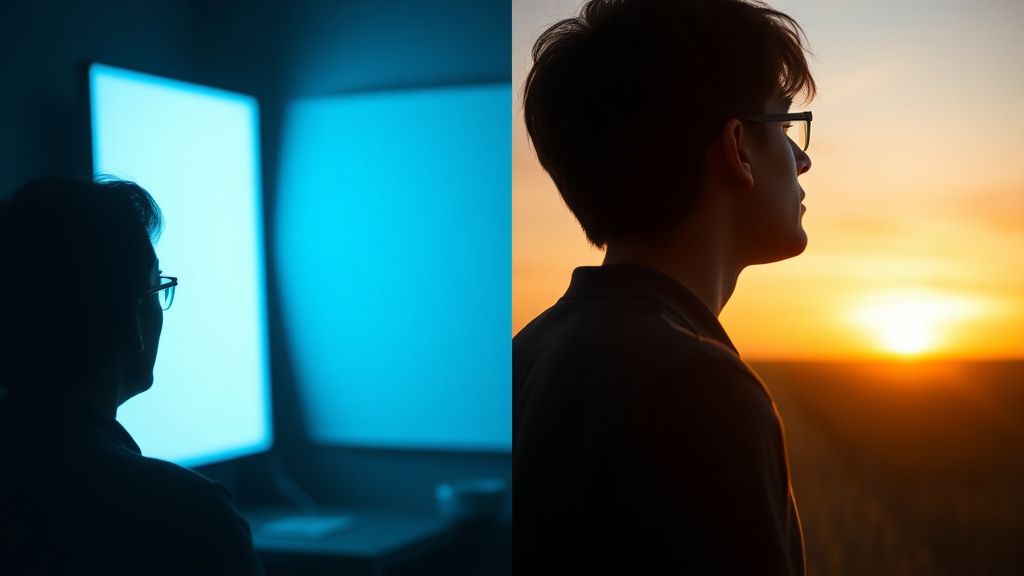
"Micro-dosing" sunlight is a rebrand of basic chronobiology, but in the hyper-optimized 2026 workspace, it has become a necessary tactical response to the blue-light saturation of modern life. By securing 5–10 minutes of direct solar exposure within the first hour of waking, you trigger a hormonal cascade—cortisol pulse, serotonin synthesis, and body temperature regulation—that stabilizes your wake-sleep cycle and elevates cognitive baseline for the rest of the day.
The modern office environment, whether at home or in a high-rise, is a sensory deprivation tank for our biological clocks. We operate under flickering LED spectra that mimic daylight in color temperature but fail to deliver the intensity required to signal the suprachiasmatic nucleus (SCN)—the brain’s master clock.
When you "micro-dose," you are essentially performing a system calibration. Without this, your internal clock suffers from what researchers call "social jetlag," a state of perpetual desynchronization where your endocrine system is constantly guessing what time of day it is, leading to the afternoon slump that coffee, nootropics, and endless scroll-breaks cannot fix.
The Physiology of the Morning Spike
The SCN is not just a passive sensor; it is a metabolic thermostat. When retinal ganglion cells detect high-intensity, full-spectrum light, they signal the SCN to trigger a healthy, time-appropriate spike in cortisol. This is not the "stress" cortisol we associate with deadline-induced anxiety; this is your wake-up hormone. It is the physiological "go" signal.
The failure point for most people is the indoor transition. You wake up, you hit the light switch (which is often cool-white, but dim compared to the sun), and you head to the kitchen. By the time you reach your desk, your brain is still essentially in a low-power mode. You’ve bypassed the biological ignition switch.
The Operational Reality: Why 2026 is Different
By 2026, the tech sector and the "hustle-lite" crowd have moved past the era of blue-light-blocking glasses, instead focusing on innovative solutions like why white-label AI chatbots are the new gold rush for agencies in 2026 to automate business efficiency. The focus has shifted from blocking the wrong light to securing the right light.
However, the operational friction is immense, especially when business owners fail to mitigate risks, which is why you should understand why your business insurance might not cover AI mistakes. If you live in a northern latitude in February, or if you work a shift-based role where sunlight is unavailable, you might need to adapt your logistics and strategy, similar to why top exporters are moving to regional warehousing to protect margins. This has birthed the "alternative spectrum" industry—a market as complex as the global logistics landscape, where why traditional exporting is failing in Southeast Asia: the AI strategy for 2026 remains a critical consideration.
Real Field Report: The "Light Box" Failure
In a recent thread on a prominent productivity subreddit, a user documented their experience with a "best-rated" 2025-era therapy lamp. The user, a software engineer living in London, attempted to use the device as a substitute for morning sun.
"The marketing said it was 10,000 lux. I spent two weeks using it for 20 minutes every morning. My sleep onset latency actually increased. I felt wired at 2 AM but exhausted at 10 AM. It turns out the spectral power distribution was garbage—it was peaking in wavelengths that suppressed melatonin but didn't actually hit the photoreceptors responsible for the cortisol pulse. It was just a high-intensity eye-strain machine."
This underscores a critical reality: There is no replacement for the sun. The sun emits a broad-spectrum emission that includes infrared, which has its own localized, non-visual physiological benefits. A light box, even a high-end one, is a crutch—much like relying on outdated tech; for example, you wouldn't use a failing system to fix a pipe when you could stop replacing your kitchen faucet: a property manager's guide to cartridge repair. If you are struggling with display settings, ensure you are testing your monitor's output against ambient levels, while also considering how the post-quantum security gold rush: how consultancies are preparing for 2026 will impact your digital security. You can double-check your display brightness calibration with our Screen Calibration Guide to ensure you aren't fighting your circadian rhythm with your own hardware.
The "Workaround" Culture and Its Discontents
Because the "perfect" morning is rarely possible for the modern worker, a massive workaround culture has emerged. People are now "stacking" their sunlight exposure. If they miss the morning window, they are trying to reclaim it by taking "light walks" during the 10 AM break or utilizing outdoor coworking spaces.
But this brings its own conflict: The tradeoff between productivity and biological optimization.
If you step away from your desk at 10 AM to get your "dose," you lose the flow state you might have just entered. This is the central tension of 2026 productivity: the system demands continuous presence, but your biology demands a fragmented, sun-lit existence.
Counter-Criticism: Is "Micro-dosing" Just Another Wellness Fad?
The loudest criticism comes from circadian biologists who argue that the term "micro-dosing" is reductive. Dr. Elena Vance, a recurring voice in bio-hacking circles, notes:
"Calling it 'micro-dosing' implies you can just take a hit and move on. Sunlight isn't a drug you titrate. It’s a sensory input that requires duration and specific angles. If you’re just standing in your backyard for two minutes, you aren’t doing anything. You are just standing in your backyard."