
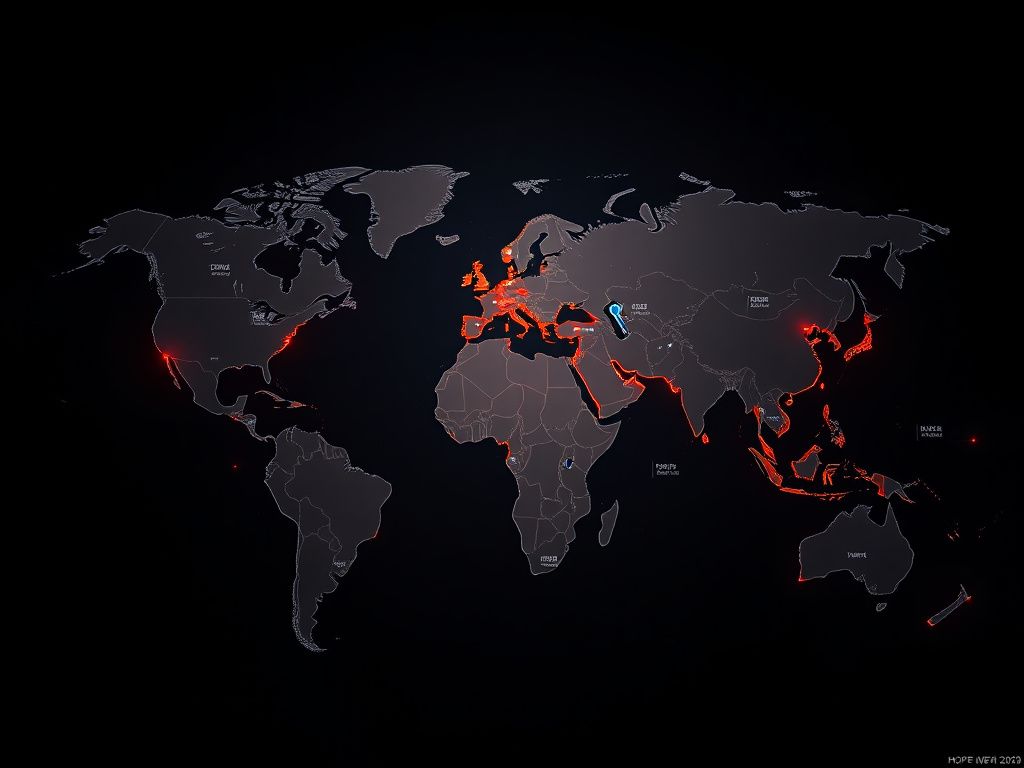
The global competition over AI semiconductors is rapidly intensifying, heading towards a critical juncture in 2026. This isn't just about trade; it's a profound geopolitical struggle for technological dominance, with nations like the US and China deploying massive subsidies, strict export controls, and strategic alliances. Their aim is to seize control over the design and production of advanced AI chips, a quest that is fundamentally reshaping global supply chains and the very dynamics of digital power.
Look beneath the sleek surface of your smartphone or deep within the vast server farms that fuel our connected lives, and you’ll find the quiet, complex battlefield of an undeclared war. This conflict doesn't involve traditional armaments, but rather silicon wafers, highly advanced photolithography machines, and intricate government policies. At its core lies the advanced AI chip, the fundamental building block for the next wave of economic growth and military capability. By 2026, the strategic alignments forming today will have solidified, creating a new global technology map defined by critical vulnerabilities, strategic partnerships, and a desperate race for technological self-sufficiency.
The New Battlefield: Why AI Chips Are the New Oil
For many decades, the Central Processing Unit (CPU) reigned supreme in computing, serving as the versatile, general-purpose workhorse for almost every task. However, the explosive growth of artificial intelligence, particularly the demands of deep learning, called for a fundamentally different type of architecture—one specifically designed for massively parallel computation. This is precisely where the Graphics Processing Unit (GPU), once primarily used for rendering video games, discovered its profound new purpose.
To put it simply: imagine a CPU as a single master chef, meticulously handling a series of complex, sequential steps with incredible precision. A GPU, on the other hand, is more like an entire kitchen staff of sous-chefs, each efficiently executing a simpler, repetitive task simultaneously. Training a large language model requires trillions of these straightforward calculations, a workload perfectly suited for the GPU's inherent parallel architecture.
This fundamental architectural shift propelled companies like NVIDIA beyond their origins as a gaming hardware manufacturer, transforming them into a crucial geopolitical player. Their GPUs quickly became the de facto standard hardware for nearly all AI research and deployment efforts. Yet, these aren't merely commercial products; they are increasingly viewed as critical national assets. They provide the processing power for:
- Economic Engines: Powering sophisticated AI models for finance, accelerating drug discovery, and optimizing global logistics.
- National Security: Driving innovations in autonomous drones, enhancing intelligence analysis, and developing next-generation cyber warfare capabilities.
- Cultural Influence: Enabling generative AI technologies for media creation, entertainment production, and widespread information dissemination.
Control the availability of these chips, and you effectively control the speed of innovation for every other nation. This profound realization is precisely what ignited the intense semiconductor wars we see today.
The Foundry Chokepoint: A Planet Reliant on One Island
The modern semiconductor industry largely operates under a fabless model. This means a company such as Apple, AMD, or NVIDIA designs its chips—each a marvel of digital architecture—but doesn't actually produce them itself. Instead, they transmit their intricate blueprints to highly specialized manufacturing facilities known as foundries, or "fabs."
This setup reveals the single most critical chokepoint in the entire global economy. An astonishing more than 90% of the world's most advanced logic chips (those built below 7 nanometers) are manufactured by just one company: the Taiwan Semiconductor Manufacturing Company (TSMC).
Such a high concentration creates a catastrophic single point of failure for global technology. Should a natural disaster strike, a trade blockade occur, or a political crisis unfold involving Taiwan, the production of almost every advanced electronic device on Earth could cease. Picture the entire global economy grinding to a complete halt because a solitary, hyper-specialized factory complex goes offline. This isn't an exaggeration; it’s the harsh reality that deeply concerns policymakers in Washington, Brussels, and Beijing alike.
Further intensifying this critical dependency is another undisputed monopoly: the Dutch company ASML (Advanced Semiconductor Materials Lithography). ASML stands as the sole producer of the Extreme Ultraviolet (EUV) lithography machines, which are absolutely essential for etching the impossibly tiny transistors found on today's most advanced chips. Each of these extraordinary machines costs well over $200 million, weighs a staggering 180 tons, and requires multiple cargo jets for its transport. Without ASML's EUV systems, it is quite simply impossible to construct a leading-edge semiconductor fab. Period.
The Geopolitical Chessboard: Nations and Their Strategies
Confronted with these immense critical dependencies, major global powers have largely set aside traditional free-market principles and have instead embraced aggressive industrial policies.