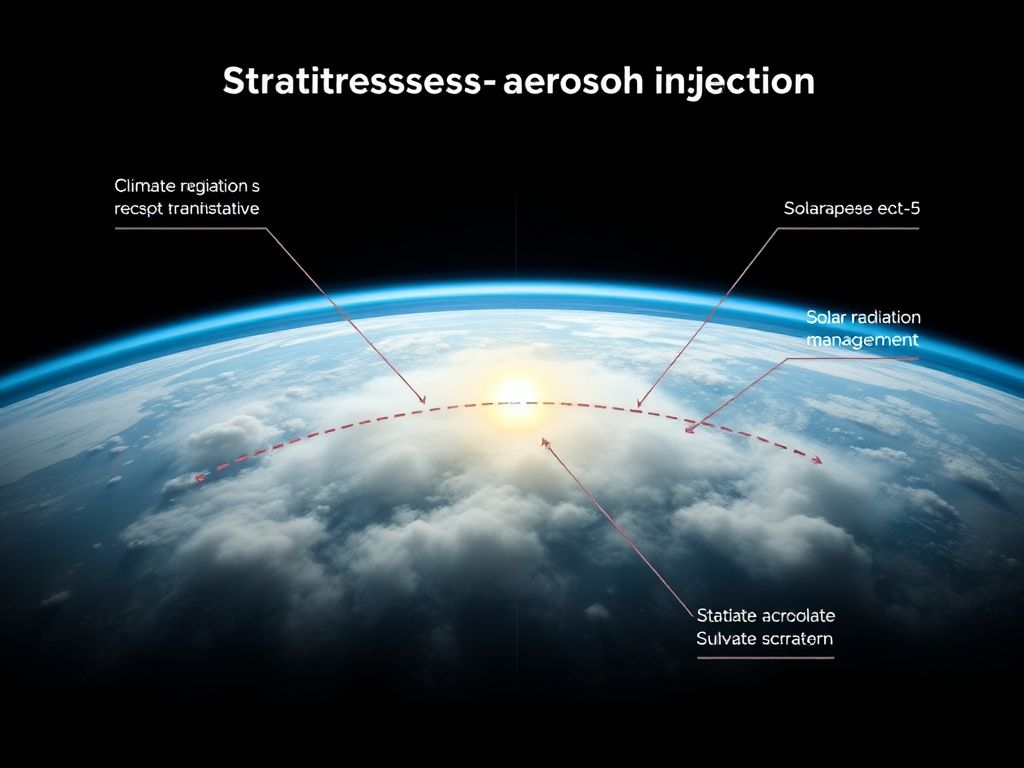
Stratospheric Aerosol Injection (SAI) is a theoretical form of solar radiation management that proposes reflecting a portion of sunlight back into space by dispersing reflective particles into the upper atmosphere. While models suggest it could lower global temperatures, the practice remains highly controversial, carrying significant risks of unpredictable climate shifts, geopolitical instability, and ecological disruption.
The conversation around Stratospheric Aerosol Injection (SAI) has shifted from the fringes of "mad science" to the serious, if uncomfortable, agendas of high-level climate policy. We are no longer talking about whether it is possible; the physics of the Mount Pinatubo eruption in 1991—which cooled the Earth by about 0.5°C for over a year—proved that volcanic aerosols act as a global thermostat. The question today is not "can we," but "what happens if we try to replicate a disaster?"
The Mechanics: How We Play God with the Stratosphere
At its core, SAI is an engineering problem disguised as a climate solution. The proposal involves deploying specialized aircraft or high-altitude balloons to inject sulfur dioxide ($SO_2$) or similar reflective aerosols into the lower stratosphere, typically at altitudes between 18 and 25 kilometers. Once there, these particles form sulfate aerosols, which have a high "albedo"—they reflect incoming shortwave solar radiation before it reaches the troposphere.

The engineering challenge here is scale. To achieve a cooling effect of 1°C, we are talking about injecting millions of tons of material annually. This is not a task for a few hobbyists; it requires a fleet of specialized tankers that don't currently exist, flying sorties every few hours, indefinitely. If you stop the injection, the cooling effect dissipates within months, leading to "termination shock"—a rapid, violent spike in global temperatures as the suppressed warming effect catches up with the current greenhouse gas concentration.
The Operational Reality: Why Engineers Are Skeptical
If you spend time on forums like Hacker News or dig through the MIT Climate Science discussion threads, the enthusiasm for the technology is often tempered by a cold, hard look at the operational requirements. The primary issue isn't just the dispersal; it’s the lack of global regulatory infrastructure.
Engineers point out that the stratosphere is a chaotic, fluid environment. We struggle to accurately predict weather two weeks out with current supercomputing models. Proposing a permanent "aerosol umbrella" implies we have the omniscience to manage global rainfall patterns, monsoon cycles, and agricultural yields across every continent.
"We are talking about building a global cooling system that requires 100% uptime, managed by a coalition of countries that can’t even agree on basic carbon credit standards. One minor diplomatic spat, and someone pulls the plug. Termination shock isn't just a theory; it's an operational certainty if the system fails." — Anonymous contributor, climate-engineering-discussion mailing list.
The Failure Points: From Regional Droughts to Ozone Depletion
The most glaring risk is the disruption of the hydrological cycle. Aerosols reflect sunlight, but they don't treat the CO2 already in our atmosphere. While the average temperature might drop, the distribution of rainfall changes significantly. Models—such as those run via the Geoengineering Model Intercomparison Project (GeoMIP)—show that massive SAI deployment could potentially suppress the South Asian and African monsoons, endangering the food supply of billions of people.
Furthermore, there is the issue of ozone recovery. We spent decades undoing the damage caused by CFCs. Injecting sulfur into the stratosphere provides a surface for chemical reactions that could accelerate the depletion of the ozone layer, effectively trading heat stroke for skin cancer and increased UV radiation.
Real Field Reports: The SCoPEx Controversy
The Stratospheric Controlled Perturbation Experiment (SCoPEx), led by researchers at Harvard, serves as the perfect case study for the social and political friction of this field. The project wasn't even about geoengineering; it was about releasing a small amount of calcium carbonate to measure how particles behave in the atmosphere.
The backlash was immediate and fierce. The Swedish indigenous group, the Saami Council, led a charge against the project, arguing that the mere act of testing signaled a "techno-fix" that distracted from the urgent need to decarbonize. The project was eventually canceled, not because of technical failure, but because of a massive loss of social license. This highlights the "adoption friction" that any real-world deployment will face: it isn't the technology that will stop it, it’s the lack of global consent.
Counter-Criticism: The Moral Hazard Trap
The most frequent criticism of SAI is the "Moral Hazard." Critics argue that by even researching these technologies, we are providing a convenient "get out of jail free" card to fossil fuel companies and obstructionist politicians. If a solution exists that lets us keep the engine of capitalism running while suppressing the side effects, why would anyone make the painful transition to renewables?
- Political Fragmentation: Who controls the thermostat? If India decides it needs to cool the planet to save its crops, but the resulting rain patterns cause a drought in Brazil, does that constitute an act of war?
- The "Unknown Unknowns": In the 1960s, we didn't know what leaded gasoline was doing to our brains until it was too late. With SAI, the feedback loop is global. By the time we realize we’ve made a mistake, the atmospheric chemistry might take decades to revert.