
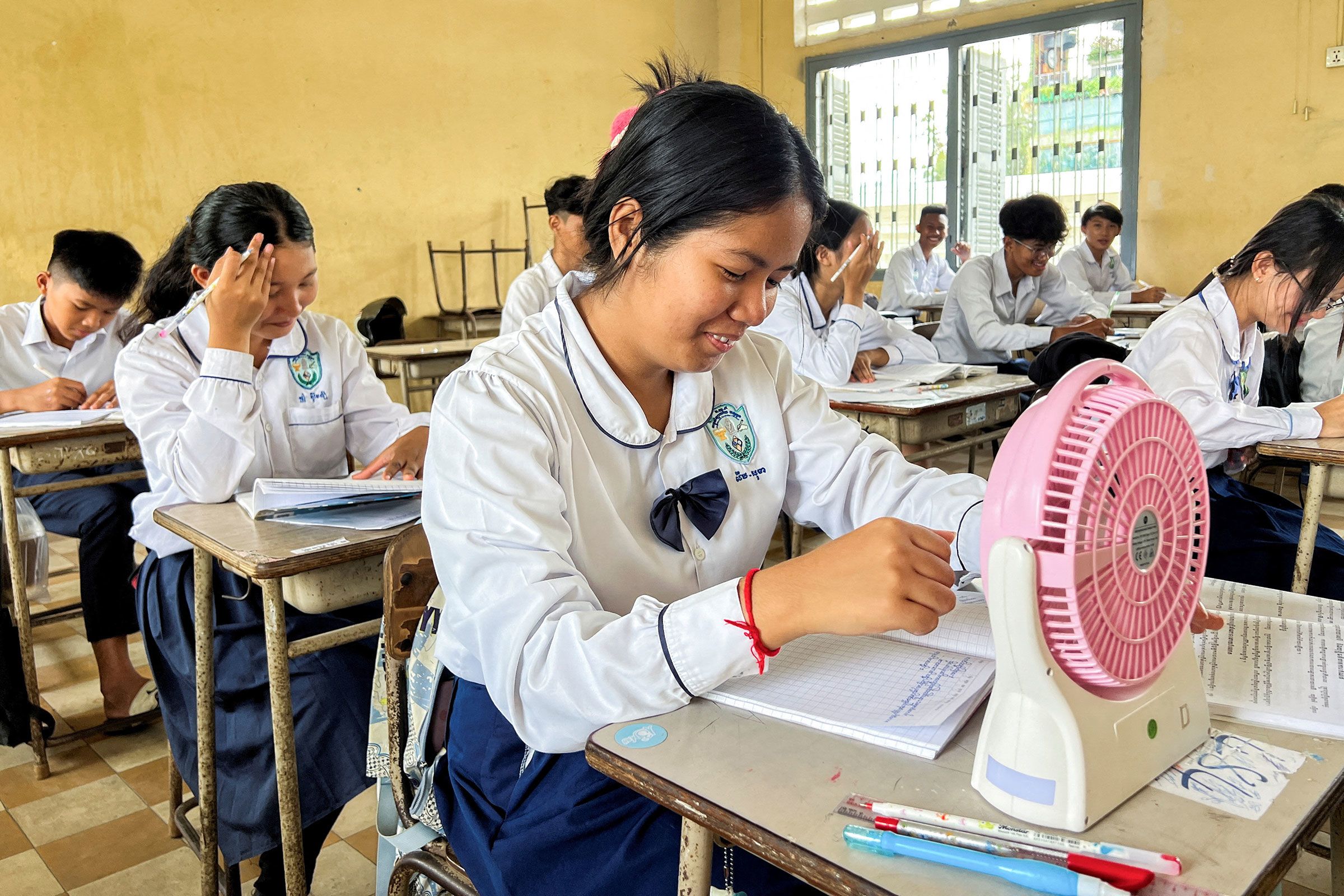
The silence in what was once the bustling courtyard of the Santo Niño Elementary School in Manila is the most unsettling part. Where hundreds of children once played, there is now only the shimmering haze rising from the cracked concrete. The school has been officially closed since May, not for a holiday, but for the foreseeable future. Its 800 students are now part of a rapidly growing, tragic cohort: the climate-displaced learner.
This scene is being replicated with alarming frequency across the Earth's tropical belt. From the sprawling megacities of South Asia to the rural villages of the Sahel, a radical and previously unthinkable policy is taking hold. In 2026, the temporary, heat-related school closures of years past have begun to metastasize into something far more permanent. Governments, facing an unrelenting onslaught of extreme heatwaves, are being forced to concede that their educational infrastructure is fundamentally incompatible with the new climate reality. The Great Shutdown is no longer a forecast; it is a present and escalating crisis.
The Unsurvivable Classroom
The tipping point was the brutal, record-shattering summer of 2025, which bled deep into what were once cooler autumn months. It was followed by a spring in 2026 that offered no respite. Insiders at the World Meteorological Organization report that dozens of meteorological stations across a band stretching from Pakistan to the Philippines registered wet-bulb globe temperatures (WBGT) exceeding 32°C for unprecedented durations. This isn't just a measure of heat; it's a critical index of heat stress on the human body, combining temperature, humidity, wind speed, and solar radiation.
For children, who are physiologically less capable of regulating their body temperature than adults, these conditions are a medical emergency. "We are not talking about simple discomfort," explains Dr. Aruna Sharma, a pediatric specialist and lead author of a recent, stark report in The Lancet Planetary Health. "We are talking about a state of profound physiological distress. At these temperatures, a child's body cannot cool itself effectively. We see a cascade of events: severe dehydration, electrolyte imbalance, acute kidney injury, and a terrifying increase in the incidence of heatstroke, which can cause permanent neurological damage or death."
The data backs up her warning. During a three-week period in April 2026, hospitals in India's Rajasthan and Pakistan's Sindh province reported a 400% increase in pediatric admissions for heat-related illnesses. The infrastructure in most tropical-region schools—often poorly ventilated, overcrowded concrete buildings with corrugated metal roofs and no air conditioning—transforms them from places of learning into dangerous heat traps. The cost of retrofitting millions of schools with sustainable cooling and insulating them against the heat is, for most affected nations, an economic impossibility.
The Digital Mirage
The default response from ministries of education has been a panicked pivot to remote learning. On paper, it seems like a 21st-century solution. In reality, it is proving to be a catalyst for one of the most significant educational equity disasters in modern history.
"The concept of 'Climate E-Learning' is a mirage for the vast majority of our students," a senior official in Indonesia's Ministry of Education and Culture confided, speaking on condition of anonymity. "We are creating a permanent educational underclass."
Market analysis confirms this grim assessment. In many of the hardest-hit regions, the digital divide is not a gap but a chasm. Consider the numbers: