
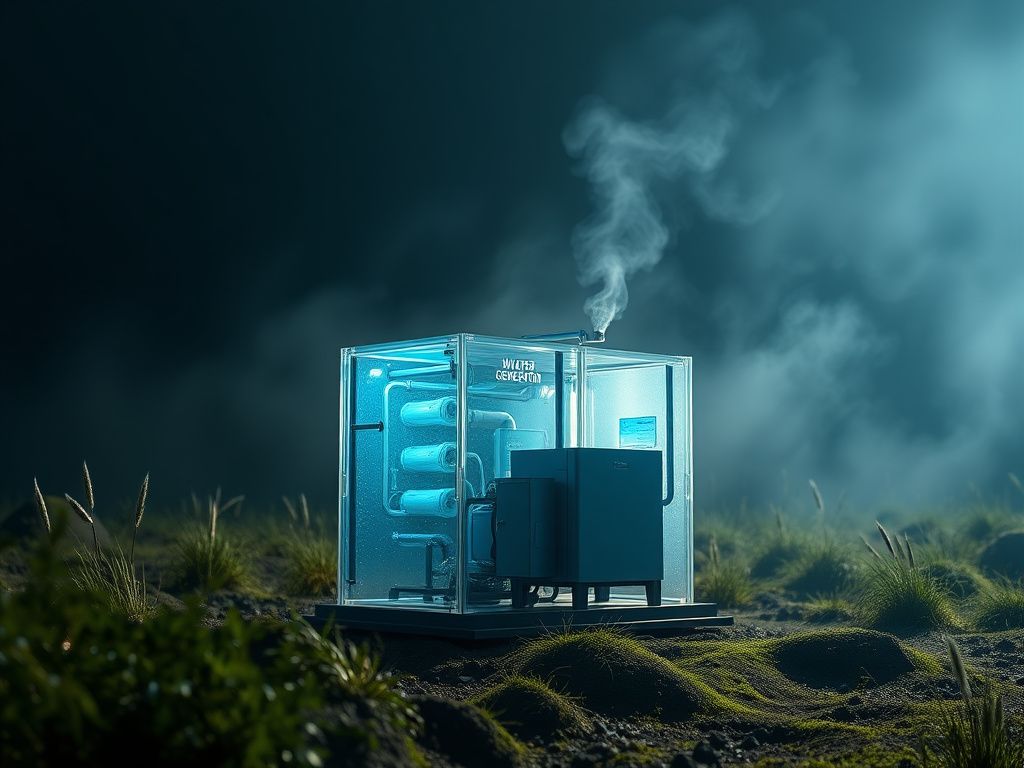
Quick Answer: Atmospheric Water Generation (AWG) extracts drinking water directly from humid air using condensation or desiccant technologies. The global AWG market is projected to exceed $50 billion by 2030. While promising for water-stressed regions, AWG is not a universal solution — its viability depends heavily on local humidity, energy costs, and deployment scale.
The world is running out of accessible freshwater. Over 2.2 billion people lack safely managed drinking water (WHO/UNICEF, 2023), and by 2050, an estimated 5.7 billion could face water scarcity for at least one month per year. Against this backdrop, a technology once confined to military field operations and science fiction has entered the mainstream investment conversation: Atmospheric Water Generation.
But is AWG genuinely transformative — or is it an expensive solution searching for the right problem?
What Is Atmospheric Water Generation?
AWG is the process of extracting potable water from ambient air by exploiting the moisture content of the atmosphere. The Earth's atmosphere holds approximately 12,900 cubic kilometers of water vapor at any given time — more than six times the volume of all rivers on Earth combined.
There are three primary technical approaches:
1. Cooling Condensation (Refrigerative AWG)
The most commercially deployed method. Air is drawn in, cooled below its dew point, and the resulting condensate is collected and filtered. This is essentially the same principle as a household dehumidifier, but engineered for potable water production.
- Operational humidity threshold: Typically requires ≥40–50% relative humidity (RH)
- Energy consumption: 0.3–2 kWh per liter depending on unit efficiency and ambient conditions
- Key players: Watergen (Israel), SOURCE Global (USA), AKVO Atmospheric Water Systems
2. Desiccant-Based AWG
Solid or liquid desiccants (hygroscopic materials) absorb atmospheric moisture, which is then released as water vapor using heat and subsequently condensed. This method can operate in lower humidity environments (as low as 15–20% RH) — a critical advantage for arid regions.
- Example technology: SOURCE Hydropanels use a proprietary hygroscopic material powered entirely by solar energy
- Output: ~2–5 liters per panel per day in optimal conditions
- Thermal regeneration requirement: Makes solar integration particularly attractive
3. Fog/Mesh Collection
Large mesh nets capture fog droplets in coastal or mountain fog zones. Low-tech, low-cost, but geographically restricted.
- Case study: The Moroccan village of Aït Baamrane has operated fog-collection systems since 2015, supplying water to over 400 households at roughly $0.05 per liter — among the lowest costs for any AWG modality
The $50 Billion Market Projection: What's Driving It?
Market research firms including MarketsandMarkets and Grand View Research project AWG industry revenues reaching $43–55 billion by 2028–2030, representing a CAGR of approximately 25–30%.
The drivers are multi-layered:
Economic Factors
- Declining cost of renewable energy (solar PV costs dropped ~90% between 2010–2023 per IRENA) makes off-grid AWG increasingly viable
- Bottled water alternative: AWG at commercial scale can produce water at $0.15–$0.30/liter vs. bottled water at $0.50–$3.00/liter in developing markets
Geopolitical Factors
- Military procurement: The U.S. Department of Defense has invested in AWG for forward operating bases where supply lines are vulnerable
- National water security programs: India, UAE, and Israel have integrated AWG into strategic water portfolios
- The UAE's National Water Security Strategy 2036 explicitly includes AWG as a diversification pillar
Social Factors
- Climate-driven migration is concentrating populations in coastal urban areas — often high-humidity environments optimal for refrigerative AWG
- NGO procurement: UNICEF and Red Cross field operations have trialed Watergen's GEN-350 units (producing up to 350 liters/day) in disaster relief scenarios
Critical Limitations: Where AWG Fails
AWG proponents sometimes overlook serious systemic constraints that limit universal applicability.
Energy Intensity
Refrigerative AWG is energy-hungry. A standard unit producing 20 liters/day may consume 300–600 watts continuously. Scaling to municipal supply levels — say, 1 million liters/day — would require energy inputs equivalent to a small power plant.
Comparative benchmark: Reverse osmosis (RO) desalination produces water at 0.003–0.004 kWh/liter; refrigerative AWG averages 0.5–1.5 kWh/liter — roughly 100–400x more energy-intensive per unit.
Humidity Dependency
In hyper-arid zones (Sahara, Atacama, Arabian interior), where water need is greatest, relative humidity often falls below 20%. Cooling condensation systems become economically non-viable below ~40% RH.