
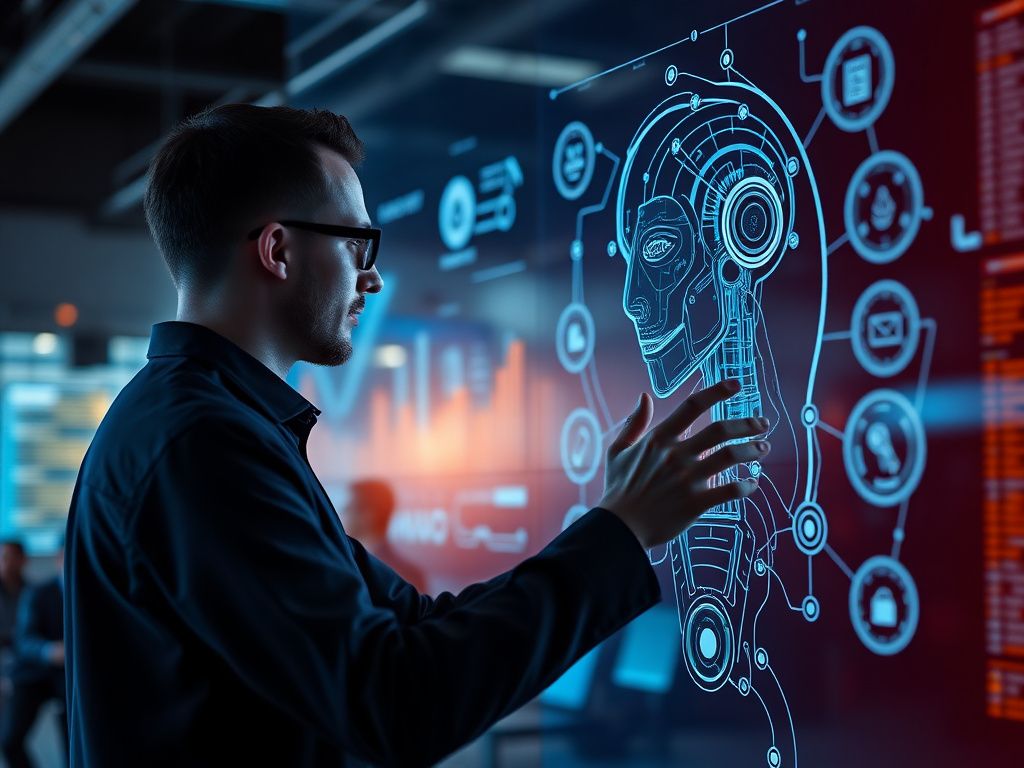
To truly safeguard your career against the tide of automation heading our way by 2030, your best bet is to zero in on skills that artificial intelligence simply can't mimic. This means putting a strong emphasis on cultivating advanced emotional intelligence, honing your complex problem-solving abilities, and developing a knack for creative systems thinking. Beyond just knowing how to use AI tools, you'll want to become a master of AI literacy and prompt engineering—learning to strategically guide these powerful systems for the greatest business benefit.
When we talk about Artificial Intelligence and its impact on careers, it often feels like a stark competition: us versus the machines. But in my experience as a business architect, having spent decades crafting intricate commercial systems, I believe this view fundamentally misunderstands the huge economic and technological shift unfolding around us. AI isn't here to compete with us; think of it more as the brand-new operating system for how businesses run. The real winners by 2030 won't be the ones who try to hold back automation, but rather those who master the art of directing and integrating it.
The shifts we're seeing aren't primarily about entire jobs disappearing, but rather about specific tasks being taken over. Those repetitive, predictable, and data-heavy responsibilities are rapidly being handed off to AI assistants. This actually frees us, as humans, to focus on what we truly excel at: understanding nuance, crafting strategy, and building genuine connections. Over the next decade, your professional worth will hinge directly on the skills you bring that are simply beyond what a machine can do. The aim here is to transform your position from someone who just executes tasks to someone who provides strategic oversight.
Essential Skills for the AI-Powered Professional
To truly secure your career path, you'll need to cultivate a collection of enduring, distinctly human skills. Don't think of this as a simple checklist, but rather as a carefully constructed framework for your professional future. While technical know-how forms the base, the elements that will sustain your value long-term are, without a doubt, uniquely human.
1. AI Literacy and Prompt Engineering: Your New Superpower
Back in the 1980s, being able to navigate a command-line interface felt like having a secret weapon. Fast forward to today, and the equivalent skill is AI literacy. This isn't just about typing a query into a chatbot; it's about truly grasping what different AI models can do—and, crucially, what they can't.
- Model Awareness: Can you instinctively tell when to reach for a large language model (LLM) like GPT-4 for crafting compelling marketing copy, versus when a specialized data analysis model would be better for spotting the next big market trend?
- Prompt Engineering: This is both an art and a science—the skill of giving AI clear, effective instructions. In fact, it's shaping up to be the most vital technical skill of the coming decade. A vague prompt will get you bland, unhelpful results. But a meticulously crafted prompt, packed with context, specific limits, and desired formats, can deliver output that's 90% ready to go. Think of it as the difference between vaguely telling an intern to "write something" and handing a senior analyst a comprehensive, multi-layered brief.
- Ethical Oversight: Knowing how to identify the inherent biases within AI models, and then having the ability to check and correct for them, is rapidly becoming an essential part of responsible management.
Experts often point out that excelling at prompt engineering isn't really about writing code; it's far more about communicating clearly, thinking logically, and bringing your specific industry knowledge to the table. In essence, you're taking on the role of a manager, guiding a brilliant but extremely literal team member.
2. Data Synthesis and Critical Analysis: Uncovering Real Insights
AI is an incredibly powerful machine when it comes to churning out and collecting data. It can digest terabytes of information in mere seconds. What it can't do on its own, however, is extract genuine wisdom or build a solid decision-making framework. That crucial part still belongs firmly in the human realm.
The professional who's truly ready for the future isn't the one simply collecting data. Instead, it's the person who can glance at an AI-powered dashboard and assert, "While this is interesting, it's not actually answering the most important question." They possess the ability to pull together information from all sorts of places—an AI report, a chat with a customer, even a faint shift in market mood—and then craft it into a clear, strategic story. This demands profound critical thinking and the courage to question the very assumptions behind the data you're seeing. The real talent isn't just reading the chart; it's understanding what the chart isn't telling you.
3. Emotional Intelligence (EQ) and Human-Centric Skills: Our Irreplaceable Foundation
This truly forms the bedrock of a sustainable career for the long haul. While AI can certainly mimic empathy, it simply can't build genuine trust, ignite a team's passion, or navigate a complex, high-stakes negotiation with the kind of subtle cultural awareness that humans possess. These traditionally labeled soft skills are quickly becoming the most powerful skills you can have.
- Collaboration: Excelling at leading and actively participating in teams made up of people with diverse perspectives.
- Negotiation & Persuasion: Deeply understanding what motivates people to effectively build consensus and achieve common goals.
- Leadership & Mentorship: The ability to truly inspire and foster the growth of others.
- Client Relationships: Cultivating lasting rapport and trust with clients that goes far beyond simple transactions.
From where I stand, businesses are already placing immense value on individuals who possess a high degree of emotional intelligence. These are the people who act as the vital connective tissue within AI-powered teams, making sure that technology truly supports the company's human-focused objectives, rather than becoming an end in itself.