
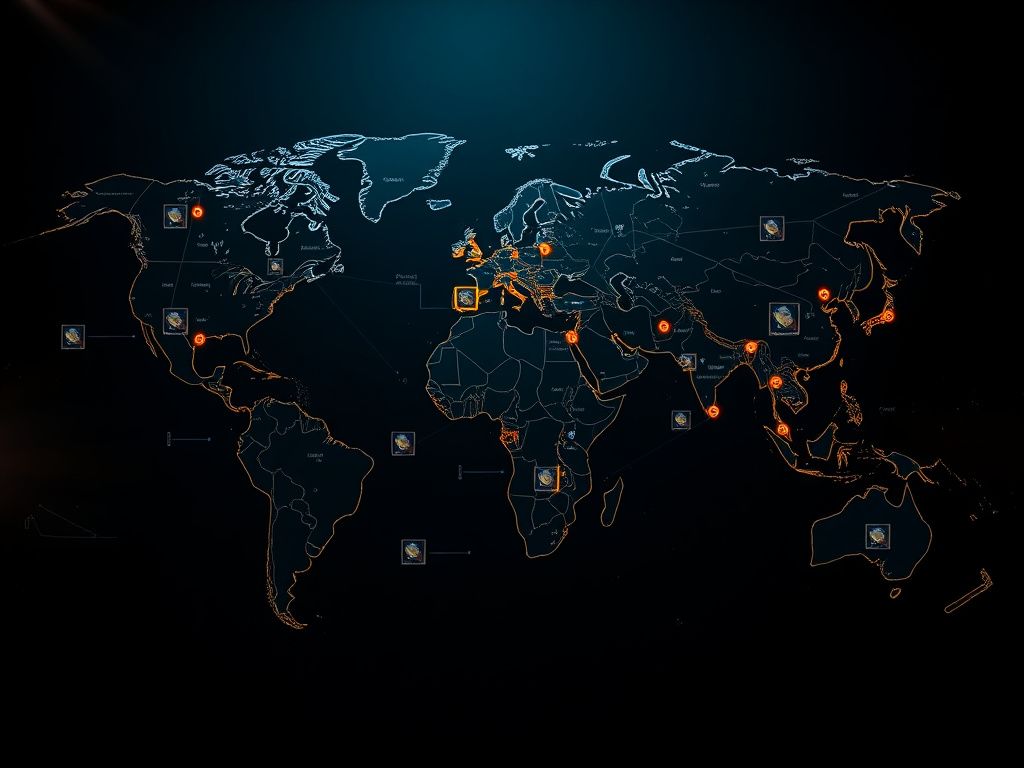
The unfolding drama around artificial intelligence isn't just a clash of brilliant algorithms; it's a fierce global contest for the very physical brains of AI. We're talking about the 'AI chip war,' a deeply geopolitical struggle focused on who controls the blueprints, factories, and flow of advanced semiconductors. These tiny components are, in essence, the fundamental building blocks of our modern economy. This high-stakes competition is dramatically reshaping the world's technological landscape, with massive ripple effects on national security, global economic power, and even the everyday tech devices we all rely on.
The New Silicon Oil: Why AI Accelerators are the World’s Most Critical Resource
For generations, crude oil fueled the world's economy. Now, and even more so by 2026, the true engine of innovation is the AI accelerator. These aren't the familiar CPUs you find powering your average laptop. While a Central Processing Unit (CPU) excels as a versatile performer, handling sequential, general-purpose tasks with ease, an AI chip—often a Graphics Processing Unit (GPU) or a highly specialized Tensor Processing Unit (TPU)—operates on an entirely different principle.
Architecturally speaking, these powerful chips are supremely skilled at just one thing: performing calculations on a massive scale, all at once. Imagine it like this: a CPU is a brilliant university professor tackling one complex problem methodically, step by step. An AI accelerator, by contrast, is akin to an entire stadium filled with students, each equipped with a basic calculator, all working simultaneously to solve tiny portions of an enormous equation. This parallel processing capability is precisely what's needed for the intensive matrix multiplication that forms the backbone of deep learning models.
Experts typically distinguish between two crucial types of workloads:
- Training: Picture this as the incredibly demanding, energy-guzzling process of teaching an AI model, much like ChatGPT. It involves feeding the model gargantuan datasets and often requires thousands of the highest-end GPUs to run continuously for weeks or even months. This is where truly powerful and costly chips, such as NVIDIA's H100, become absolutely essential.
- Inference: This is the 'real-time' stage, where a fully trained model applies its knowledge to make predictions or create new content. While not as resource-hungry as training, serving inference to millions of users at scale still calls for specialized, highly efficient hardware to keep costs low and responses instant.
If you control the flow of these chips, you essentially control the very speed of AI innovation itself. This profound reality is something global superpowers understand all too well.
The Key Players on the Global Chessboard
The semiconductor supply chain is truly one of the most intricate and geographically focused marvels of modern engineering. To grasp the complexities of the AI chip war, it’s essential to identify the main players and the distinct roles each one fulfills.
The Designers: United States
The U.S. has historically commanded the most profitable, high-margin segment of the chip industry: design. Companies such as NVIDIA, AMD, Google, and Apple follow a 'fabless' business model. They pour billions into research and development to engineer the world’s most advanced chips, yet they entrust the actual manufacturing to external partners. NVIDIA, notably, has secured a near-monopoly in the crucial high-end GPUs vital for AI training, granting the U.S. significant influence. The recent CHIPS and Science Act represents a monumental push to counteract this fabless approach by offering incentives to bring manufacturing back onshore, directly addressing existing supply chain weaknesses.
The Foundry: Taiwan
If the U.S. designs the blueprints, Taiwan constructs the skyscraper. TSMC (Taiwan Semiconductor Manufacturing Company) stands as the world's unrivaled contract chip manufacturer, or 'foundry.' They possess an almost magical capability to transform intricate designs into physical silicon, operating at the very leading edge of process nodes, like 5-nanometer and 3-nanometer. Astonishingly, over 90% of the planet's most advanced logic chips are produced right there in Taiwan. This extreme concentration creates a perilous single point of failure, arguably making TSMC the most strategically vital company anywhere in the world.
The Enabler: Netherlands
Neither the U.S. nor Taiwan can bring advanced chips to life without a crucial, yet often overlooked, partner: the Netherlands. One Dutch company, ASML, maintains an absolute monopoly on the Extreme Ultraviolet (EUV) lithography machines—the indispensable tools for imprinting unimaginably tiny circuits onto today's sophisticated chips. Each EUV machine carries a price tag exceeding $200 million, weighs a staggering 180 tons, and represents the absolute zenith of modern physics and engineering. Simply put, you cannot construct a leading-edge semiconductor fabrication plant without ASML. It is the ultimate bottleneck.
The Challenger: China
Aware of its profound reliance on foreign technology, China has launched an extraordinarily ambitious, state-backed mission for tech sovereignty. Through programs like 'Made in China 2025,' it is channeling hundreds of billions of dollars into cultivating its own domestic semiconductor industry, spanning everything from design software to advanced manufacturing capabilities with companies like SMIC. Despite these immense efforts, China still lags several generations behind the global forefront, a disparity further widened by coordinated actions from the U.S. and its allies aimed at impeding its advancement.
The Battleground: Export Controls and Silicon Diplomacy
The main instrument in this unfolding conflict isn't military might; it's policy. The United States has enacted extensive export controls specifically designed to block China from obtaining both the most cutting-edge AI chips (such as NVIDIA's A100/H100) and the specialized machinery required to produce them (like ASML's EUV machines).
This extends far beyond a typical trade dispute. It's a calculated strategic maneuver aimed at decelerating China's military modernization and reining in its progress in state-sponsored AI surveillance and warfare technologies. Recent industry analysis reveals these controls have sparked a significant global realignment, ushering in a new era of 'Silicon Diplomacy.' Countries are increasingly compelled to take a stance. The U.S. has effectively persuaded crucial allies such as Japan and the Netherlands to implement comparable export limitations, thereby establishing a synchronized blockade on vital technology.