Quick Answer: Sony Bravia XR screen artifacts — including flickering, banding, green or pink pixel flashes, and black frame glitches — are caused by a combination of firmware bugs, HDMI handshake failures, panel stress, and cognitive processor miscalibration. Most cases respond to a soft reset, firmware update, or HDMI reconfiguration, but some point to deeper hardware degradation that a factory reset won't fix.
There's a particular kind of dread that sets in when you're thirty minutes into a movie and your $2,000 Sony Bravia XR panel starts throwing what looks like a static-filled seizure across the screen. A green horizontal band pulses through the image. Or a cluster of dead pixels blooms in the corner. Or the entire display cuts to black for two frames every few minutes—if you are experiencing a persistent blackout on other devices like a Fire TV Stick 4K Max, check this guide on how to fix a Fire TV Stick 4K Max black screen.
These aren't niche complaints. Search any AV forum, and you'll find threads documenting symptoms for Bravia XR models, just as gaming communities troubleshoot hardware quirks like how to fix PS5 DualSense stick drift or replace a PS5 CMOS battery. Some threads run hundreds of replies deep. The fact that Sony hasn't fully resolved several of these through firmware patches — despite acknowledging some — is itself worth examining.
This is not a simple "update your TV and restart" walkthrough. This is an attempt to understand what's happening at the firmware and panel levels, similar to how one might diagnose why a Home Assistant Green won't boot or why a Garmin Forerunner loses GPS accuracy.
What "Screen Artifacts" Actually Means on a Sony Bravia XR Panel
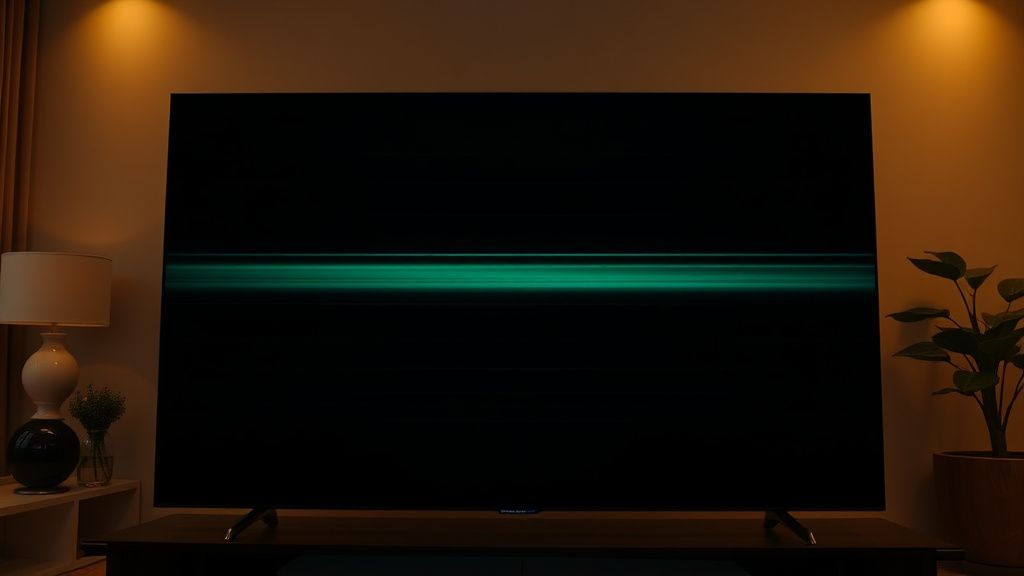
The term "artifact" is frustratingly broad, much like the vague error codes found when troubleshooting a Jura E8 Error 8 brew group stall or a Philips Hue bridge disconnecting. In display engineering, it refers to any visual anomaly that isn't part of the source content. On Sony Bravia XR hardware specifically, artifacts tend to cluster into recognizable categories, and each category has a distinct diagnostic fingerprint.
Banding and Uniformity Problems
Panel banding is a common display issue, not unlike dealing with DeLonghi Magnifica S flashing lights or diagnosing why Wi-Fi 7 drops packets due to MLO jitter. It appears most visibly in scenes with large areas of uniform color: grey skies, dark interiors, gradient backgrounds in UI menus.
On the A80J and A90J specifically, this became so consistent that community members on AVSForum created dedicated test pattern threads to document it. The phenomenon is partly inherent to OLED panel manufacturing tolerances — every OLED has some degree of non-uniformity baked in — but the Bravia XR Cognitive Processor's upscaling and scene analysis algorithms can amplify or suppress it depending on how aggressively picture processing is engaged.
The key variable: Motionflow settings and Picture Mode. Cinema Pro mode with Motionflow set to "True Cinema" tends to expose banding more visibly than Vivid mode, because the former applies less temporal noise masking. This isn't a bug exactly — it's a processing tradeoff — but users who calibrate their displays for accurate color often find themselves staring directly at the panel's physical limits.
Pixel Flash Events: The Green and Pink Anomaly
This one is harder to explain away as normal behavior, similar to the frustration of an LG OLED flickering or an iPhone 16 Pro suffering from rapid battery drain. Multiple Bravia XR A90K and A95K owners documented sudden single-frame or multi-frame flashes of vivid green or bright pink clusters — sometimes isolated to a corner, sometimes spanning a third of the screen. It happens unpredictably, often during HDR transitions or when the TV switches between content sources.
The working theory in the engineering community is that this relates to OLED pixel driver initialization during dynamic range switching. When the panel rapidly transitions from SDR to HDR10 or Dolby Vision metadata, the per-pixel current drivers briefly misfire. Sony pushed firmware updates targeting this — firmware version 6.x addressed some of it on A90J — but the fix was incomplete. Threads on the Sony Community Forums (support.sony.com) from 2022 and 2023 still show users reporting identical behavior on fully updated hardware.
"Updated to latest firmware, factory reset twice, same green flash every time I switch from Netflix to a PS5 input. Sony support told me it was 'expected behavior during input switching.' I don't accept that." — User bravia_frustrated_88, Sony Community Forums, September 2023
Flickering Under Specific Conditions
Bravia XR OLED flickering is almost never random. It's almost always conditional. The conditions that consistently trigger it:
- Low APL (Average Picture Level) content — very dark scenes, particularly in Dolby Vision or HDR10+ mode
- HDMI 2.1 4K/120Hz input from gaming consoles (PS5, <a href="https://www.amazon.com/s?k=Xbox%20Series%20X&tag=gunesseo-21" rel="sponsored noopener" target="_blank">Xbox Series X) with VRR enabled
- Content with rapid scene cuts — action sequences, music videos, sports
The OLED panel's auto-brightness limiter (ABL) is a primary culprit. Sony implements ABL to protect panel longevity — if the panel gets too bright across too large an area for too long, it throttles luminance dynamically. The problem is the transition isn't always smooth. Under certain content conditions, the ABL threshold is crossed repeatedly in short succession, causing visible luminance pumping that registers as flickering.
This is a known tradeoff in OLED design. LG, Sony, Philips OLED — they all navigate it differently. Sony's implementation on XR panels has historically been more aggressive than some competitors, prioritizing longevity over absolute stability in borderline-ABL content. Whether that's the right call depends on who you ask.
The HDMI 2.1 Handshake Problem: A Years-Long Operational Nightmare
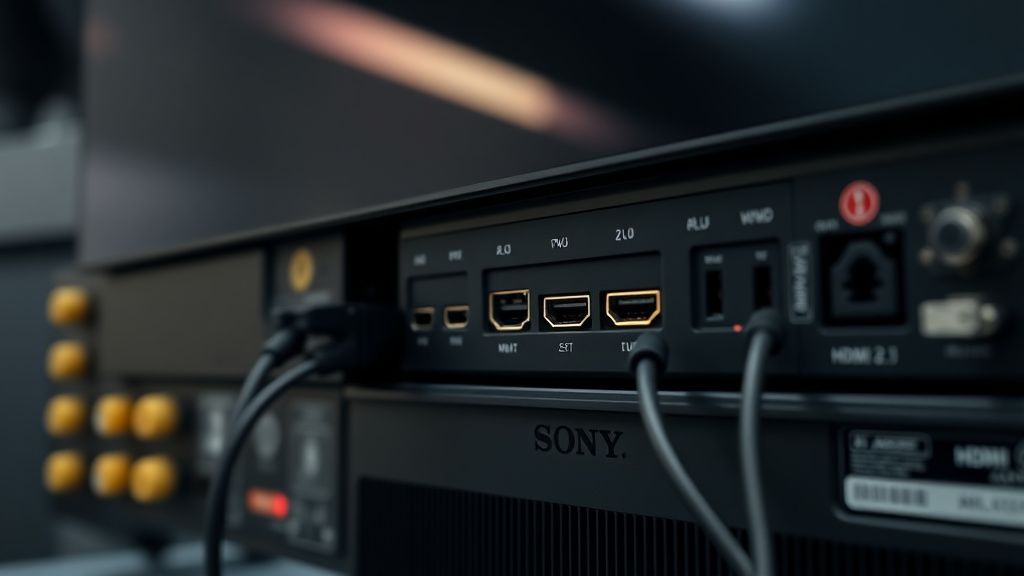
If there is one persistent, multi-year failure point in the Bravia XR ecosystem, it's HDMI 2.1 signal handling. Not the hardware itself necessarily — but the firmware stack managing HDMI Enhanced Format, HDCP 2.3 negotiation, and ALLM (Auto Low Latency Mode) handshakes.
The symptoms are well-documented: a brief black screen flash every time a device sends a new HDMI signal. Connecting a PS5 and switching from a 4K/60Hz app to a 4K/120Hz game causes a 2-4 second black screen. Changing HDR modes on the source device causes another drop. In some cases, the display enters a looping negotiation state and the picture never recovers without a power cycle.
This isn't unique to Sony — Samsung and LG owners report similar issues — but the Bravia XR implementation has a specific wrinkle: Sony's HDMI port assignment logic. Only HDMI 3 and HDMI 4 on most Bravia XR models support the full HDMI 2.1 48Gbps bandwidth spec with 4K/120Hz + VRR simultaneously. Many users connect their gaming devices to HDMI 1 or 2 out of habit or cable management preference and spend months troubleshooting artifacts before discovering the port assignment mattered.
Sony's documentation on this was, charitably, unclear for the first 18 months after launch. The enhanced format setting buried in Settings > Channels & Inputs > HDMI Signal Format was not prominently communicated. Users who never found it lived with degraded HDMI 2.1 performance indefinitely.
The HDMI Forum's Variable Refresh Rate (VRR) implementation added another layer of complexity. VRR requires a continuous renegotiation of the HDMI link at variable refresh intervals. On early A90J and X95J firmware, this renegotiation occasionally caused frame drops or brief luminance glitches. Not every frame — just enough to be noticeable in fast-paced games. Sony patched this several times. Whether the current firmware fully resolved it is debated; some users report clean VRR behavior, others report it persists under specific GPU driver combinations (notably AMD cards connected via PC).
The Cognitive Processor XR: What It's Supposed to Do vs. What Actually Happens
Sony's marketing for the XR processor is heavy on the phrase "human-centric processing." The idea is that the chip analyzes content the way a human brain perceives it — identifying focal points, enhancing texture, sharpening contrast where the eye would naturally look.
In practice, this works remarkably well for native 4K HDR content watched as intended. Where it creates problems is at the edges: streaming compressed video, 1080p upscaling, mixed-content environments.
The XR processor's Reality Creation upscaling algorithm, when applied to highly compressed streaming content (think Disney+ on a congested home network, or a Blu-ray with aggressive DNR applied at the encode stage), can generate what appear to be "ringing" artifacts — halos around edges, mosquito noise amplification, and occasionally false contouring in gradient areas. This isn't the processor "breaking." It's the processor doing exactly what it was told — enhancing detail — but on content that doesn't have the quality to support that enhancement without side effects.
The right response in most cases: reduce Reality Creation from its default level, or switch to a picture mode that applies less aggressive processing. But many users never touch these settings. They assume the default configuration is optimal. It often isn't.
XR Smooth Gradient is another feature that cuts both ways. It's designed to reduce banding in gradient areas using dithering. On some content, it works invisibly. On others — particularly content with intentional film grain or stylized color grading — it introduces a subtle processing shimmer that can read as an artifact to careful observers.
Real Field Reports: What Owners Actually Encounter
The A95K QD-OLED and Color Accuracy Drift
The A95K was Sony's first QD-OLED television, using Samsung Display's quantum dot OLED panel. QD-OLED offers dramatically wider color gamut and higher peak brightness than traditional white OLED — but it also brought a new category of artifact reports.
Several A95K owners on AVSForum's dedicated thread (running since mid-2022) documented a phenomenon they described as "color fringing" on near-white text and graphics. The effect looked like chromatic aberration — red and blue fringes on high-contrast edges. This is partly physical: QD-OLED's subpixel structure (using red, green, and blue emitters rather than WOLED's white + color filter approach) renders fine text slightly differently, especially at smaller sizes.
More concerning were reports of luminance non-uniformity that changed over time. Some owners found that after several hundred hours of use, certain screen zones were measurably brighter or dimmer than they'd been when the TV was new. This is known in the industry as "panel aging variation" — different screen zones accumulate different amounts of use, and OLED pixels age at different rates. Sony's "Panel Refresh" feature (run automatically when the TV is in standby) is supposed to mitigate this. Whether it keeps pace with heavy use is a legitimate open question, and Sony does not publish panel longevity data for consumer evaluation.
The X90L and the Backlight Uniformity Complaint
The X90L is an LCD/LED television — Mini LED, in fact — not OLED. It uses Sony's backlight master drive algorithm to control the local dimming zones. And it has its own category of artifacts: blooming, halo effects, and clouding.
Blooming is the glow that appears around bright objects on a dark background — a star against black space, white subtitles on a dark scene. It's inherent to any local dimming LCD implementation; the zones can't be infinitely small, so light bleeds from bright zones into adjacent dark ones. The X90L's blooming behavior is considered moderate-to-good by the standards of LCD TVs, but users coming from older OLED sets or from high-end mini-LED competitors sometimes find it jarring.
Clouding — irregular brightness patches visible in dark, uniform scenes — is more variable. Some X90L units exhibit significant clouding; others are relatively clean. This points to unit-to-unit variance in panel and backlight assembly quality control, which is a real and persistent problem in LCD TV manufacturing at scale. No public data exists on the rate of out-of-tolerance units reaching consumers.
Systematic Troubleshooting: What to Actually Try
This is where most guides start and end. This one is placing it here deliberately — after understanding what's happening — because troubleshooting without understanding the failure mode is guesswork.
Step 1: Isolate the Variable
Before touching any settings, determine: does the artifact occur on all inputs and content, or only under specific conditions?
- All inputs including the TV's own apps: Points to panel hardware, firmware display pipeline, or internal power supply.
- Only on a specific HDMI input: Points to HDMI signal handling, cable, or source device.
- Only in certain picture modes: Points to processing pipeline — specific algorithms are causing or amplifying the artifact.
- Only at specific brightness levels or content types: Points to ABL behavior, local dimming behavior, or HDR tone mapping.
This diagnostic step eliminates most wasted troubleshooting. It sounds obvious. Most users skip it.
Step 2: The HDMI Configuration Audit
If the artifact involves any external device:
- Navigate to Settings > Channels & Inputs > HDMI Signal Format
- Confirm the port your device uses is set to Enhanced Format (not Standard)
- If gaming on PS5 or Xbox Series X, confirm ALLM is enabled
- Verify the cable is rated for 48Gbps (look for "Ultra High Speed HDMI" certification, not just 2.1 branding — uncertified 2.1 cables are a major source of signal artifacts)
- Try a different HDMI port — specifically ports 3 or 4 on most XR models for full 4K/120Hz support
Step 3: Firmware
This one genuinely matters. Sony's Bravia XR firmware history shows meaningful artifact-related fixes in several release branches. The process:
- Settings > Device Preferences > About > System Software Update
- Enable automatic updates if not already set
- Check the Sony support site for your specific model number to see current firmware version and patch notes
Important caveat: Some firmware updates have introduced artifacts. Sony firmware 6.x on A90J resolved the pixel flash issue for many users but introduced new reports of color temperature drift during HDR transitions. This is not unusual in consumer electronics firmware development, but it means "update to latest" is not unconditionally safe advice. If your TV currently works well, read the release notes before updating.
Step 4: Picture Settings Reset and Recalibration
A significant number of Bravia XR artifact reports are downstream effects of incompatible picture setting combinations. The XR processor's features interact — sometimes adversarially.
Reset a picture mode to default: Settings > Display & Sound > Picture > (select mode) > Reset
Then rebuild from a calibrated baseline. The settings most likely to cause or suppress artifacts:
| Setting | Artifact Risk | Recommendation |
|---|---|---|
| Reality Creation | High (ringing, noise) | 50 or below for streaming |
| XR Smooth Gradient | Medium (shimmer) | Off if you notice gradient issues |
| X-Motion Clarity | Medium (judder artifacts) | Test with On and Off |
| Local Dimming | High (blooming, halo) | Medium rather than High for LCD models |
| Noise Reduction | Medium (smearing) | Off if watching native 4K |
| MPEG Noise Reduction | Medium (blocking reduction vs. smearing) | Low or Off for high-bitrate content |
Step 5: Soft Reset vs. Factory Reset
A soft reset (power off, unplug for 60 seconds, plug back in) clears the TV's volatile memory and re-initializes firmware state. This resolves a surprising proportion of transient artifact complaints — particularly those that appeared suddenly after the TV had been on for many hours.
A factory reset (Settings > Device Preferences > Reset) wipes all user settings and re-initializes the system partition. This is appropriate when:
- A firmware update appears to have introduced the artifact
- The artifact appeared after a settings change you can't identify
- Sony support has suggested it
What factory reset does NOT fix: Hardware-level panel defects, physical HDMI port damage, long-term burn-in or OLED aging variation, backlight hardware issues on LCD models. If factory reset doesn't resolve the artifact, the problem isn't in software.
Step 6: When to Stop Troubleshooting and Call Sony
There are artifact profiles that indicate panel or hardware failure, and no amount of firmware cycling will fix them:
- **Dead or stuck pixels
Bu makale affiliate linkleri içermektedir.